The size of that M1 Ultra package is just enormous. I’d love to see what it looks like under the heat spreader.
It’s also interesting Apple is cooling both sides of the chip. Is that just for efficiency so the computer is quieter? Intel/AMD chips that put off way more power aren’t cooled from both sides right?
> The dual blower is completely non-standard, as well. Goldberg says that the engineering team found that by splitting each impeller of the blower by a divider partway up its height, they were able to make adjustments using the disc that allowed for different pitches of the blades above and below the divider.
“That results in drawing different amounts of airflow from each section of the box so we can tune for the thermal performance based on the cooling needs, adjust the height of that divider, adjust the the pitch of the blades and each section and then kind of optimize for thermals and acoustics at the same time,” says Goldberg.
Apple has really stepped up their cooling game in the past few years.
The heat sink in the iMac Pro was where things really started to shift. It keeps the Xeons in those machines reasonably cool while being whisper quiet at idle/low load and reasonably quiet at load. They really kicked it up a notch with the Mac Pro, which remains nearly inaudible at all times, and now that’s carried forward into the Mac Studio.
Really nice work. I’d love to see this kind of innovation in more standardized PCs — the NH-D15 and front fans in my custom built tower do a good job on thermals but their acoustics leave something to be desired, despite Noctua coolers and fans being some of the quietest on the market.
They stepped up the game with the original retina MBPs too (first shrink of the “unibody” case), but it couldn’t keep up with the high end mobile Intel thermals. That model was (enviably) quiet compared to my previous gen MBP.
It’s basically never an i9, because once it hits 70°C it starts throttling quite rapidly and then stays stuck between 1.0 and 1.4 GHz clock speed for at least 5 minutes, and what good is an i9 running at 1 GHz?
Their laptop cooling has been absolute dogshit for the past (at least) 10 years.
It’s more of an inadequate cooling combined with Intel releasing CPUs that run just hotter and hotter.
I can’t wait to upgrade to a 16” MBP with an M1 Max (or next gen if they release it by then). There are still some essential tools in my workflow that don’t work all that great on ARM.
If your i9 16” throttles down to 1 or 1.4ghz, then most likely it is clogged with dust. Open the bottom cover and clean both the heat sink and the Fan blades properly. I need to do this to my 16” i9 once every 3-4 months to prevent it from throttling under load.
Interestingly, sharing an external screen using google meet and running something like npm install will easily throttle the CPU even if the CPU usage never shows anything above 15% of use.
So I had a thermal problem with my 2018 15" i7 MBP that sounds very similar to what you describe. Temps hit 60° and then get heavily throttled. It started happening after a repair to the keyboard. After dealing with that for 6 months I brought it in to Apple and they fixed the issue by replacing the mainboard, I think. Since it's very rare I see throttling for my use cases (compiling, some gaming).
My iMac once was super quiet, but many years later is less so. Unfortunately, I cannot clean its fans, which would probably reduce the noise levels quite a bit.
You can take it to an Apple certified repair center to get it cleaned.
But keep in mind the noise could also be caused by worn out fan bearings. You'd need to replace the fans to get the noise level back to 'as new'.
Yes, its just between 100 and 200€ of service charge, as they have to unglue and glue back together the machine. And carrying an 27" iMac is also a challenge - you don't want to have it damaged in transport. This all is possible, but it shouldn't be necessary. Didn't stop me from buying and loving my iMac, but it is not good design.
I am planning to get a Mac Studio as the replacement for that iMac, but I would be happier, if easy cleaning of the fans would be possible.
Can't you just pop the screen off and clean it? I had an iMac; the glass is held on magnetically and there are a dozen-or-so Torx screws behind the bezel.
No, that was an earlier design. On later iMacs, the magnets were replaced with glue. So to perform any service on the machine, the repair shop has to cut through the glue and after the work glue the Mac back together. Which, for a desktop, is pretty unforgivable in my eyes.
That glued on iMac design was really stupid for a desktop that uses fans. Even my older generation iMac with the magnetically held cover is too much of an effort to clean. And from the looks of it, this new Mac studio suffers from ur same issue. While you can access the fan and the heartsink, it requires too much fiddling and too many screws to make it easy for any user.
I’m guessing it’s like everything else: cost and margins. Most people either aren’t willing to pay for it, or aren’t given the option because people think they won’t be willing to pay for it.
Apple only has something like 10% of the desktop market yet they seem to be the only company in that space doing anything interesting. Dell, HP, Lenovo, and all the other big desktop computer makers look pathetic in comparison. I say that as someone who has only bought Lenovo computers for the past 15 years.
Is there any chance at all that six months from now Dell or HP will wow us with something that is faster, quieter, and as aesthetically interesting as the Studio? Or will they crank out another version of a black sheet metal case that is loud and hot and inexpensive? There have to be people in those companies that want to do something interesting, right? Or do they assume that anybody with money and taste are already out of the Windows market?
Maybe it is all the fault of Windows. There's a pretty good story about the problems of Windows elsewhere on HN right now. The comments there are so damning it makes me think nobody believes in the platform anymore. You know how there's no M in FAANG? Is Microsoft stuck with people not good enough to work elsewhere? There might be no point in building interesting hardware that is ultimately going to run Windows.
Personally I would be more than willing to pay a premium for exceptionally quiet PC cooling, even if that meant having to use a case, CPU cooler, and GPU cooler all designed for each other.
They make passive CPU coolers that work fairly well on modern processors. Additionally, you can set fan curves on a GPU to only trigger in the case of a legitimate emergency (eg. 85c+, which you would never hit in casual non-gaming workloads), which would probably get you 90% of the way there.
Used to own an Intel. Recently purchased an M1 Pro, and it’s astounding how quiet it is.
My old Intel MBP would sound like a jet engine just by opening Chrome.
This one… I hammer it all day with multiple servers running, JS projects, tons of tabs, Docker containers, many misc. software utilities… not a single noise.
I’ve only heard the fans once while using Handbrake.
The 16” M1 Pro also has amazing battery life. I regularly use mine for a whole day’s work on battery, while with the i9 16” battery rarely lasts more than 3-4 hours under similar loads.
I own both a 2019 and 2022 MBP. The former is the loudest laptop I've ever owned when doing day to day compute tasks. The latter is the most quiet. It's shocking how bad the older Apple laptops are.
Yes, addressing that was a major theme when they redesigned the MBPs in 2021. People complained that they looked chunky compared to the sleeker 2016-2020 models but acknowledged that cool and quiet might be worth a little more utilitarian appearance.
My work gave me this and it’s the worst! I thought mine was faulty. Sent it for repair 2 times and then I realized it’s just garbage thermals and noise. The i9 + dGPU is too much for that form factor.
The optional i9 upgrade is a bit of a trap, to my mind. The regular i7 version has pretty reasonable thermals by comparison, with marginally lower performance.
I have hit more cases of "burnt a body part" with Windows machines than with Apple laptops. Apples tend to run with more warm surface area because the aluminium spreads all the heat on the entire surface, but high-power Windows laptops can be downright nasty if you manage to touch the area around the fan outflow because all the heat concentrates there to form an incredibly hot spot.
>different pitches of the blades above and below the divider
I thought that was interesting, so I looked for it on the video: https://youtu.be/IY0gRMpT4AY?t=878 If there's a difference in blade pitch, it's not visible from that angle. What is pretty clear is that the split isn't exactly halfway down, maybe 55/45 instead of 50/50.
You would probably need to cut an impeller up to see a difference, or xray it.
I would also be interested if someone swaps out the blowers and see what difference the Apple impeller makes. I would be surprised if it's more than 5%. But injection molding makes fancy geometries very cheap, and if you're making the molds anyway you might as well pick up the easy design win. Amortized over however many millions they're going to make, the NRE costs are going to be pennies per unit.
It's not beating Moore's law, it's beating die yield curve limits.
Working near the limits of manufacturability will result in occasional defects. If you only have to have a few eight-core 10x8mm chiplets and a more reliable 12nm process node interconnect die come out defect-free, that's much easier than trying to get all of that on a single giant die with 64 cores and the IO on the same die.
To exaggerate, if each chiplet has a 50% chance of failing, on average you have to make 16 chiplets to get one good multi-package chip. But you'd need (2^8 * 8) = 2048 to get one contiguous super-die. with no defects.
What I've heard is that the M1 Ultra has to be all contiguous to exist. The interconnact cannot be assembled later. All those M1 Ultra chips are indeed 64 cores and the IO on the same die. https://patents.google.com/patent/US20210217702A1/en?oq=2021...
Sure, it's not interconnected as in multiple sockets on the motherboard talking over QPI, but it's a silicon interconnect. The M1 Ultra is two M1 Max processors on an interconnect with some DRAM.
Here's the Pro, with 8 or 10 CPU cores and 14 or 16 GPU cores, depending on die yield issues where they might have to shut off a couple cores:
Yeah but those two Max chips that make one Ultra have to be next to one another already on the wafer. That leaves no room for error or picking up a chip from somewhere else.
There are a lot of ways to win Tetris with 1x2 blocks!
If you make an M1 Max wafer there are a lot of ways to spin out 8/24-core Maxes, 10/32-core Maxes, and adjacent 10/32 core Maxes into an Ultra. Nothing in the patent seems to indicate they have to decide which ones to use before testing the wafer...


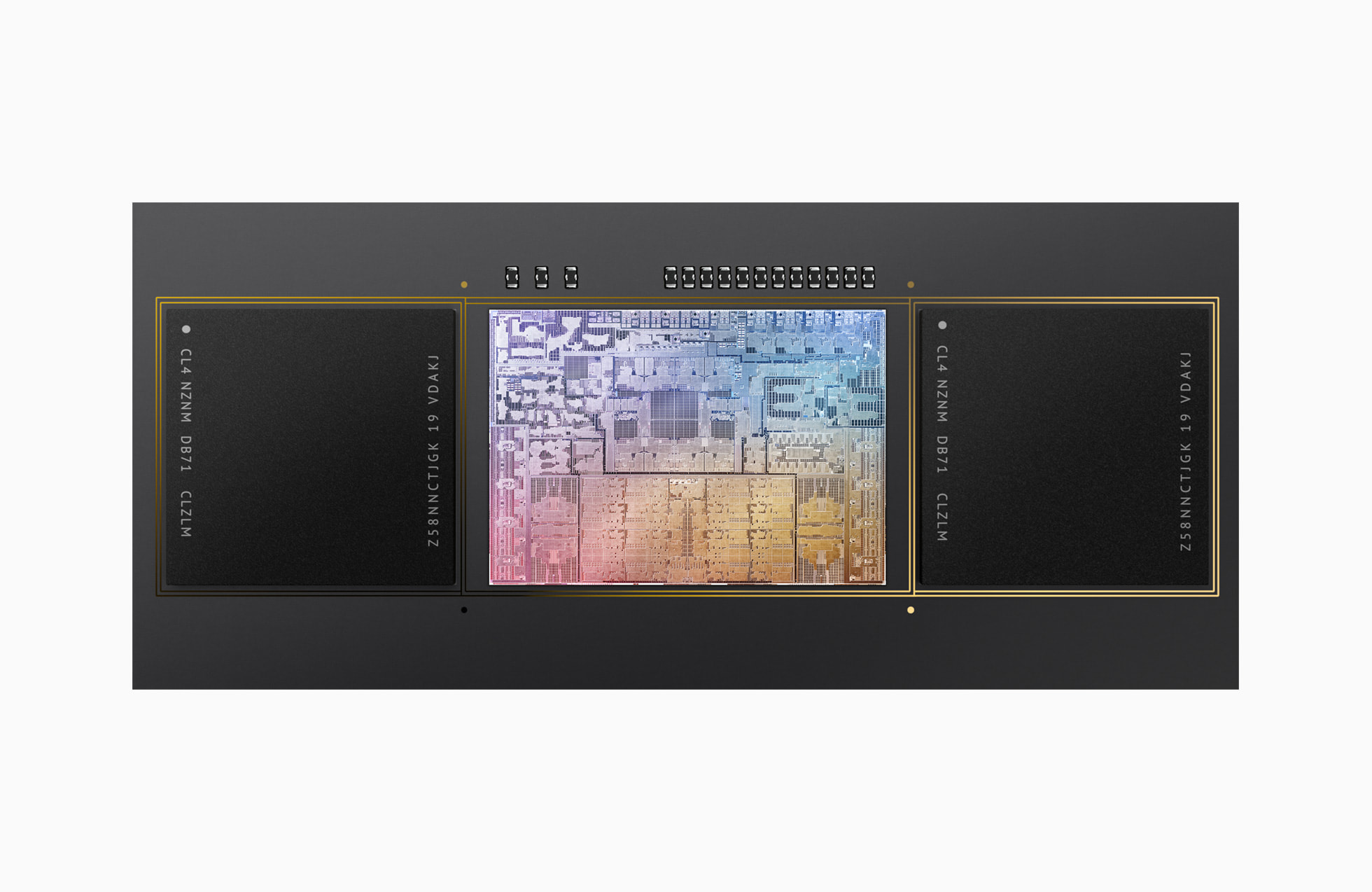
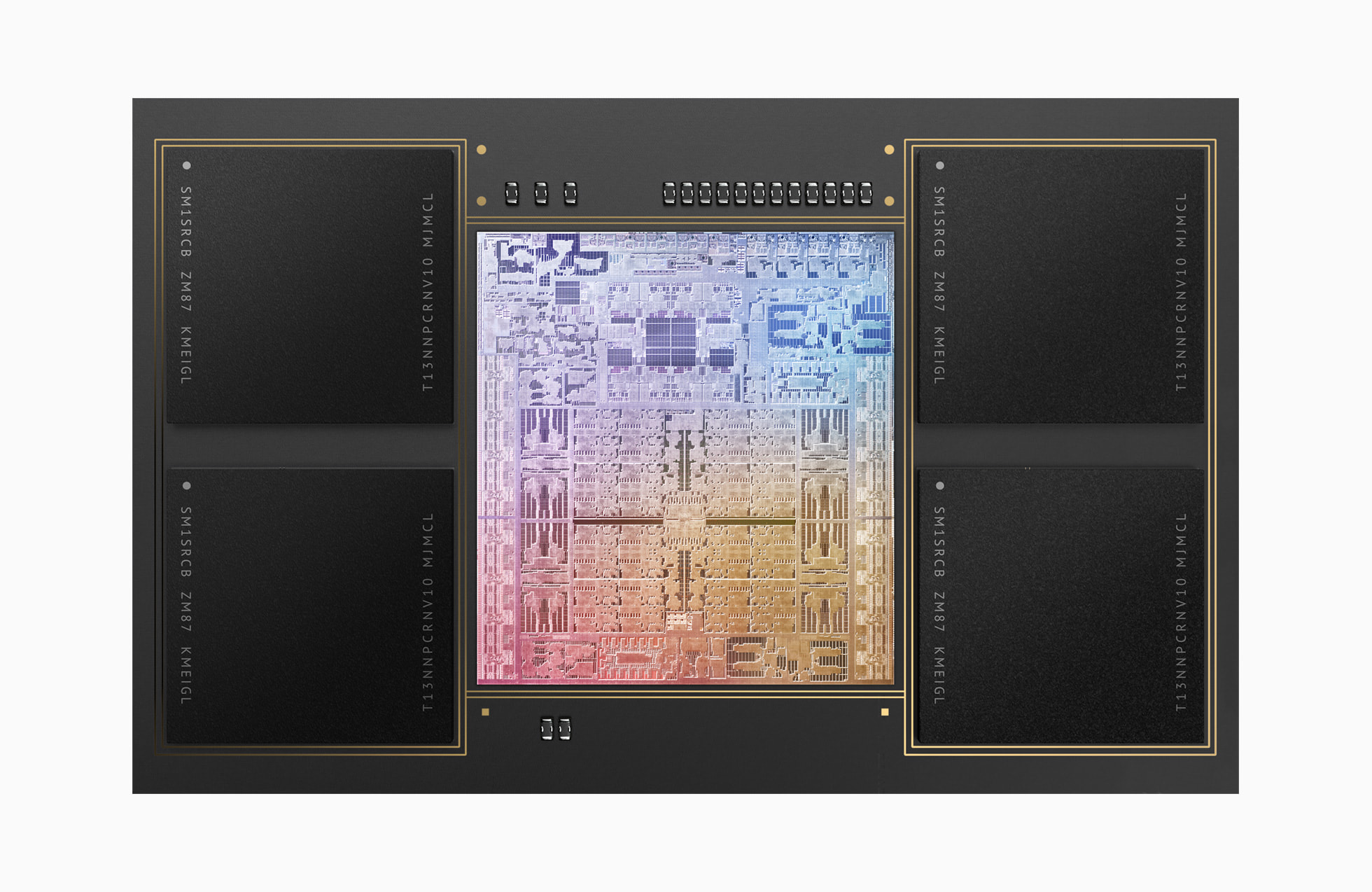
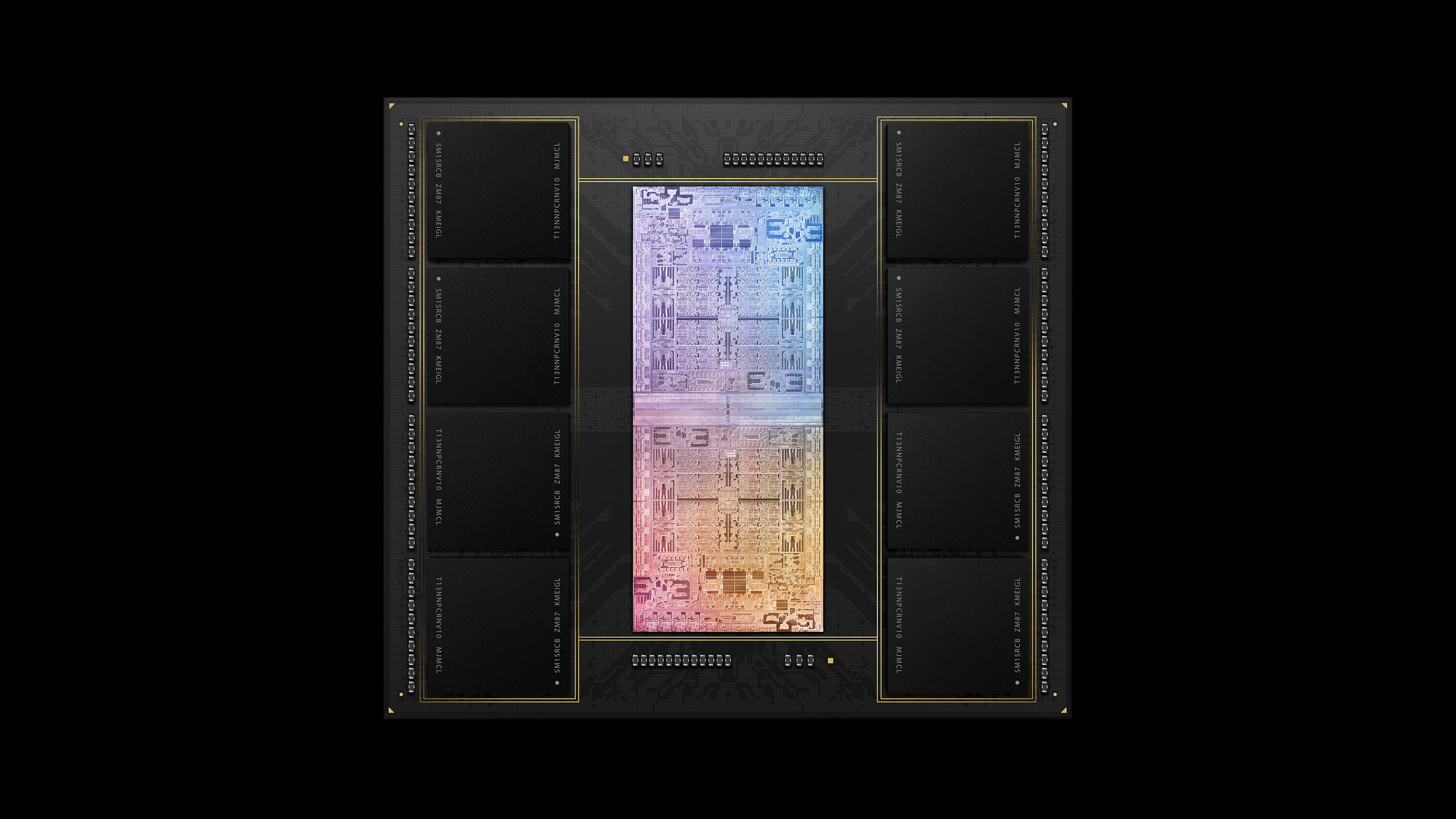
It’s also interesting Apple is cooling both sides of the chip. Is that just for efficiency so the computer is quieter? Intel/AMD chips that put off way more power aren’t cooled from both sides right?