The headline says "masks work", then the article redefines masks to exclude the things that many people are wearing, and then adds further criteria that rules out most other people. It then fails to take into account research that shows that cotton masks become saturated with exhaled moisture and perspiration, and that stops their filtering properties. It also fails to take into account reductions in social distancing or handwashing.
So, yes, if we have a tight definition of both "masks" and "work" we can say that masks work. But we don't care if a piece of fabric can catch droplets, we care if public use of masks in a pandemic helps slow the spread of that disease.
This article is a demonstration of a method of mask testing. It's not a test of masks. From the authors "As the title indicates, our work focused on developing a simple technique for mask evaluation that can be replicated at other labs, rather than a comprehensive mask test.
They do not test how long the masks stop droplet transmission. Other studies say that these masks start losing effectiveness as soon as you put them on, and most masks are ineffective after a few hours.
And, again, we do not care if masks stop droplet emission. (It's very likely that they do). What we care about is whether the public wearing masks in a pandemic stops virus transmission, and at the moment we don't know if it does or not.
“This is a very powerful visual tool to raise awareness that a very simple masks, like these homemade cotton masks, do really well to stop the majority of these respiratory droplets,” Fischer told CNN.
I read the same article as you. They did not redefine masks, nor add further criteria. They chose a model that applies to masks of any fiber and weave but with different filtration efficiencies.
I'm pretty fed up of people acting so incredibly arrogant. Unless you can show evidence that wearing a mask is dangerous, and makes things worse, then just wear a mask. Stop trying to find reasons to prove everyone wrong.
Normally, you'd expect people demanding awkward and massive social change to show evidence that it works and isn't dangerous. You should not invert this by demanding people prove things don't work and aren't dangerous; that way lies madness.
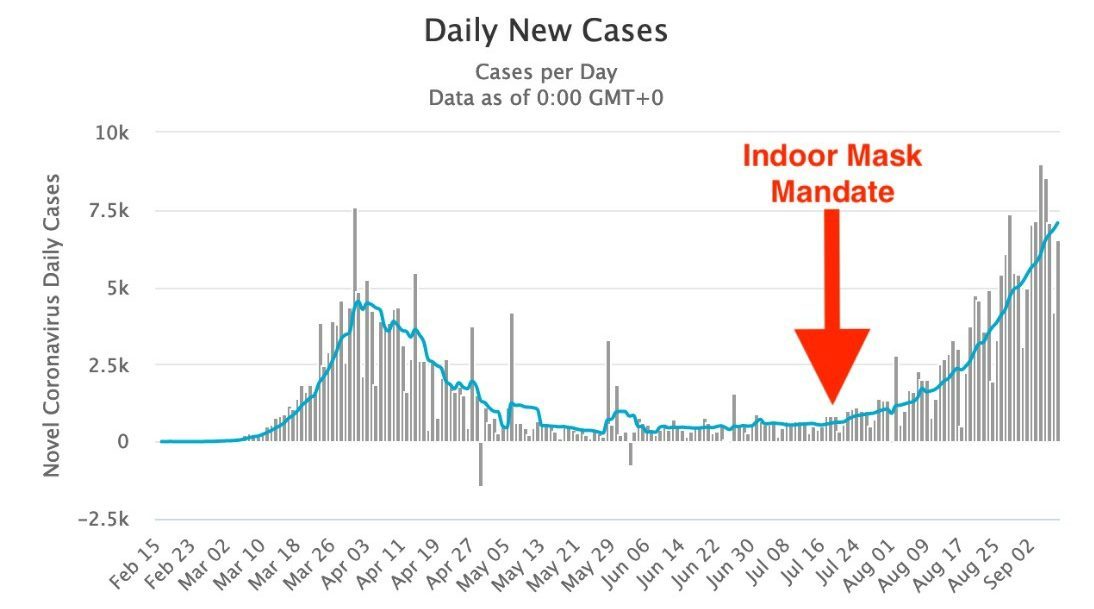
But at any rate, we can see for ourselves how great an impact those mask mandates had:
Mask mandates don't seem to be associated with any impact on the graphs of positive test results, anywhere. If they don't work then they should not be used for all kinds of reasons, dangerousness is by no means the only factor that should determine decisions. Consider also cost, impact on the environment, choking hazards, comfort, psychological distress created by the appearance of fear and so on.
But as some of the writing on this acknowledges, masks long ago became purely political, so we should expect people to keep arguing from different assumptions and not agreeing.
The Surgeon General said back in March that wearing masks increases the chance of spreading covid because people aren't trained on how to use them correctly and it gives them a false sense of security.
Yes, that was a concern back in March. Back in March, when we had very little understanding of transmission and when hospitals were facing dire mask shortages. What has the surgeon general said since then?
Are people on HN actually too stupid to learn how to properly wear a mask in 8 months time? I don't believe that. I think that each of us is smart enough to do that research and train ourselves.
You can characterize what you’re saying to simply: “just comply, citizen”
That attitude is precisely what’s wrong with this situation. An elite who’s prescribing technocrat-informed decisions instead of offering balanced and neutral scientific conclusions. Meanwhile you can point to a long line of completely wrong technocratic advice during the pandemic.
Always make sure you’re able to say “I might be completely wrong.”
Yes, you can point at a long line of mistakes. Wiser minds focus on possible solutions, when they exist, and mitigations when they don't. Masks are shown to be effective mitigations. You're being asked to understand the evidence at hand, and make a best effort to participate in the mitigation. Not to comply on blind faith.
And sure, I accept that I, and other scientists, make mistakes. To err is human. What about you?
No, I do not think so either. But unless wearing a mask is shown by scientific study to be harmful, the default should be to wear a mask - if a study then shows that a mask isn't as helpful as we were led to believe, then fair enough but at least we didn't make things worse.
I also fail to see how saturation leads to a decrease in filtration. I could imagine other scenarios in which efficacy of the mask would be reduced when saturated, but not because it stops filtering.
Mask proponents say we need to wear a mask to prevent us spreading our covid to other people.
When you touch your mask you transfer covid to your hands. You then need to clean your hands immediately. You may have excellent hand hygiene, but we know (because there are hundreds of studies on this) that most people do not wash their hands often enough, and don't wash their hands properly.
If the science is telling you to wear a mask it's telling you to keep it on and stop touching it.
I'm a critical care doc and directly involved with COVID administrative policies for my health system organization. I have recently told friends and family to start buying and wearing medical masks. Our experience is that medical masks are very protective in protecting the wearer from catching the disease. Hospitals have plenty of masks now. A cloth mask prevents spread away from the wearer, but a medical mask protects both the wearer and those around him/her.
Medical masks protect in two ways. One, they filter the air at an extremely high level. Two, they are fluid resistant, so the saliva droplets that are filled with virus particles cannot penetrate the mask.
Most health organizations, including mine, are noticing that COVID prevalence within their employees is less than the local population as a whole despite being around contagious COVID patients all day long. The major difference in these two populations is that health care workers are wearing medical masks.
How often can one reuse a medical mask? What would be most effective use for prolonged life?
eg: wear a mask 20 min at a time, then change with another while leaving the previous in open air to dry. Cycle 3 masks like this. Total mask lifetime (until effectivity drops to <75%) with this usage pattern: 10 hours.
The primary difference in a medical mask and an N95 respirator is the tight seal that doesn't allow air around the sides. Unless you are in a high risk aerosolized environment, an N95 is unlikely to give you much additional benefit.
Most medical masks are made of the same material out of China that filters > 95% of infectious particles. If you want extra protection, you can look for masks with an "ASTM Level" that gives additional support that the mask is medical grade.
That seems to support parent's comment. The surgical masks prevented much of the smoke from going out the front, the "cloth mask he borrowed from his wife" let much of the smoke come through the mask.
Regarding the rest of the video, his claim of "masks have no effect" seems to be easily demonstrated as false from his experiments. Yes, some smoke does leak, but compare that to him exhaling without a mask. You would get a blast of vape smoke right in your face. The masks clearly filter some smoke and deflect the rest of the smoke away from where he's facing. While obviously not perfect, it looks like a clear improvement to me.
Finally, comparing smoke to covid-19 is disingenuous. You will almost never find individual virus particles floating around the air, they will instead be contained in water droplets which you exhale.
You mean a mask which filters both on inhale and exhale? N95 masks do a decent job of that, although I'd guess there's still some leakage on exhale (not designed for that). N95s are still sold out in my area, so I got some KN95 which I use. The CDC tested some of them for effectiveness, many of them got pretty high marks: https://www.cdc.gov/niosh/npptl/respirators/testing/NonNIOSH...
Some of the KN95s have been found to be counterfeit. Some of the ones we tested were no better than a cloth mask. When buying KN95s, please check that they've been validated by the CDC's list.
If it's legitimate KN95, it probably protects at least as good as a medical mask but probably not as good as a N95. This is because KN95s are not designed to form a complete seal so many folks will have some leakage around the edges. This is the reason that you see many systems 3d printing molded frames to improve the KN95 fit and decrease leakage.
"Disposable" medical masks cost pennies to make, can be worn for multiple days, and are highly effective. In an environment where some folks refuse or can't mask, they are the most effective way for people to keep themselves safe.
By the way, I don't make or sell masks. I'm just interested in keeping people out of the hospital and my friends/family safe.
You telling people to buy expensive masks. They're going to be used multiple times forwards and backwards sticking them in their pocket 20 times then touching it and touching everywhere else. That's why masks are dangerous because the wearers don't understand how to use them This is what my MOPP training taught me in the 90s and again in 2000s. WE WERE TAUGHT BY UNITED STATES MILITARY TO NOT HAND OUT MASKS IN AN EPIDEMIC WHAT CHANGED?
> WE WERE TAUGHT BY UNITED STATES MILITARY TO NOT HAND OUT MASKS IN AN EPIDEMIC WHAT CHANGED?
The US military was the wrong place to look for a general solution to a civilian crisis.
All advise given from a military context relies on the idea that the civilian administration will step in, and coordinate, or handle things on its own.
For example, the military is advised not to do long term criminal investigations... but that’s not because detective work is valueless, but because it’s expected that the civilian police will handle that.
Many (not all) HN readers, being software engineers, have a high level of pretentiousness that comes from being good in one field, and then carry over that arrogance into areas where they have no clue.
Suddenly, you see software engineers pretending they know more than sociologists who have studied the topic for years and dismissing their evidence out of hand or merely responding to the title of the article, without engaging its substance.
We see it quite clearly whenever any topic from the social sciences is discussed, be it discrimination, social inequality, government regulation, taxes or the welfare state.
> Many (not all) HN readers, being software engineers, have a high level of pretentiousness that comes from being good in one field, and then carry over that arrogance into areas where they have no clue.
The irony is to watch people get up in arms when an article is posted by some expert in another field who does the same. Its kinda funny thr amount of HN comments I've seen where some user says something along this lines of "author has no idea what they're talking about and should stick to xyz"
> Many (not all) HN readers, being software engineers, have a high level of pretentiousness that comes from being good in one field, and then carry over that arrogance into areas where they have no clue.
Or maybe they trust scientists who are saying that we don't have good evidence yet?
> Although direct evidence is limited, the optimum use of face masks, in particular N95 or similar respirators in health-care settings and 12–16-layer cotton or surgical masks in the community, could depend on contextual factors; action is needed at all levels to address the paucity of better evidence. Eye protection might provide additional benefits. Globally collaborative and well conducted studies, including randomised trials, of different personal protective strategies are needed regardless of the challenges, but this systematic appraisal of currently best available evidence could be considered to inform interim guidance.
This para says we don't have enough evidence, and what we have isn't particularly good, and we need more evidence, but in the mean time the bits and bobs we have could guide us.
This is why I say "people should wear masks, masks may help, but we need better evidence".
All the way through your article there are people saying that the science is not clear.
> But for the variety of masks in use by the public, the data are messy, disparate and often hastily assembled.
[...]
> So, scientists have relied on observational and laboratory studies. There is also indirect evidence from other infectious diseases. “If you look at any one paper — it’s not a slam dunk. But, taken all together, I’m convinced that they are working,” says Grabowski.
> But such studies do rely on assumptions that mask mandates are being enforced and that people are wearing them correctly. Furthermore, mask use often coincides with other changes, such as limits on gatherings. As restrictions lift, further observational studies might begin to separate the impact of masks from those of other interventions, suggests Grabowski. “It will become easier to see what is doing what,” she says.
This article has fancy animations and whatnot, but lacking in real data. So for anyone not convinced, here is a statistical analysis from my home state South Carolina. The numbers speak for themselves.
When comparing the jurisdictions that have mask requirements in place to those that don't, the jurisdictions with mask requirements have shown a 44.2 percent greater decrease in the total number of cases during the five weeks after the requirements were implemented.
Jurisdictions without mask requirements have experienced an overall increase in total cases of 1.2 percent when compared to jurisdictions with a mask requirement in place.
For anyone convinced in this mask pseudoscience, here is extensive scientific literature over decades that establishes that wearing surgical masks, respirators and cotton masks do not reduce the risk of contracting verified illnesses.
Ok so I randomly clicked on one of you links and it says
Meta-analysis of randomized controlled trials (RCTs) indicated a protective effect of masks and respirators against clinical respiratory illness (CRI) and influenza-like illness (ILI)
Meta-analysis of observational studies provided evidence of a protective effect of masks and respirators against severe acute respiratory syndrome (SARS)
Does the literature talk about reducing the risk of sharing those verified illnesses with others? For example, if a person has an illness that transmits through coughs, then if they wear a mask and cough, is the chance that people around them get the illness lower?
Masks do work. They are not the only measure but part of a set of small actions that are easy to take and -together- work.
For some further evidence, see Hong Kong;
Nearly 8 million people live in some of the densest city of the world; from day one, hkers have been wearing masks en masse and implementing cleaning precautions -not just hands but also doors and lift buttons, etc;
The result is an infection rate proven to be extremely low: 700/M infected and 14/M deaths. That’s about 1/40th the rate of the US.
This without hard confinement.
There have been additional measures to stop the importation of the virus, like enforced quarantine and intermittent closures or early closure of some businesses.
There has also been a mass test of more than 1.5M people with only about 40 cases found, so the infection rate _is_ really low.
What has not happened because of the mask? no deaths, no marked increase in hospital admissions for respiratory illnesses or infections caused by masks, no-one got carbon dioxide poisoning...
Is wearing a mask pleasant? No, it’s a pain in the a and I was quite sceptic at the beginning. I still think we may be overdoing it a bit in HK since there is so little infection, but no-one here is ready to live another SARS, so people do what’s right and don’t complain.
It's shocking, especially on a scientific forum like HN, that people get so triggered over being asked to wear a teensy extra bit of clothing that might protect those around them from dying.
Sure, but does the science here matter? Is wearing a mask, which might reduce the spread, and might save lives, really that much of a burden, that you won't do it even though it might be a good idea?
I say, do it anyways, I'll wait patiently for the science at literally any point in the future. If it turns out masks, statistically, do nothing, then I will be no worse off for trying.
I mean, I even said "people should wear masks, masks may help".
But when we're trying to persuade as many people to wear masks as possible it's really unhelpful for people to make dishonest or misleading claims about the effectiveness of masks.
A message of "we think masks work, and here's why" is more persuasive than "masks definitely work and you're an idiot if you think otherwise" because it's very easy to find good quality studies that don't show a benefit to mask wearing.
I agree with you, but I don't think it is a practical approach -- almost no one actually cares about the science.
We're all supposed to wash our hands after going to the bathroom, especially if we're preparing meals for others -- California makes this very clear with their mandatory signage!
But do I need to see the science behind it? I've never seen any hard data on hand-washing -- and yet...
> We have lots of RCTs on mask wearing (mostly in healthcare professionals) and they struggle to find a benefit.
This is false. If you look around and read actual studies, not demand other people to do it for you and not cherry pick garbage studies, you'll find even real life "experiments" of healthcare workers in the US during COVID-19 not wearing masks with rapidly rising number of COVID-19 cases then mandated to wear masks with subsequent rapid drop of cases.
What you won't find though is studies supporting the assertion that sick person wearing a mask protects others, not the wearer. Those are the studies that show little to no benefit and always did actually. You protect others with a mask by not catching the virus yourself, it's a second order effect.
I've read the actual studies. They don't show benefits.
> not demand other people to do it for you and not cherry pick garbage studies,
The reason I ask you to provide the studies you think are persuasive is so we avoid the tedious discussion about cherry picking. I cannot cherry pick articles that you supply.
Lancet is a reputable high impact publication. The paper is peer reviewed.
> Transmission of viruses was lower with physical distancing of 1 m or more, compared with a distance of less than 1 m (n=10 736, pooled adjusted odds ratio [aOR] 0·18, 95% CI 0·09 to 0·38; risk difference [RD] −10·2%, 95% CI −11·5 to −7·5; moderate certainty); protection was increased as distance was lengthened (change in relative risk [RR] 2·02 per m; pinteraction=0·041; moderate certainty). Face mask use could result in a large reduction in risk of infection (n=2647; aOR 0·15, 95% CI 0·07 to 0·34, RD −14·3%, −15·9 to −10·7; low certainty), with stronger associations with N95 or similar respirators compared with disposable surgical masks or similar (eg, reusable 12–16-layer cotton masks; pinteraction=0·090; posterior probability >95%, low certainty).
For masking they find only "low certainty" evidence, and that's with N95s or 12 to 16 layers of cotton. (Most people are wearing 3 to 4 layers).
Low certainty comes from GRADE and means "The true effect might be markedly different from the estimated effect" -- masks may be markedly more, or markedly less, effective than they found.
> What you won't find though is studies supporting the assertion that sick person wearing a mask protects others, not the wearer. Those are the studies that show little to no benefit and always did actually. You protect others with a mask by not catching the virus yourself, it's a second order effect.
Oh-ho, so here we see a clearly shifted goalpost. Everyone else in this thread is saying that the science is obvious and that you wear a mask to prevent your infection from spreading to other people. So, does the science support "source control" or not?
It seems outrageously wrong to me to summarize that Lancet article by saying "We have lots of RCTs on mask wearing (mostly in healthcare professionals) and they struggle to find a benefit." or "I've read the actual studies. They don't show benefits".
The Lancet article looks at dozens of studies of the relationship between mask-wearing and infection with coronaviruses. (Some SARS, some MERS, some COVID-19.) Those studies fall, without exception, into the three following categories.
1. A few saw no cases of infection with or without masks, and therefore tell us nothing about whether masks help and how much.
2. One saw no cases of infection with masks and just two without masks (in a fairly small sample). It somehow manages to report a relative risk of 1.03 for wearing masks (!), which I can only assume is the result of some statistical adjustment that doesn't quite make sense in this case. (The real conclusion from this one is: "This study doesn't provide enough data to draw any conclusions.")
3. In every single one of the others, wearing a mask was associated with lower probability of infection. Some of the studies weren't powerful enough for the difference to be (on its own) statistically significant, but all of them pointed in the same direction and the underpowered ones had relative risk point-estimates similar to those of the not-underpowered ones.
Sure, they report this as "low certainty" because, e.g., none of these studies was a proper randomized controlled trial. Sure, we would do well to get more data. But I see no possible way to characterize what it says in the ways you have.
They don't "struggle to find a benefit". They readily find a very considerable benefit. They don't "not show benefits". They absolutely do show benefits. There are issues: we don't have e.g. nice big RCTs where someone has somehow contrived to have two otherwise identical large populations of the general public make different mask-wearing choices, and that means that there is inevitably some uncertainty in applying the results to the question of what benefit there is from getting the public to wear masks. But it 's pure grade-A bullshit to say that the studies "don't show benefits".
Anything that in any way reduces the flow of virus particles by definition reduces the spreading of the virus.
If a single globule of liquid leaving an infected person's mouth, whether due to a cough, a sneeze, or just a spitty staccato spoken statement, is a transmission opportunity. If a mask catches only one such drop, then it has lowered the risk of transmission.
Hell, having all conversations with a pair of underwear on your head (covering your mouth and nose) would help.
People saying otherwise are either truly ignorant or intentionally lying.
Now maybe masks ultimately provide such a modest benefit relative to their cost and discomfort as to not be worth it, but we just don't know and probably never will definitively know.
>Anything that in any way reduces the flow of virus particles by definition reduces the spreading of the virus.
It does not. It's possible for a filter to break some droplets into smaller droplets that linger in the air for longer. Evidence suggests that masks are still a net benefit, but this is by scientific study, not "by definition".
Ok, fair enough. We cannot say based on current information if withholding some virus particles at the cost of delivering a few in a more long-lasting form is better or worse.
Since we cannot test all possibilities here, it is then left to intuition and "wisdom". I have to believe that significantly reducing the number of virus particles in the air while allowing a few to linger longer would be preferable to the opposite.
As I have observed, people are terrible at judging distances. I am probably more likely to get infected by a spray of cough droplets at close range than a few individual tiny droplets floating in the breeze. If I had my way, most people would be wearing masks permananently (and also not allowed to come within 3 meters of me), virus or not.
They're using I think single layer of cotton, and 2ply or 3ply disposable paper masks. These are very low quality masks, and if masks work people probably shouldn't be wearing these.
They aren’t wrong, the main culprit appears to be the synthetic neck gaiters. But most types of masks have not been shown to do this. So masks aren’t perfect, but are undoubtedly a net benefit.
I remember reading it in a comment on HN and I'm struggling to find the source. It was about improvised woven fabric masks, not medical type masks. But even if this is actually false, it doesn't change the fact that reducing flow rate does not "by definition" reduce virus spread (assuming this means infection spread, and not a literal synonym). Infection risk depends on more than just virus particle count, so you need to count infections (and as many other comments point out, that is being done, and the number of infections is reduced).
There also appears to be a viral load issue. Exposure to a few droplets containing the virus carries risk of transmission, but exposure to many lung-fuls of contaminated air seems to have an even higher risk[1].
> Anything that in any way reduces the flow of virus particles by definition reduces the spreading of the virus.
On an individual level yes. On a population level, probably. But studies are few (and difficult, relying on natural experiments).
The important question isn’t whether a mask reduces transmission but how much people change behavior. For example: you really need to go somewhere and the bus looks full. Does people wearing masks on the bus increase the likelihood that you get on it? You don’t want that to happen
Stopping a single virus particle technically reduces risk of transmission but if you're only stopping a single particle, whatever your doing isn't worth the time it's taking to do it.
There is a line somewhere. People saying otherwise are either truly ignorant or intentionally lying.
Anecdotal evidence. Why does Japan do better than US? Considering it is more population dense, has more older people, and a frequent train goers.
Japan does not do better compared to other Asian countries like South Korea or Taiwan, because the other Asian countries enact more measurements than Japan other than just masks. Japan pretty much doesn't really care that much about Covid compared to other Asian countries but they always wear masks.
My wife is going to office everyday (Tokyo), she is also going to a wedding party tonight, and also next week. Life is really going pretty much normal right there.
Face mask use in health care workers has not been demonstrated to provide benefit in terms of cold symptoms or getting colds:
https://pubmed.ncbi.nlm.nih.gov/19216002/
The volume that goes through directly, does so with reduced velocity.
Meanwhile what goes around - doesn't go "everywhere". Instead it stays localized.
Now we remember the fact that masks don't cancel social distancing but instead go hand in hand - and it seems to show that it would in fact provide a benefit - containing the aerosol in a smaller radius around the mask-wearing individual.
From the summary of your second link... “ There is some evidence to support the wearing of masks or respirators during illness to protect others, and public health emphasis on mask wearing during illness may help to reduce influenza virus transmission.”
That video is the dumbest thing I have ever seen. It doesn't make any sense. Vape Smoke isn't a fair comparision to droplets and aerosolized particles, masks didn't have a good seal at all, in of the them he was still holding the bottom of the mask open LOL.
This article has some good links to studies and articles, some math and science.
It also points out you don't even have to science very much, there is lots of anecdotal evidence that shows that in gatherings where masks are worn, transmission is slowed.
Lot's of other factors play into that, but you only have to math a wee tiny bit to realize that properly worn masks can help fewer people be infected, and therefore fewer people will die.
MATH.
This has some nice visualizations based on anecdotal evidence and statistical analysis and compares transmission rates in different settings given the variables of masks wearing vs. no masks and ventilation vs no ventilation, while also taking into account surface based transmission.
Proving exactly how effective masks are, and why, is a luxury we don't have right now. We can't ethically do the experiments that would give conclusive results. Arguing about the details takes up energy that could be used to keep us safe in other ways. Wear them just in case. Do not let them be your only defense. Cover your eyes. Don't talk to people up close when you're wearing a mask if you can help it. Breathe through your nose. Don't shout at each other about god knows what like the dumb ladies in the laundromat standing on either side of me the other day, putting me in their microbial crossfire.
at this point, it should be abundantly obvious that the point of mask-wearing is collective protection from asymptomatic people. You’re a bad person because you’re actively putting others in harm if you’re not wearing a mask in public, because there is a chance you’re an asymptomatic carrier.
People already knew in March that the virus spreads via droplets (as all respiratory viruses do) and that widespread mask usage would slow the spread. They had implemented this protocol in China and the rest of Asia for at least a month by then.
Scientific studies have not proven that masks are effective in limiting the spread of the virus. Quite a lot EU countries suggest they can do more harm than good if used sloppily. Masks and covid in the US have become political issue riddled with pseudo science from all sides.
Sociological studies strongly suggest that masks do work.
For example, there was a recent study that compared COVID hospitalization rates of districts in Tennessee that had mask mandates vs those which didn’t and the areas with mask mandates had significantly lower disease spread.
It is but with 70% being non-reproducible we should be careful what we conclude. Humans are not robots. Lots and lots of factors in play.
I have worn mask since march and have no problem with doing so, I believe they help curve some, but scientific rigor not clickbaity politicized headlines on NYT is what is needed here.
Because it's not science. Spain has been wearing masks for months now, 99% of people comply and it gets only worse and worse. Both of our statements are anecdotes.
masks alone have no significant effect in interrupting the spread of ILI or influenza in the general population, nor in healthcare workers:
Clearly you aren't reading your source well.
Masking lack of evidence with politics
Lack of evidence does not imply evidence to the contrary.
Two were done in healthcare workers and four in family or student clusters.
The problem with these clusters is that there are other ways a virus can infect close contacts. If someone in your dorm, house has the virus, mask alone cannot help because there is shared contact with surfaces. So it does not imply masks do not work.
The face mask trials for influenza-like illness (ILI) reported poor compliance,
Well..
and showed that masks alone have no significant effect in interrupting the spread of ILI or influenza in the general population, nor in healthcare workers.
This is what everyone is saying, masks alone don't help. But masks do help along with other precautions. If you are in a crowd, masks do help if someone standing next to you has the virus. If your coworker or spouse gets infected, masks alone might not help because the risk of surface contact related infection is higher.
It is debatable whether any of these results could be applied to the transmission of SARs-CoV-2.
Different disease with different IR.
However, recent reviews using lower quality evidence found masks to be effective.
This reduces the confidence of your source.
Regardless, even if it's possible masks have a minute reduction on transmission, there is no harm in wearing one. Why not wear it until there are more confident studies which show masks don't help. If that does happen we could even allow doctors to stop wearing masks during surgeries!
Your pants do not protect your from someone else urinating on you but they definitely make it harder for you to do it to someone else, especially by accident. Sorry to be crude.
The way I have explained it to my less scientific friends.
If I shot 100 golf balls at you directly most of them would hit you.
If put a soccer net between us but closer to me the thrower of golf balls some number of those golf balls would not hit you anymore... so you would be hit by less than 100 golf balls.
And even better if there is a soccer net close to me and a second soccer net close to you even less of the 100 golf balls would hit you.
Probably not completely accurate but close enough.


So, yes, if we have a tight definition of both "masks" and "work" we can say that masks work. But we don't care if a piece of fabric can catch droplets, we care if public use of masks in a pandemic helps slow the spread of that disease.