The amount of material must have been ridiculous to store in such a place. The blast is staggering in size, almost like the Tianjin explosion a few years ago.
Roughly twice the amount exploded compared to Tianjin, actually. 2750 tonnes of ammonium nitrate compared to 800 tonnes of ammonium nitrates and 600 tonnes of potassium nitrate in Tianjin.
What strikes me as odd (aside from the massive shockwave), is how there were no fireballs, all other fertilizer fires have bright explosions. It's burnt rather than detonated. Here, all of the fertilizer ignited faster than the speed of sound (resulting in a virtually perfect spherical shockwave). Although the shockwave could have doused any flames, so that idea is plausible..
The other anomaly is the deep red smoke, that's something that seems unusual too (aside from storing so much fertilizer in such a built up area for so long). This is a disaster on so many levels, but then when is a disaster only caused by a single issue?
You're just not looking hard enough. The video used in this post has exactly 1 frame where the fireball is clearly visible [1]. I'm guessing the sheer scale just threw you off.
Yes, particularly ammonium nitrate (or another nitrate) without enough fuel to consume the excessive oxygen released when the nitrate decomposes. Nitrogen dioxide is that deep red-orange. It's the most common oxidizer in hypergolic rocket motors (though, they pressurize and cool it to get it to largely dimerize dinitrogen tetroxide). The other oxides of nitrogen produced by ammonium nitrate decomposition are basically colorless. Hot nitrogen dioxide would have pretty much instantly oxidized any fuel present, releasing more energy and dramatically toning down that deep red-orange color.
This is good evidence against an intentional detonation. Even if it were arson, it probably wasn't an intentional detonation. It's inconceivable that anyone with enough research to successfully cause an ammonium nitrate detonation wouldn't have run across the fact that any of a number of cheap organic fuels increase both the power and reliability of ammonium nitrate explosions. So, it's very unlikely this was an intentional explosion, unless they were trying to make it look like an accident. If they were trying to make it look like an accident, then the objective wasn't to generate fear in the populace / political change, and any conspiracy theorist then has the problem of having to figure out what the specific target was, since we can rule out the general populace. This should put most conspiracy theories to rest, at least without silly statements by the tweeter-in-chief.
In Angle #6, did that crack in the roof occur in real time due to the explosion or does it just seem that way due to low resolution of the camera? If that crack was due to the explosion, then I'm concerned for much of the infrastructure which is within a 3 KM radius around the explosion.
I believe we watched it happen in realtime. If you turn your volume up (careful, the initial blast is quite louder) you can hear [what I believe is] it cracking. Yikes.
CHEMISTRY FACT: Explosives have characteristic "detonation velocities" at which shockwaves expand. Smartphone video records at 30 FPS, so the adjacent frames here suggest the front expands at ~100 m/(1/30 sec), or 3,000 m/sec. Consistent with ammonium nitrate, not black powder.
This was terrifying to experience. Hospitals are being overrun with injured people. We need blood donations and disaster relief. Help however you can.
As a US citizen, is there any way I can help directly? Is there any organization that ships blood donations directly to a disaster site? I suppose that would be very difficult, so the answer is probably no; it's frustrating not being able to assist.
"Explosives have characteristic "detonation velocities" at which shockwaves expand"
but the detonation velocity isn't that; from https://en.wikipedia.org/wiki/Detonation_velocity "Explosive velocity, also known as detonation velocity or velocity of detonation (VoD), is the velocity at which the shock wave front travels through a detonated explosive."
I assume that for an infintely sharp explosion, the shock front would rapidly decelerate to something resembling the speed of sound in the medium? - I can't imagine a shock front in the air at 3km/sec (~ 2 miles/sec) not totally utterly destroying everything, be it building or large living organism, literally shredding it.
Looking into blast waves might be of interest. The jargon of the difference between a shock wave and a blast wave somewhat depends on the sub field of interest.
You could tell it wasn’t a military explosive by the noise. Military explosives tend to be of the high speed type, and tend to make a sharper snap. This looked and sounded more like what you’d see in mining, which is pretty close since ANFO (made with ammonium nitrate) is indeed a mining explosive.
Looking at the videos of Tianjin disaster, there are multiple large explosions, each with a massive fireball, highly irregular, fiery projectiles flying everywhere etc.
The massive blast in Beirut was a singular event, with no preceding or subsequent blasts of similar magnitude. As if the ignition of the material was very efficient.
How many blasts from fire have you seen? How many blasts of AmNH4? If it’s more than 3, you may be able to form a trend of what to expect.
But wait—-are you controlling all variables? Is every characteristic identical? Were they all open warehouses? The same amount of fuel? The same air humidity level?
My point is, there’s no way to know what a characteristic explosion should look like, unless you are an explosives expert with hundreds of prior experiences.
Also, I’d recommend taking the time to learn Bayes theorem. It’s currently also on the front page.
What you’re describing is the difference between a detonation and deflagration. Explosions are usually extremely regular in shape unless if obstructed in some way due to the way shock waves propagate in open air.
And the Beirut explosion wasn’t just one detonation. There were two explosions, with a large fire and small detonations prior to the largest detonation. In all of the videos you can see a huge plume of smoke before the final detonation, as well as fire and smaller explosions if the video was close enough.
Some chemist acquaintances of mine suggested the same from just looking at the footage immediately after. Along with some scary explanations of what fast shockwaves like that do to human blood vessels.
I was convinced this stuff should be outlawed for most uses pretty fast.
Though on the other hand, the number of incidents and deaths aren't that high considering how prevalent it is. It's just that a critical failure of handling that stuff is quite spectacularly bad.
You can decrease such risks by mixing carbonate minerals (calcium-carbonate and magnesium carboante) into the AN fertilizer, as done in EU counties (and probably in the rest of the world as well).
Turns out it wasn’t voluntary - an unscrupulous ship owner abandoned their crew, vessel and cargo when the vessel was deemed unseaworthy - they’ve been trying to get rid of it for years.
It’s not the most stable stuff, but with wet nitrate you’ll usually just get a fierce fire, not a detonation - but if a percussive shell from the fireworks landed in it and then detonated, that would be enough to make it go bang.
The natural heat was the killer. IF twitter was right the fire started from sparks from a welding on a door. The AN must have already been decomposing in the heat and under weight just waiting.
I wonder how often this storage facility was at a critical point like this. Like how many hot days. How often before this. It makes you think about all the other risks sitting out there just waiting for a small spark.
That's probably how it's done in your nearest port, as well as anywhere else. With actual storage and fire safety procedures (hopefully) better followed.
Same reason you have ammunition depots in the military and not mixed storage of your howitzer shells with MREs and socks. Partitioning hazardous stuff into dedicated holds with heightened access and fire security is how it's done everywhere.
These are the realities in many parts of the world: safety routines are followed only as much as to obtain the necessary international certification/rating for the site.
Consider this the next time there's discussion about merits of introducing nuclear power globally.
Isn't it also used as a cost effective explosive in some places?
I mean, perhaps thats the reason it was not made inert when it was fabricated in Ukraine. It was on the Lebanese authorities to properly store or dispose of it after they seized the shipping.
What do you recommend using for fertiliser in its place?
(I'm sure someone's thought about this idea before. Timothy McVeigh did his mad bombing with typical rural materiel. Not so fun fact: the VBIED predates the internal combustion engine.)
I think there's some meta commentary here, having someone propose "this dangerous stuff might be getting clamped down on soon".
One of the most important materials in the history of modern civilization, that enabled us to get to a place where we can all sit around on HN and not worry how our food is grown
There’s an even easier giveaway - the bloody great cloud of NO2 that immediately appears. I think anyone who’s ever seen a fertiliser dump go up will have immediately recognised this explosion - reminded me of my childhood, when we’d regularly go and explode things with the stuff.
You could do much worse than donating to the Red Cross and selecting “Disaster Relief”, and if you want to take an action, call your representatives and let them know how important you’d find a robust USAID response. Neither are sexy options, but both will have an effect
It's a different branch of the Red Cross, but I gave them some money back when the Philippines was hit by an earthquake and a cyclone in quick succession. I swear they spent more on sending me big glossy fundraising brochures every few months for the next decade than I'd donated in the first place. I later read that the Philippines only got a small percentage of their donations for that campaign.
Yes, in fact most international aid organizations have major operations in Lebanon, because there is a large population of Syrian refugees, currently about a Million. Per capita, Lebanon takes in the most refugees from the war, at about 1 refugee per 4 ordinary inhabitants. It would be comparable to the US taking in 80 million refugees. Extremely impressive hospitality. They should absolutely be helped now that it's their turn to need it.
Edit: why am I being downvoted. I am not agreeing with him or saying he is right. Just stating what was said. It seems noteworthy that the president of the US commented on it regardless of accuracy or trustworthiness.
When I was trying to get as much information as I could (I'm a Lebanese abroad) I automatically mentally filtered out/skipped what trump was saying. Literally not worth the time. Anything officials say unofficially has more value to me.
Unverified and likely false information (fake news) is downvoted. If you question the accuracy of the information it's better, still not good, but you didn't before your edit.
I agree with your sentiment. There are videos that appear to depict the main explosion resulting from a missile strike, the folk filming react to it as it enters the frame immediately prior to detonation.
It's wrong to classify something false with certainty when it is just conjecture and likely of a political nature at that.
Trump’s statements on the matter are of no interest though. If it was possibly going to lead to some imminent executive action, then it might be. It all depends. For most topics, his statements are not worthy of posting here imho.
> On the flip side, perhaps knowing that you are off the hook for paying for the expense of many children would increase the desire to reproduce?
Prosperity, and strong social safety nets in particular, have been shown to lead to decreased propensity to reproduce. The less one relies on family for old age, disability, unemployment, etc., support, the smaller families people have.
Trump is not a reliable source for anything. He lies/misleads more than he tells the truth whenever he's talking about something verifiable as far as I can tell.
Disagree. I downvoted not for its obvious falsity, but because the non-consequential statements of a fraudulent buffoon are of no interest in a forum like this. Such quotes only raise the heat and noise level here.
If it was a consequential statement, that would be different.
On some matters, we must pay close attention to what he says, because it can warn us of big mistakes he is about to make. So he does make some statements that are consequential. But this determination of whether a statement is consequential or not is not dependent on whether the statement is false or not. It’s more dependent on the details of the context, and how those fit in the whole picture.
"We have a very good relationship with the people of Lebanon and we will be there to help. It looks like a terrible attack," Trump told reporters at the White House.
"I've met with some of our great generals and they just seem to feel that this was not some kind of manufacturing explosion type of an event ... They seem to think it was an attack. It was a bomb of some kind."
Why is Trump used as a source on HN? I don’t think I’ve ever seen that man say something that was useful or true.
I’m not American, mind you, so I’m certainly biased because he’s mainly in our media when he does something stupid, but everything I have ever heard him say about Europe has been so far from the truth that it’s hard to take his word on anything.
I am seeing other analyses that put the size of the explosion at about one tenth of this size.
The analysis in this Twitter thread correlates the observed degree of damage with the distance from the explosion. It comes up with an estimated 240 tons TNT-equivalent, though naturally this comes with a considerable margin of error.
This Twitter thread is making the point that the explosiveness of ammonium nitrate can vary significantly depending on how it is stored. 2750 tons of AN at 20% efficiency gives 550 tons TNT.
There are still a great many unknowns, and none of this should be mistaken for the real analysis which will come later, but these disparate sources of information all seem to agree with each other, to a first approximation.
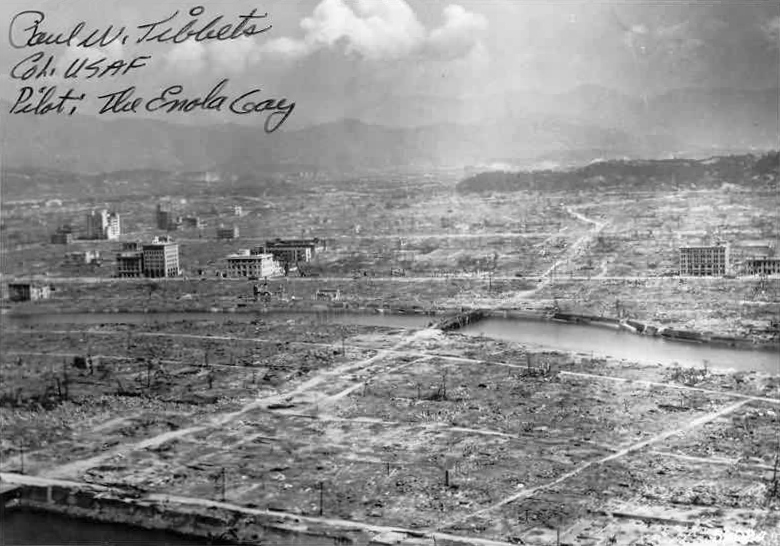
My fluid mechanics prof told the class that a scientist in the 1940's published the yield of the Hiroshima bomb. Since this was top secret, he got investigated. But he showed how the yield could be calculated from the film of the explosion - how fast the blast radius expanded.
So I imagine the yield of the Beirut explosion could be calculated the same way from the video.
You have to be careful about your errors though with this method, because you get higher-order powers. If the radius estimation was wrong by only 10%, your final answer will be wrong by almost 50%.
And data from smaller explosions of known magnitude, in order to determine the dimensionless constant that cannot be determined from Buckingham’s theorem alone.
Imagine being so good that Feynman tells stories about you (rather than himself).
Fermi also put Dyson down gently once "A successful theory must have either a strong physical intuition or a rigorous mathematical basis: you have neither"
>Fermi saw the Trinity Test as an opportunity for one of his famous exercises of rational estimation, a Fermi problem. First, he offered to take wagers from other scientists on whether the bomb would ignite the atmosphere, destroying New Mexico or even the entire world. Then, the evening before, he carefully prepared an experiment to estimate the bomb’s explosive yield:
> "About forty seconds after the explosion the air blast reached me, I tried to estimate its strength by dropping from about six feet small pieces of paper before, during and after the passage of the blast wave. Since, at the time, there was no wind, I could observe very distinctly and actually measure the displacement of the pieces of paper that were in the process of falling while the blast was passing. The shift was about 2.5 metres, which, at the time, I estimated to correspond to a blast that would be produced by ten thousand tons of TNT."
> "He was so profoundly and totally absorbed in his bits of paper," his wife recorded, "that he was not aware of the tremendous noise." The answer later calculated by the instrumentation specialists was 18 kilotons, but Fermi’s answer was arrived at on the spot – and it was correct within an order of magnitude.
> First, he offered to take wagers from other scientists on whether the bomb would ignite the atmosphere, destroying New Mexico or even the entire world.
Of course if you bet on the bomb not causing the end of the world, you can only win.
I went on Nukemap and twiddled the yield until the radius of overpressure damage roughly matched the damage seen in the footage.
I arrived at 0.25 +/- 0.1 kT before the 2750T figure came out. That's in line with TNT-equivalent efficiency of AN and incomplete reaction due to scattering.
Tragically, this suggests a much higher death toll than currently reported. I am not sure if nukemap factors local population density; fortunately the epicenter was a sparsely populated pier.
2750 tons of AN perfectly mixed to make ANFO only gets you 2.2kt. So unless if the actual amount of AN was higher, or something else detonated with it, 2.2kt is probably our theoretical ceiling.
Damage estimates in some cases may underrate the explosion because that grain elevator which remarkably remained largely upright seems to have acted like a huge sandbag, subtending an angle so large as to shield the heart of the city of Beirut from the worst ravages of the blast.
> I am seeing other analyses that put the size of the explosion at about one tenth of this size.
Random twitter users are guesstimating from smartphones videos and have 0 knowledge of the actual location, so yeah, it's just guesstimates. I'm still wondering why people do that, it's kind of a weird flex and bring literally nothing of value to the table besides trying to sound like a smartass.
Some of those are involved in the OSINT community where they do this as their day job, because analysing random strange explosions can sometimes tell you things about military weapons development programs that aren't otherwise advertised.
It's hard to imagine, but that would mean this explosion was nearly 3.5x larger than 2015 Tianjin[1] which was 800 tonnes of ammonium nitrate (336 tons TNT equivalent). The video[2] from Tianjin looked way bigger and apocalyptic, but perhaps just because of the the fireball.
It says there was a 15 ft wave out into the Gulf of Mexico that lasted for almost 100 miles.
And Texas City is not actually on the Gulf Coast, it is on Galveston Bay about a half hour away from the Gulf shore. And there is only a relatively narrow channel opening from the bay into the gulf.
There are ton-sized pieces of shrapnel still in a few places across the town.
I was stationed there in the early '80's when I was 20-something and everyone my age or older had parents & grandparents who had been through it, some surviving some not.
Now it's been twice as many decades and it's not as present, elements of recovery come into reach that are not possible the first few years or decades.
Another useful recent explosion for comparison might be the Oklahoma City bombing by McVeigh, for which a bit over 2 tons of ammonium nitrate was used.
Yeah, honestly, the Beirut explosion looked bigger/scarier to me, like how they show nuclear explosions in the movies. The Tianjin explosion was an enormous fireball but didn't seem to have the same magnitude of shockwave from the videos I've seen of it.
From the videos I have seen the Tianjin fireball seemed to rage even for a longer duration. In the Beirut one maybe because of daylight, fire is not visible after the big blast. I wonder what would cause that difference, the Beirut one supposedly had more material as well.
High explosives burn too fast for regular flames and suck the oxygen out for subsequent burning. Though you can definitely see fire in the first few frames. https://en.m.wikipedia.org/wiki/Red_Adair got famous for putting out oil well fires with high explosives. Explosives on burn that fast due to their chemical structure not because of free oxygen in the atmosphere. So if you see a fireball, the explosion has slowed way down.
People are used to huge fireballs in movies because they just aerosolize gasoline or others for that effect. Also it's a lot safer than high explosives. High explosives are dangerous.
An goes at around 10,000 feet/second or 6,800mph or 10,900 kmh.
In those videos when the white large cloud comes out (likely some form of the air being hyper compressed by the shockwave and forced faster than the speed of sound) I was like drop Camera get behind wall nooooooowwww. Or we'll keep camera it may be useful in about 45 minutes.
> In those videos when the white large cloud comes out (likely some form of the air being hyper compressed by the shockwave and forced faster than the speed of sound)
The white cloud is due to the shockwave causing moisture in the atmosphere to condense. Or rather immediately after the shockwave in the low pressure region.
You can see the same effect sometimes due to supersonic aircraft.
In Tianjin there was also 600 tonnes of Potassium Nitrate that exploded in addition to the ammonium nitrate, so to compare them you'd need to count that as well.
The US Chemical Safety Board has a video[1] discussing ammonium nitrate, in relation to an explosion in West Texas on April 17th, 2013. That incident involved 40–60 tonnes of ammonium nitrate, killed 15 people and leveled a neighbourhood.
She was a good chair person. I learned a lot from the CSB outreach material from her era.
> In 2017, Sutherland was chairperson of the agency when the Trump administration attempted to defund the CSB for the 2018 United States federal budget.[10] In March 2018, the Office of Management and Budget informed Sutherland that the Trump administration had again proposed to shut down the agency as part of the 2019 United States federal budget. This caused Sutherland to resign despite having two years left in her five-year term.
From what I understand, ammonium nitrate isn't particularly flammable, until it gets hot--then it gets explosive. Furthermore, ammonium nitrate conflagrations tend to give a distinctive reddish smoke cloud.
The cloud accompanying the big explosion has a very distinct red tint to it, indicating that it's a result of the ammonium nitrate going off. That before it doesn't, which suggests that the ammonium nitrate wasn't burning at the time. If you compare the Texas City disaster, it's noted that spectators were drawn towards the site by the unusual smoke clouds before the big explosion happened.
There's a lot of details that aren't clear yet, but a variety of materials being stored in a warehouse catching fire, with fireworks going off first and the ammonium nitrate going off last, is consistent with the known facts. It would, however, be exceptionally bad safety practices to store ammonium nitrate anywhere near something like fireworks. Then again, storing a large amount in a warehouse right next to downtown Beirut is itself insane, considering it has a history of being implicated in the largest explosions not involving nuclear weapons.
Ammonium nitrate will decompose into nitrogen dioxide under a number of conditions other than detonation. Even under detonation, it implies an excessively oxygen-rich environment.
Just as an FYI, this account is a well known fake persona run by MEK cultists in Albania, not really a great source of info- note that it immediately began boosting a completely unsubstantiated theory that the explosion was caused by a depot of Iranian munitions.
It should be obvious that it's more like 10 times smaller than Halifax, otherwise we wouldn't have gotten half the footage we are seeing right now, those people would be dead.
Yes, utterly horrifying on those points alone, to say nothing of the added destruction that air blast and supersonic shockwaves will do, even before you get to radiation.
This video [1] from The Guardian include the same video in that tweet, but also has a few other angles which gives a better appreciation of how big that thing was.
The interesting part about the explosion in the video is that there's two clouds: first the rapidly expanding almost perfectly spherical white puff, and then the slower dark black mushroom cloud. I vaguely recall the first is mostly water vapor that suddenly condenses out of the air because of the massive shockwave, while the second is the 'actual' explosion and its byproducts being shot up into the air. Any physicists out there care to set me straight?
> I vaguely recall the first is mostly water vapor that suddenly condenses out of the air because of the massive shockwave, while the second is the 'actual' explosion and its byproducts being shot up into the air.
I had only seen the headlines about this, but had not investigated anything until seeing this video. That's a much larger explosion than I was expecting.
Yeah, I was taken aback when I saw the video because I thought the initial smoke plume was the aftermath of the explosion. Then it went off and bloody hell.
I have family and friends living in Lebanon. The explosion destroyed the windows of most homes in Beirut. Apartments of my family, friends, and colleagues have been shattered. Even the ones living dozens of kilometers away from Beirut. It's horrible, what pure incompetence can do to a people already living in poverty and under the covid-stress. I hope something good comes out of this...
Change the whole governmental bodies. Build a new constitution. Hold new elections. Create a government that acts and builds, not one that talks and promises. Something that can lift this poor, small, desperate country out of its misery. I'm hoping for such changes...
The following is a citation for the seminal paper on this matter. G. I. Taylor was a god of fluid mechanics, and quite a lot of his work is available online for free.
Taylor, Geoffrey. “The Formation of a Blast Wave by a Very Intense Explosion. - II. The Atomic Explosion of 1945.” Proceedings of the Royal Society of London. Series A. Mathematical and Physical Sciences 201, no. 1065 (March 22, 1950): 175. https://doi.org/10.1098/rspa.1950.0050
Note that the distinctive orange color is probably a large volume of nitrogen dioxide at pretty high concentration. If it was an ammonium nitrate explosion, the orange cloud supports the idea it was accidental. The explosion would have been easier to set off and more powerful had there been a fuel (or more fuel) mixed with the ammonium nitrate.
Why do you think that the release of NO2 makes it an accident? Nitrate based high explosives only release NO2 during an actual high-order detonation. Ammonium nitrate does this with or without sensitizers such as fuel oil.
This is definitely not the case. NO2 release is characteristic of spontaneous decomposition of nitrates, which can happen under a wide variety of conditions that have nothing to do with detonation. I’ve had the misfortune of seeing this happen once in a lab, due to a rookie mistake. It usually is the harbinger of a runaway exothermic reaction. There is nothing surprising here if ammonium nitrate is the primary suspect.
In the specific case of bulk ammonium nitrate, it has a low melting point (relative to a fire) and it starts to become quite unstable in that phase. The low risk of AN is premised on it being stored in a relatively clean, non-reactive environment.
Fuel oil generally isn’t considered a sensitizer for AN, you still need a booster, it compensates for the oxygen richness which improves efficiency. There are a bunch of nitrogen organics and metals, which I won’t list here, that will sensitize AN quite effectively but those aren’t implicated here.
Most fires with AN are caused by its reactivity. It will readily combine with other chemicals in the environment to produce compounds that are far more unstable than AN. These byproducts often act as the ignition point that ultimately causes the AN to detonate.
A mixture close to a neutral oxygen balance (stochiometric mixture) would consume much of the N02 and have a much less brilliantly orange plume. Though, point taken that sensitization happens much before reaching a neutral oxygen balance.
A comparable explosion happened in Toulouse, France, in 2001, estimated at 20-40 tons of TNT.
It was also some nitrate storage that blew up. Similar end result, pretty much everything window in the city was blown away, and most of the injuries were caused by broken glass.
Was watching some reporting from that explosion, and it starts with teachers being on strike when the explosion occurred. So French... https://www.youtube.com/watch?v=TioM7N0y8Co
When I first saw the initial video, I immediately assumed a nitrate explosion. A bomb that large would be too hard to place or even deliver (if a plane), and fireworks would not explode with a such a perfect shockwave. The red color of the original smoke is rather telling as well and that it occurred in a dockyard.
I am awestruck. What an awful event. I will be keeping up to date with this and looking for ways I can help... All I know to do right now is pray for those that have suffered from this. My breath has been taken away...
Wikipedia's page of the largest non-nuclear explosions [1] was already updated and states "It generated a shock-waves equivalent to 13 tonnes TNT". Not sure who made this estimation and how, but various photos on that page can give you an idea what a large explosion looks like. For example take a look at the Yamato explosion [2]. Yamato was a 70000 ton Japanese battleship; the large explosion was due to its magazines being hit by bombs (this happened quite frequently when battleships were hit as they were fundamentally stacks and stacks of gun ammunition surrounded by a hull); it's likely that Yamato was carrying a few thousand tons of explosives, so that's how you get a few kt TNT non-nuclear explosion. Now in that photo you can see for reference another ship in the lower left. It looks quite puny. So, it appears to me the Yamato mushroom cloud was much, much bigger than today's mushroom cloud in Beirut.
Edit: The wikipedia page was updated and now states 1kt TNT.
The ship you can see in the bottom left of the Yamato's explosion (link [2]) is a Japanese destroyer. I'm not sure which ship it is specifically, but she is likely 100-130 meters in length (those were the only ones around at the time Yamato sank). And she's closer than the actual cloud.
Another fun note about Yamato's explosion is that it appears to have been responsible for more plane losses than all of the AA fire during the battle. For a battleship with well over 100 AA guns, that's a pretty damning indictment of their quality.
One of my favorite YT naval historians, Drachinifel, constantly derides the Japanese 25mm AA gun, which was based on a French design. One of his longer podcasts (in the Drydock series) has a segment explaining the technical details of why.
Naval ships are generally spaced at about "I can see the nearest ship to me in my binoculars"-distances.
To give a sense of scale, the USS Washington firing on the IJN Kirishima in the Second Battle of Guadalcanal is reckoned as one of the shortest-range engagements in WWII... at about 5km.
That said, the remaining ships in the area were the surviving Japanese destroyers, and destroyers closing in closer to ships would not be unusual. Furthermore, the Yamato was in the process of abandoning ship at this point, and the destroyers may have been closing in to help fight fires or rescue survivors. I doubt they'd be closer than about a km from the ship at the time of the explosion, and none of the Japanese ships (so far as I'm aware) reported any effect from the explosion. Some planes (up to 7) were lost in the fireball, though.
Some WW2 battles were fought at significantly shorter ranges than that. Just in the Malta campaign, at Cape Passero the Italians closed to around 1700m before opening fire. In the attack on the Tarigo convoy, the British closed to 1800m before opening fire and approached as close as 50m to the Italian ships.
The WW2 battle of Leyte Gulf was fought between US destroyers and Japanese cruisers at very close range - the cruisers couldn't aim low enough to hit the destroyers, while the destroyers raked the cruisers topside with 5" guns.
Also in the WW2 battle of Singapore, two British battleships were sunk by Japanese bombers, but the Japanese ships were very close to the British fleet at times. The result was that Japan dominated both the Pacific and Indian oceans until Midway.
In https://www.reuters.com/news/picture/pictures-report-idUSRTX... you can see ships berthed after the explosion, with no visible damage (as seen from a distance, surely there must be lots of minor damage to the superstructures etc.) even though they must have been really close to the explosion.
Since it was a ground level explosion, the quay and other buildings probably largely shielded the hulls of the ships from damage.
Ships in general are quite sturdy things, they are made to withstand heavy seas and winds after all.
Officially, they had 2750 tones of ammonium nitrate on that dock. Even if it were properly mixed with fuel oil to make ANFO, that would give you 2200 tones of tnt equivalent. It is quite unlikely that it was mixed to the perfect proportions, so we’d expect actual yield to be below theoretical max
So unless if something else was involved (or the official amount of ammonium nitrate was wrong) I would expect the final blast to be under 2kt.
There are plenty of petroleum distillates in a dockyard. Diesel, bunker fuel, kerosene, gasoline....not to mention other flammable hydrocarbons and powders. You're assuming an 80% ratio ANFO/TNT but you're neglecting the mass of the FO, as well as the possibility of other oxidizers being stored near the blast site. I guess you could make some assumptions about the fuel based on detonation velocity as observed on video.
Properly mixed ANFO doesn't contain a huge amount of FO; ideally it's supposed to be 6% by mass. Good enough for a quick HN estimate, although I'd hope an actual after action report does better. A better calculation is that 2750 tonnes of AN would yield 2864 tonnes of ANFO, which is 2,291 tonnes of TNT equivalent.
However, we know that the explosion wasn't stoichiometrically perfect, because of the brown NO2 clouds that were hanging over Beirut. Properly mixed ANFO should release only H2O, CO2, and N2. So we know that there was some level of explosive power that wasn't fully consumed. This is why I put the ANFO yield as the absolute theoretical max, I think in reality the actual yield was much much lower.
Some other people have speculated that the fireworks like mini explosions between the first and second big explosions was actually ammonium nitrate decomposing, which would imply that this was a pure ammonium nitrate explosion and not one accelerated by some sort of oil or other fuel. If that's true, various manufacturers give the AN to TNT equivalent of poorly handled AN at 15-40% of TNT, giving a yield somewhere in the 412-1,100 tonne range.
Unless I'm missing something they forgot to account for the fact that dimensional analysis will only give you a result up to a constant.
This should be somewhat obvious as otherwise you'd get a different result with different units (and no SI units won't save you here, those just work for several common equations in physics not ones you came up with yourself).
Okay looks like there is some justification for that assumption given by G.I. Taylor.
By the way with your data it looks like you get a better fit if you assume your first image is not at 50ms but rather 38 ms. A line fit between t and r^(5.2) gives a slope of 1.6 10^13. This gives 4 kt if you use the lower estimate of 1 kg/m^3 for the density of air.
I do worry you may have overestimated the distance slightly, as these numbers are frankly ridiculous, and with a power of 5 even small errors grow quickly.
Absolutely, I do think it is an overestimate. The angle of the video makes it hard to accurately estimate the size of the ball, and as you rightly pointed out an epsilon difference in size gives epsilon^5 differences in energy, so size estimates are extremely important.
It is dimensional analysis provided you can justify that the constant should approximately be 1. This is what G. I. Taylor did for the fireball of the trinity test. And apparently it does end up being close to 1.
I do worry about the accuracy of this a bit, but looks like it could in theory work.
IIRC dimensional analysis lets you put constraints on the form of the equation, by requiring that the variables form dimensionless groups. But you still have to include the right variables, and then measure the values of those dimensionless quantities under different conditions (for instance the Reynolds number for different velocities or length scales) to figure out how the groups scale relative to one another. But I'm sure that data already exists for the situation in question. It would just be a matter of estimating the values from the video and dropping them into the equation.
> The cause of the explosion was not immediately clear. Officials linked the explosion to some 2,700 tonnes of confiscated ammonium nitrate that were being stored in a warehouse at the port for six years.
This reminds me a lot about AZF, a chemical explosion that happened in Toulouse, France back in 2001 [1]... And it was hundred of tons of ammonium nitrate here too.
Ammonium nitrate is 1.35 less potent than TNT. So this was just over 2,000 tons of TNT blast. The first nuclear bomb ever dropped was 15,000 tons of TNT of force. So this was 13.3% of the force of what Hiroshima experienced. About 70,000 people died from Hiroshima. So 13.3% of Hiroshima force is still devastating. It's probably not going to be nearly as bad as 13.3% of 70,000 deaths because Hiroshima was more densely packed and there wasn't the electromagnetic pulse wave that vaporizes people and long lingering radiation associated with a nuclear bomb. ... Still what happened in Beirut is immensely devastating.
Just in case people are wondering reason this explosion: there was 2,750 tonnes of ammonium nitrate stored without safety measures in a warehouse that went off.
I wonder if the shape of the storage receptacle and the geometry of surrounding buildings could have resulted in an elliptical fireball shape. If so, that could be one drawback of this method. Depending on viewing angle, you could overestimate or underestimate the R figure versus a same-energy spherical fireball.
Dust pollution has turned out to be quite significant in the 9/11 aftermath, causing cancer in thousands of people.
> As of August 2013, medical authorities concluded that 1,140 people who worked, lived, or studied in Lower Manhattan at the time of the attack have been diagnosed with cancer as a result of "exposure to toxins at Ground Zero". It has been reported that over 1,400 9/11 rescue workers who responded to the scene in the days and months after the attacks have since died.
what was the white ball during the explosion? it looks like some liquid spraying up in the shape of a ball, was it sea water? other liquid? or was it just looking to me like a liquid but actually was gas of something?
The white ball is water vapor that condenses into a cloud around the explosion as the shockwave passes through the air. Specifically it's the low-pressure area that comes after the initial shockwave, the rapid decrease in pressure causes water (and any other volatiles) to condense out.
Nitpicking here maybe but this does not look like a 3 kiloton blast to me. Neither the size of the core explosion or the apparent shock wave damage correspond to that magnitude from a surface blast. Guessing here but I'd say closer to 2 kilotons at most.
Amazingly, the massive, hollow grain silo right next to the detonation itself remained standing afterwards.
I don't understand why i'm being downvoted or why there's anything wrong with analytical speculation of this type, even about a tragedy.
If anything, this very site and its comments are loaded with exactly that kind of commentary, done mostly in good spirit and tolerance for those who do it. No, i'm not an explosives expert or professional with detailed knowledge of blast yields, but like many of you, I have something of a strong curiosity in a topic irrelevant to my professional occupation. So, based on educated guesstimating, I decided to share a polite opinion about it, like so many others regularly do on HN. Chill.
I posit that it's definitely above 1 kiloton though. I base this on the radius of damage it caused (from photos compared to Google satellite images of the area around the explosion site) and by comparing the explosion's apparent magnitude with that of the PEPCON blast, which was fairly carefully estimated to have been roughly 1 kiloton. This blast looks bigger and spread its impact further than the PEPCON blast..
A few hours before you made this comment, you made a nit-picky objection on a different HN post about Intel i5 versus Intel i7. Someone responded to you saying that i5 and i7 are marketing terms that most consumers interpret as an indicator of performance. You replied, "I guess this isn't really 'hacker news' then, because I would expect just about any 'hacker' would know the difference."
Then, you came to this HN post and described a bunch of people as "nerds" for trying to interpret the magnitude of the blast by observing what was captured on video.
The contrast between these two simultaneously held attitudes is so bizarre that I am chuckling to myself as I try to grasp your underlying thought process.
(You could easily have switched your approach to the two threads, criticizing the Intel i5-vs-i7 nerds while doing some napkin math to come up with your own estimate of the Beirut explosion in TNT terms.)
This whole thread is full of debate about diverse details about this event and things related to it, so yeah, it's perfectly normal to debate claims like a headline's subject, Nobody thinks it literally matters too much, They do it out of intellectual curiosity.. It's not just a "nerd" thing.
Lebanon has its share of enemies, internal and external. All it would take is a mavic inspire drone to fly over and drop the initial explosive.
Trump said "it looks like a terrible attack" at his news conference. Which is probably what his intelligence officers/advisors speculated when they briefed him.
This speculation is silly, uninformed and unhelpfull.
There was a primary fire of fireworks, you dont need to invent conspiracy. Besides one does not need a drone to start a fire in an unattended warehouse.
The media doesn't seem to understand how big this is yet in short and long term damage and loss of life. I guess that doesn't matter? They are more for political bickering now?
Running theory Ammonium Nitrate stored at port for many years -
This story is on the front page of every major news site in the world right now.
They're not providing an "in-depth analysis" because there aren't yet sufficient facts to analyze. Even the authorities don't yet know what actually exploded, or what caused the explosion, or the number of dead, or the number of wounded, or the number of missing.
President(*) Trump just suggested the explosion was an attack. Do you believe his "authority" and "credibility" in the matter, over the "fake news" media?
+1
I would bet my hand that Trump wouldn't be able to roughly point on the map where Lebanon is. But for sure he is the expert on their internal politics and struggles.
I am surprised anyone on HK is considering him as source of any info (unless a bot).
On a slight positive side, at least this explosion will mean the rulers of that country can now ask for help without losing face/admitting their failures/corruption...
See, again with the expectations. If every big event requires a link to in-depth analysis on the front page of a news site, they'd need to have a small font size and a 16K monitor... And you'd complain that it's not in the corner you looked.
If you think this shouldn't be the clear headline, then I guess we consider news to be different things.
I'll go back to reading next in my feed how George R R Martin is racist because he mispronounced someones name (Not an article in the Guardian, and the Guardian's coverage is exceptional for Beirut compared to others like CNN or Fox)
[edit] Does the media not care about the largest peacetime explosion in a capital city because they are Arabs? What exactly is bigger than this today?
Reply to your edit: who's "media" here? The Guardian has it front and center and red (red means live news event). If your "media" falls below your expectations, then stop reading them. But stop saying all media is shit because you read shit news sites. IMO you're part of this problem of people saying all media is illegitimate because some of it is shit...
The news is way worse than that. A couple notable things they mostly buried just this past week:
The George Floyd bodycam video leaked out, destroying the BLM narrative (see https://news.ycombinator.com/item?id=24046940 for DailyMail). ABC doesn't cover it. CBS and NBC edit out "Stop resisting". Youtube suppresses it from trending. NBC even had privately seen the bodycam video a month prior, leaving them no excuse for stoking violence across the country.
We finally got evidence (both flight logs and a victim statement) that a former US president was at Epstein's island.
Both of those are far more important to Americans than a big explosion in a far off city.
This is less an issue of biased narrative vs the truth than _your_ values vs BLM values. To BLM, nothing excuses someone who is supposed to protect and serve putting their weight onto someone's neck for nearly ten minutes. Is a stained toxicology report and non-compliance permission to kill? The BLM "narrative" assumes the answer is no. The right-wing "narrative" assumes the answer is yes. This is less a question of reporting and more a question of what is justified.
Thus, the BLM narrative that police violence is excessive is still compelling if you subscribe to the belief that someone placing their knee and weight on a detained person's neck for 8 minutes is excessive, regardless of other circumstances.
Ask yourself if you think the situation could have been resolved differently, without loss of life. If outcome isn't important to you because of a toxicology report, mannerisms, circumstances of arrest, other reason to deny life... then a certain unorganized group of people would like to remind you and many others like you that _black lives matter_.
But alas, to say the leaked body cam footage "destroys the BLM narrative" implies you won't care about reporting at all if you resort to regurgitating clickbait-language.
There were no neck injuries (see the autopsy report) and thus the "putting their weight" concept is clearly an exaggeration. Nothing involving the neck was involved in the death.
It is a gross mischaracterization of the right that "the answer is yes".
There doesn't exist any way to arrest a non-compliant criminal without somebody getting all upset about it. Ultimately, some degree of violence will be required. Leaving criminals to run free is how you get a failed state, and then gangs create their own not-so-nice justice system.
Hiding the video in order to create needless racial strife was just plain evil. Numerous additional people have died as a result.
Is it? A fireworks explosion in Lebanon is more important to me than whether Congress gets unemployment support fixed, or how my city is doing with the pandemic? Or whether a tropical storm is flooding NYC?
I should just pre-flag this comment, so feel free.
But Hezbollah use Ammonium Nitrate and could use the other small explosives stored near by.
I think under current rules being actioned if there was intel people were stealing from the factory it would be considered a legitimate target.
The question would be, would the analysis of intel be good enough to know exactly what was stored there and if it is clearly not an appropriate target. And I think their analysis would suck.
If you want a source, the President of the United States said it was an attack. So we either believe official statements or we should learn to think for ourselves.
  Equally arson or a fire due to lack of security
  and maintenance due to coronavirus stress.
Hezbollah also uses Toyota trucks, but not every fatal Toyota accident in Lebanon is a targeted attack. Millions of tons of ammonium nitrate are produced every year. It has several nonmilitary uses in explosives and fertilizer.
If you want a source,
the President of the United States said
The current President of the United States is not a reliable source of information.
Equally arson or a fire due to lack of security
and maintenance due to coronavirus stress.
It seems counterproductive to speculate about this on the internet, given what little we know.
The closest to an official statement (US dept of defence officials to media) is that it is not thought to be an attack, Donald’s ex-cathedra ramblings notwithstanding.
Nasty accidents at fertiliser plants are unfortunately somewhat common; they dominate the list of largest non-nuclear explosions.
Also, why would you steal fertiliser from a fertiliser factory? Traditionally, I’m fairly sure people just BUY it if they want to make a bomb.
> The closest to an official statement (US dept of defence officials to media)
Where is this press release from the US Dept. of Defence? Or are you talking about the mysterious "three unnamed defence officials" CNN wrote about in an article?


.jpg)

Collected videos:
Angle #1 https://streamable.com/xmmoa7
Angle #2 https://streamable.com/nscx9m
Angle #3 https://streamable.com/zbjj5f
Angle #4 https://streamable.com/saoafz
Angle #5 https://streamable.com/4ga1vb
Angle #6 https://streamable.com/lmivb2
Angle #7 https://streamable.com/mcy82f
Angle #8 https://streamable.com/zg9oal
Angle #9 https://streamable.com/zykkj6
Angle #10 https://streamable.com/22e152