I had the privilege of undertaking the first (and now the last..) study on the spire of Notre Dame since 1933.
The restoration works that were under place are a result in part of our recommended actions.
The spire was incredible. It was one oak trunk, connected with a "Scarf Joint", or "Jupitre" in French (Bolt-of-lightning joint)
There were the names of the last guys to inspect it in the 1930s, engraved at the top.
There was a french ww2 bullet embedded in the spire, presumably shot at a germany sniper who was in the spire...
Everything in the roof was antique wood. Anyone that went into the roof was paranoid of fire.
It's a very, very sad day.
As a celebration, I'm throwing up some photos that we'd never published from our study.
Individually, it feels like an intimate acquaintance has died, and collectively it is a huge loss.
Over the weeks we'd spent on the spire, we photographed and documented literally every square centimeter of the spire and roof space.
Outside of its intrinsic value, the spire also held religious relics (Thorn from the Crown of Thorns etc..). They were apparently contained in the wind-vane on the top of the crow's nest.
We were unable to access the crow's nest - the last 3 ladder rungs (the spire had iron foot pegs every 50cm or so up one side) had been removed - ( presumably to stop people from getting to the relics ) - and there was no way we could get access without installing scaffolding.
There was so much hidden detail on the roof - works that would never be seen from the ground - invisible to everyone but the workers and artisans. Truly a loss.
As for the cause, there would be some solace in an 'unavoidable' situation - I just hope it wasn't someone discarding a cigarette butt.
Just a point in clarification: when you say antique, that means mid 19th century. The original 13th century spire was removed in 1786 because it was falling apart.
Apologies, I wasn't using 'antique' in a quantitative fashion, simply trying to convey that it was aged and dry.
With that said, I was referring specifically to the carpentry in the roof itself, which dates before the spire itself.
The smell of the roof space was incredible - deep, wooden and wise.
André Finot, the spokesperson of Notre-Dame de Paris, announced soon after the fire was known that the roof's wood frame was doomed. This frame was in two parts: one side from oak beams of the 13th century, the other half from the 19th. Of course, the spire was in later part, since it was built by Viollet-Le-Duc.
To prevent fire, there was no electricity wires in attic, because the oak beams were extremely dry.
> when you say antique, that means mid 19th century
Where is that coming from?
I don't see any definitions that constrains antique to a specific time window, some definitions/laws include "at least 100 years old"
Antique: a work of art, piece of furniture, or decorative object made at an earlier period and according to various customs laws at least 100 years ago
They meant that antique means "only" 19th century in this case because that's when the spire was installed. It's not as antique as the rest of the cathedral.
Thanks for sharing the photos. It's an incredible tragedy. I had the privilege of visiting Notre Dame twice, but I'm deeply saddened for all those who will not have the opportunity to see it in its former magnificent form, including my own young children. I only hope that some of it will remain and be a foundation for rebuilding.
This is awesome - thanks for sharing your story, and that photo. I'm sure that the detailed studies performed by you and others will be invaluable going forward - both with remembering and healing, and eventually perhaps, rebuilding.
With my sympathy for this tremendous loss,
but could you comment on the accuracy of
this report on the amount of lead metal
in the spire (or is it the entire roof?)
> The 3-meter-tall statues are being sent to southwestern France for work that is part of a 6 million-euro ($6.8 million) renovation project on the cathedral spire and its 250 tons of lead.
My partner shot the inside of the spire, but I have a few quick shots.
On one of the sides I did - there were the traces of what we could only assume to be some type of explosion (probably a stray explosive from WW2 ..?).
There are also the eagles that were halfway up the spire.
Curiously enough, there were six, each one had a number stamped on its head - if you traced the numbers, it made a star composed of 2 equilateral triangles.
It seems the North Tower has since caught fire as well - so the bells will have gone, and all of the stored relics too - so some photos of those.
No, they're in the North Tower.
The bells are suspended in a wooden structure that is free-standing, and free moving inside the stone structure.
This allows free movement when the bells are ringing, without stressing the stones.
It was a priority to extinguish the north tower fire to prevent the bell structure from collapsing - the falling bells would have destroyed the stone structures on the way down, presumably triggering the collapse of both towers..
Is it possible that the stone parts of the structure will be more resilient than the (apparently) wooden roof, and might survive if the fire is put out quickly enough?
Yes, the vertical structures are likely to survive. See any number of photos of post-WW2 cities.
It’s debatable, however, how much that means. I suspect it serves more of a symbolic purpose, as a kernel of truth to a shared future fiction that the building is at least partially “original”.
In terms of costs, I suspect integrating those structures is likely to be more expensive than rebuilding from scratch. The loss is also greater than just the building, as it contained a multitude of art, some of it part of the structure like the famous stained glass windows, some not.
Also no expert, but from the cases I remember, actual construction is rather fast.
What takes time is often the financing: there are churches in Germany where, to this day they are collecting money and constructing piece-by-piece. I don’t know how this will play out here. For example: how much is the Catholic Church still involved? But I would assume the French state to be somewhat generous.
The other potentially delaying question is how to reconstruct. Going for an exact replica often feels anachronistic and sometimes tacky. The German Reichstag, for example, was reconstructed with a rather modern glass rotunda, and feels like a great example of combining old and new. The World Trade Centre was replaced by something entirely new. If they decide to go in such a direction, some time will be spent on architects’ competitions.
In France, the question of financing the reconstruction is rather simpler: Notre-Dame like most churches in France is owned by the State, so the State and the citizens will pay for it.
The reconstruction will be a restoration, to what degree, it remains to be seen, for example Reims Cathedral roof was rebuilt using concrete for the structure, but the general appearance will remain the same.
The symbolic is rather different that of the Reichtag, the Reichtag being the symbol of a new state in the XIXe century, destroyed during its darkest hour, and finally reconstructed after the rebirth of Germany and the Reunification with a mix of old and new, By itself the Reichtag summarizes German history.
>how much is the Catholic Church still involved? But I would assume the French state to be somewhat generous.
Nowadays churches in France belong to the city, not the Church. Which has led to many tragedies recently, with town halls (usually Communist) intentionally neglecting churches until there was no choice but to destroy them. I don't have any faith in the French state these days to be consistent with monuments.
Notre-Dame will be restored, it's too much of a symbol. However, the money will have to be found somewhere, and there is a good chance that it will mean other restoration projects for "lesser" historical buildings will be delayed (maybe dangerously) and subsidies from the Ministry of Culture for artists and art projects will be reduced.
I'm not the person to ask (I was there as a photographer and rope worker) - but my partner estimates decades. It depends on the extent of the damage. For the moment, it seems that the entire building will be gutted - and presumably structurally unsound. If it has to be rebuilt from scratch - look to the Sagrada Familia for a time reference..
The Sagrada Familia was attacked by anarchists during the Spanish Civil War, who destroyed Gaudí's study and the plans and models for the church. Decades were spent just reconstructing the project before actual construction could resume. In Notre Dame's case, there is much better documentation on the structure, so hopefully it won't take quite as long.
The latest news said that the structure is mostly saved.
Looking at some aerial pictures (https://pbs.twimg.com/media/D4OFOKMWkAEEHsz.jpg), it looks like the vault is holding except maybe for the section above the transept area (where the spire collapsed), but it has probably suffered, if not from the collapse of the roof, the heat has probably weakened it.
But yes, one or two decades of restoration is a realistic estimation, it's roughly what it took for other cathedrals to be restored (Rouen, Reims) after the World Wars (hopefully Notre-Dame will be in a better state after the disaster)
The Sagrada is not a good example as it is more complex than traditional gothic. Part of the original plans were supposedly unsound and several architects intervened over the decades. But granted, we're still probably talking decades.
The Reims Cathedral was reopened in 1938 (about 20 years after the start of the restoration).
But in this kind of restoration, the devil is in the details, repairing the structure and rebuilding the roof and the spire will probably take around 8 to 10 years, if the vault is not in too bad of a shape, more otherwise. But repairing the the sculptures and decoration, with all their minutes details will take generations.
For these, what was not destroyed by the fire is probably heavily damaged by the tons of waters poured to save the edifice.
> In terms of costs, I suspect integrating those structures is likely to be more expensive than rebuilding from scratch.
Respectfully, you have no idea what you are talking about. Nobody in Europe would consider tearing down the remaining structures and rebuilding from scratch because it's cheaper.
The roof is not made of wood, but like most old European buildings, its frame is made of wood.
Above the vaults of stone, a wooden frame supports the roof which is covered with metal (zinc). This is obviously lighter, and easier to build and to maintain than a roof made of stone. Unfortunately, after a few centuries it becomes extremely burnable.
No thanks. If we have any redwood left to be used for building, I'd rather have them go to the better attended local cathedrals, than a cathedral that is really no longer used.
I mean that Notre Dame, while certainly still a cathedral, is not very active. I've been to daily Mass in Notre Dame, and it was completely underpopulated, when compared to other, poorer cathedrals I've been to, including in my own state.
I've been to many Catholic locales, and there are many poor Catholic artisans who would be willing to create beautiful Catholic art if they had resources. I'd rather they get the resources, than some secular artisan simply trying to copy Catholic art.
I would rather see resources go to actual Catholics to be used in an actual Catholic place of worship that is frequented and populated than to non-Catholic artisans attempting to mimick Catholic beauty to restore a building that is not actually used.
The fact is that the well-loved parish stands a chance of becoming a Notre Dame of the future, whereas, Notre Dame itself is likely to fade away and become a museum, unless the people of France actually decide to become Catholic again.
The truth is that, it was the underlying belief in the Catholic world view that made Notre Dame the legend it is today (the constant creation of beauty, the grandeur, the preservation through the ages). No amount of money to secular authorities can possibly recreate that exact mythos, whereas it could if sent to another diocese that still practiced.
EDIT: perhaps I'm wrong and Notre dame is more active than I thought and I just visited at a bad time, but from what I've read, there's not many actual Catholics in France, at least when compared to California.
Please just stop. Even your attempt at mitigation through edit is wrong, and it would have been trivial for you to correct your misapprehension. There are an estimated 10 million Catholics in California compared to between 27-58 million in France. Besides, the value of the place as a cultural institution visited by 13m+ a year just to see it isn’t something you should dismiss along with its centuries of cultural significance just because it offends your religious sensibilities.
It’s also a miserable stance to take while the place is still literally on fire.
The state government set up Jackson Demonstration Forest specifically to show people how to sustainably harvest from a redwood grove. Notre Dame is a cultural icon, I'm sure the French would appreciate the gesture.
For those asking about why there isn't visible water being sprayed on the fire... There's no point. Any firefighting efforts are focused on preventing the spread of the fire to other structures (potentially other parts of the same structure)
As a rule of thumb, the water flow necessary to extinguish a burning structure is the volume of the structure (in feet) divided by 100. The resulting number is (in rough numbers) the amount of water you need, in gallons per minute. For a fire this size, you're looking at tens of thousands of gallons of water per minute. It's just not possible.
The other thing those people might consider, and this includes our president, is that they aren't firefighters, have no idea what to do, and surely live in a place unequal to Paris in any parameter upon which you'd care to compare. IT'S PARIS. They're in Paris. And to paraphrase Chevy Chase: You're not. They know what they're doing. Imagine you're the Paris fire chief. That's like being the NYC fire chief. Such a person has a distaste for explaining to superiors why they mismanaged a firefighting operation, and has a lifetime of experience, and hence, tends to manage it properly.
"Must act quickly!" Ya think? Hopefully the fire department in Paris, France is listening for gems like that from out here in the boonies / the ghetto hemisphere. How many medieval churches are there on our whole continent? Call us if you want a church bombed.
Shoot, you're probably right, and I fell for it. I guess the unintended consequence of my strict "ignore" policy over the last 3 years, is that I'm still a novice 3 years later. (Rarely do I see those brainfarts, but this one was unfortunately quoted in an article.)
It would be nice if there was somewhere to find high quality news reporting that avoided toxic stuff like tweets. I'm not sure what that embedded tweet adds to this BBC story besides getting people worked up over something that's totally unrelated. You'd think Notre Dame burning down would be enough.
Maybe a more optimistic interpretation is that people naturally want to try to help and would rather speak up than feel helpless even if their advice is not particularly good or useful.
It's complaining about a certain ignorant disrespect I've seen personally today, so I see it as corrective and therefore constructive. But I think I get what you're saying, though your comment is a little threadbare; I'd be interested in your full argument/reasoning.
EDIT: I added a few words to the grandparent post to try to make my intent clearer.
There was nothing disrespectful about Trump's tweet. I find it strange that you can't use his name, as if it's somehow shameful. That's disrespect to me.
I really wasn't monitoring my use of the name. Though obviously I am now. Anyway you guessed right: My lack of respect for the guy we're talking about is so deep and vast that this forum won't tolerate my going into it. And rightly so, because ultimately it's boring as heck.
Actually I think I was, if anything, charitably conferring tons of undue respect on that guy, by calling him "our president," thereby not only acknowledging his office but accepting him as "ours," both of which are more than some are willing to do. Ya can't please some people I guess.
Not enough people on the internet read what they're saying outloud before posting. I blame this on the low quality of discourse on the intnernet. You're very welcome by the way.
It was disrespectful because donald, the self-proclaimed expert on all the things, doesn't understand what he is suggesting, and doesn't understand that what he is suggesting is not helping anyone/anything except his ego.
I once had a neighbor whose house burned. From the outside it definitely looked like the fire crews were taking their time arriving, setting up camp, preparing, aiming, etc. But maybe acting intelligently isn't always the same as acting quickly.
I wonder how the firefighters feel about risking their lives for art, as opposed to other lives. I'm not saying I wouldn't risk human lives for certain works of art, but I can imagine some boots on the ground feeling salty about it.
I am a firefighter. Salvage operations are part of every fire (usually after the bulk of the fire is under control, but given sufficient manpower it also happens concurrently with fire attack operations).
They're not going to take huge risks. Any environment that would be extremely dangerous would be an area where any art has already been destroyed.
Swiss firefighters work on the four priorities of save lives, stop the fire, protect property from damage (including livestock), and protect the environment. Once lives and the spread of fire are under control, reducing the cost to the victims (emotional and financial) are why they are there.
Consider the Syrian archaeologist that hid artifacts from ISIL and refused to give them up. He gave his life and was tortured to death to preserve those artifacts [0].
How many human lives and human energy went into Notre Dame? How many lives would its continued existence inspire? Humans are far more temporary than art and culture. Art and culture connects us to the people that came before us.
Engaging in an activity with greater risk of killing you than usual is not the same as "giving one's life". These guys already fight fires for their day job. One more little bit of exposure to increased risk doesn't change the overall odds that much.
If a friend of yours called you and said "Hey, can you come pick up this painting I love before my house gets demolished?" would you drive over to pick it up?
Everyone in this thread is focused on whether or not the firefighters think the risk is worth it to save artwork. You're overlooking the fact that the sort of person who signs up to fight fires gets a rush out of being in a burning building in the first place. Saving the art is just a bonus...
But it’s not the whole story. If we had no connection to the past, it would feel like there’s no way to ever have a connection to the future, and thus it would feel pointless to do anything that is not entirely contained within your life time. Humanity would then become a very short term thinking species, and no great work or progress would ever be done.
While true, one should keep in mind that preservation is ultimately a futile endeavor. Nothing last forever. And yes, obviously that statement also applies to human life, but I'm certainly not going to judge anyone for refusing to endanger themselves for a painting.
PS: I had no idea it was so controversial to forgive people for not risking their lives for an inanimate object.
"Nothing lasts forever" is technically true, but I'm sure I don't need to point out how useless this statement is when it comes to making decisions. In situations like this fire, responders need to balance their own assessment of personal risk against the value of saving a given inanimate object.
Some people will categorically shy away from any perceived risk to their own safety, even if the estimated chance of saving a valuable object is very high. At the other extreme, some people would endure suffering and death to save what they recognize as priceless artifacts of history and culture.
I think many people interpret your comment as devaluing the choice that some people make to take such risks.
If your argument is that we shouldn't criticize people for choosing not risk their for inanimate objects, can you point to such criticism in this thread? I haven't seen any.
I can see how my comment could be read that way, because it's kinda what I'm saying. The parent comment heavily implies that preserving culture, via the physical existence of artistic works, is worth more than a human life because it is just oh-so-important. If you really think your life is worth sacrificing to save these artifacts, well, I disagree. What they represent doesn't go away just because they do.
Sure, if you don't care about art, or national pride, you might not get it.
Put it this way... would you run into a burning building to try to save the Declaration of Independence? (Assuming you're an American) Would most firefighters? Seems reasonable to me. The art inside the Notre Dame is on that level of importance, to France and to civilization itself.
isn't it just a piece of paper already scanned it very high quality? by burning it you are not really opposing any information value
no piece of paper/art and especially national pride is worth someone's health
I live in fourth most visited city in Europe and I couldn't care less if most touristy church burned down, it's just church, people are overly dramatic, most important it's nobody died and whatever will be outcome life will go on tomorrow and in two weeks nobody will remember about it in news
Most people would disagree with you. Many would act at risk of their own lives to save treasures that they feel are part of their national identity or human civilization.
Just because you don't feel that way doesn't mean they're all wrong.
I guess most of those people you describe are childless minority or people too young without children mumbling idealistic phrases
any sane parent would think twice risking his life over a THING. risking life to save other (strangers) lives it's questionable, risking life to save things it's just stupid
Push your logic a little farther. Any sane parent would think twice about risking their life for their child's life. Now push another direction... if you'd sacrifice your own life for your child, what about for someone else's child? A few years ago, I ran into the street in front of a moving car to try to save a child I didn't even know. I wouldn't have made it on time; luckily the car saw the child and slammed the brakes in time. But it's interesting to find just how deep one's own altruism will go. (Also interestingly, I did this in front of my spouse and our own children)
There's nothing unusual for being willing to die for a THING. Hell, people have sacrificed themselves in the millions for mere ideas. People fight to the death over tiny scraps of symbolic land.
It may seem stupid to you. It's stupid to me, too. But that's what people do. That's what people are.
millions also voted for trump, Hitler or believe earth it's flat, just because many people do stupid things doesn't make it good/rational, most of the society it's stupid/irrational, that's just fact (sadly democracy with equal voting rights it's best we came with), just because they are in majority doesn't make their acts right unless you identify with them, then good for you and feel free to ignore facts
as for saving someone's else child I would most likely not do it if I would calculate it's too risky for me (unless I would be stupid by instinct), if their own parent/guardian font care about their lives why should I? I don't expect other people saving my children. though it's not fair comparison,I am sure you have minute to decide if you save some piece of art work compared to split second decision to save living being
I also worked in past in insurance companies, after dealing with thousands of accidents my advice it's always run over animal, don't try to save it by avoiding it (unless it's boar or something similar comparable to concrete block/tree), try to fight your instinct, saw way too many dead people or in serious injury because they tried to save some stupid dog/fox etc and then crashed into some tree/building etc
There is always a continuum of risk. By your argument, anyone who traveled to go view a historic monument is "just stupid", since there is a non-zero risk that they will die in a car accident along the way.
If entering a burning building (which isn't actually _that_ risky) to salvage one-of-a-kind historic artifacts isn't something you would chose to do, that's fine. Don't label the actions of those that make a different choice "stupid".
The Declaration of Independence isn’t just a historical artifact; it’s an expression of ideas and beliefs that Americans have always fought and died for.
Notre Dame is...was...a medieval Roman Catholic cathedral in a postmodern secular country, desecrated rather than revered by the revolutionaries who built modern France.
I’m not claiming the French people don’t care about Notre Dame. I’m merely observing that the analogy to the Declaration of Independence is significantly flawed. Notre Dame embodied ideas that modern France has repudiated rather than upheld.
History and culture are very important to the French people. Our Lady of Paris is one of the cores of the city.
The country and government being secular does not mean that the people left their Catholic roots behind. Atheist and religious French people share similar values and the past is very important to both.
While 39% of the population of France is not religious, 51% of the population is Catholic (2016). Even as an atheist French-Canadian I am hurt by the loss of this monument. I can't even begin to imagine how it feels to religious Parisians.
---
Edit: Someone on Reddit wrote a very interesting comment about its historical significance:
"Napoleon's coronation is incredibly recent in terms of Notre Dame's age. The amount of time between then and now represents less than 25% of the cathedral's existence.
It was built in 1163, one year after Genghis Khan's birth (or at least our best guess of his birth). Notre Dame predated Marco Polo and the founding of the Ottoman Empire by more than a century. It predates the creation of Islam. At the time of its construction, the best estimates for the global population are ~300 million (less than the current population of the United States). The cathedral was almost 200 years old when the Black Death destroyed a third of the world's population. The USA is currently younger than Notre Dame was when the Forbidden City was constructed in Beijing. It was 3 centuries old when Machu Picchu was built and Leonardo Da Vinci was born. It was over 400 years old when Shakespeare's Globe Theatre was built. It predated the original King James Version of the Bible by 450 years."
---
Among other relics, a piece of the Crown of Thorns was inside the Cathedral. I don't have a hard time picturing someone braving a blaze to save that.
Identity is a complex construct, and it needs symbols like that. Even if as a symbol of Church it's no longer relevant, it is still at least a past achievement to be proud of.
And we are talking a building that has survived the French history, the Revolutionaries didn't destroy it, the Communards didn't destroy it (and the destruction in this event were quite extensive http://paris1900.lartnouveau.com/paris00/commune_destruction...). It's a testament of the culture importance of the building and the fact it far exceeds its religious function.
Disclaimer: French and living in Paris (I've not seen the fire however).
Nationalism, in current usage, tends to mean jingoism. The difference between that and patriotism could be described as the same as the difference between love and obsession.
Modern meanings of nationalism are synonymous with jingoism. It was once in the definition list on Wiktionary, but was conveniently removed late last year.
and if you follow that link, it refers to the 3rd definition of patriotism:
"The desire to compete with other nations; nationalism."
Patriotism is a better fit for this use, as there's the first definition:
"Love of one's country; devotion to the welfare of one's compatriots; passion which inspires one to serve one's country."
Generally, if we're not using literal dictionary definitions, in a political context, nationalism is overpowering patriotism where you want your country to be better than others at all costs. Patriotism is a love for you country and your people.
France does seem to have a deep seated nationalism that I don't understand very well. They care extremely deeply about their cultural works to a degree that does not make sense to me.
"The difference between patriotism and nationalism is that the patriot is proud of his country for what it does, and the nationalist is proud of his country no matter what it does" [0]
That seems like a feel-good post-hoc euphemism (but ok, I accept that language evolves).
Either way: how did France (the nation) make any of these artworks? You could argue it was made by anyone in the spectrum ranging from "the artist" to "the humanity". Stopping at France seems arbitrary and a bit... nationalistic.
If any institution "made" them, it's the Catholic Church, not France.
Given that France is "overwhelmingly Roman Catholic" [0], your last statement could be considered interchangeable. Perhaps (and I'm not French, so I don't know) many of the people consider them to be one and the same. Either way, it's a reasonable point that you made.
Assuming you're American this is the most hilariously ironic comment I've ever seen on HN.
Americans are some of most obnoxiously nationalistic people I've ever encountered. Note: I've lived both in Paris, and also NY and California (14 years in the US). Only in the US do you hear mobs of nationalistic folk chanting "USA USA." I've never been in France or the UK and seen similar things. Think about things like Americans boycotting French Fries and calling them "Freedom Fries" when France decided not to join the illegal and immoral Iraq War.
There's an interesting attitude towards the word "nationalism" in US. As you say, it's probably one of the most enthusiastically civic nationalist nation in the world - indeed, to the point where American sociologists have described it as a "civic religion" at times. But the word "nationalism" itself is almost exclusively interpreted as "ethnic nationalism", and has an unambiguously negative vibe. So people who practice civic nationalism describe themselves as "patriots" instead.
My favorite part of the "USA! USA!" chant is how seriously non-Americans are about it. Every time I've started or participated in a "USA! USA!" chant it was only about 15% nationalism and 85% a joke. Part of its enchanting humor is how that seems lost on everybody else.
I can imagine that too. I can also imagine the cathedral being so iconic that a sense of national pride might take over to try to salvage anything possible.
You've been posting a whole lot of unsubstantive comments recently. Could you please review the guidelines and stop? We ban accounts that won't post civilly and thoughtfully.
One would think that they had a plan in place and some key pieces already scheduled to be saved in case of a fire. They probably stopped that operation once the fire spread to the totality of the structure. For a while, it was only in the roof since it started from the attic.
I wouldn't think that any individual firefighters are being commanded to do it against their will. It's not the same as going into a burning building to save lives.
It's unlikely an urban fire department is set up for any significant amount of drafting (pulling water from surface sources), if it's something they can do at all.
You're absolutely right though, if you want big water, that's the way to get it. It's just that "big water" doesn't even begin to approach the scale of the water that would be necessary to directly fight this fire.
It's unlikely an urban fire department is set up for any significant amount of drafting (pulling water from surface sources), if it's something they can do at all.
SFFD trucks have that capability, and it was used in the 1989 earthquake. It's intended for pulling water from the underground cisterns marked by a big ring of bricks in SF intersections.
Terrible for the equipment to run salt water, but they had to.
I thought SFFD was some brand used by the French, but of course it's just USA-centric naming. (Took me forever to understand BART and I still have to look up name-based time zones like MST, which, no, thanks Wikipedia, is not Malaysia Standard Time at +8 but Mountain time at -7.)
For anyone else confused: this earthquake was in San Francisco and this is about their Fire Department. It doesn't mean that French fire trucks have that capability 30 years later.
It's unlikely an urban fire department is set up for any significant amount of drafting (pulling water from surface sources), if it's something they can do at all.
My understanding, which is probably quite out of date, is that it's mostly harbor firefighting boats which had this ability.
A coworker of mine points out that many of the San Francisco manholes are actually covers for cisterns of water, which exist primarily for fighting fires after an earthquake possibly takes out the water mains and starts many fires. I should hope that San Francisco fire trucks can draft water to use these.
Park the truck next to the cistern. Connect a length of hose to the pump supply, drop the hose into the cistern. The pump will move water until it loses suction pressure.
Is the hose to be dropped into the cistern different from the other hoses? I would expect it to be reinforced, such that it wouldn't collapse from air pressure. Hoses downstream from a high pressure pump wouldn't need such reinforcement. However, it's different upstream from such pumps.
You can recognize the cisterns because there are big (like 20 ft in diameter) brick circles inlaid into the street in SF to mark the cisterns. Neat once you know what to look for
> It's unlikely an urban fire department is set up for any significant amount of drafting (pulling water from surface sources), if it's something they can do at all.
London Fire Brigade for example has nine special pumps that can draw 2000 gallons a minute each from river or lake supplies. So that's 18,000 gallons a minute just from them.
Yeah, but that's not "a significant amount". It's certainly less than half of what you would need to fight this fire head on. That's also assuming all those engines are in-service, staffed, and can get there and get set up within a reasonable amount of time.
I would expect the fire department of a large city with navigable waterways to have fireboats, though, which by their very nature draft water. Even if the boat's own nozzles don't reach. they can generally be used as pumps for hoses on shore.
The devil is in the details. A "short" distance on a "small" island might well amount to a huge amount of hose. Then there's the logistics of getting all of that in place and hooked up. The trucks on site would need to pump to increase the pressure to usable levels, and all of that would have to be compatible. Getting enough trucks onsite might be a logistical challenge just in itself.
The real world is complex. It's not all like software or taking multiple choice exams. Again the devil is in the details. Pay really close attention to the map legend. It looks like there's nearly 200 feet of distance from the closest water shown on that map and the nearest side of the cathedral. I really doubt that all fire trucks carry 200 feet of hard suction hose, or have pumps designed to draft through 200 feet of hard hose.
"The NFPA 1901, Standard for Automotive Fire Apparatus – Requires pumpers to carry:
15 feet of large soft sleeve hose or 20 feet of hard suction hose"
You would never try to draft through 200 feet of hard suction. In fact, I'm relatively sure it would be impossible, since no matter how well you tighten the connections, there's pretty much always going to be a minute amount of vacuum loss at each coupling. In practice, few fire departments ever draft though more than 20 feet (2 sections) of hard suction, and even then it can be a challenge getting the pump primed, depending on any elevation difference between the water surface and the engine location, etc.
In real life, if you were going to draft in an environment like this, (leaving aside any reference to fire boats for a moment), you'd drive an engine to within 20' or so of the water, have it draft, and then relay water to the fire scene using (usually) 5" LDH. But sometimes even getting an engine to within 20' of the water can be a challenge, based on the geography and circumstances.
If the body of water you're drafting from is (strongly) subject to tides, that adds another complicating factor as your water source is now moving around, which could require constant re-positioning of the apparatus.
Lay people always see fires near large bodies of water and think "Why is water supply a problem, they're surrounded by water?!?" But it's often more complicated than that.
Source: was a firefighter and firefighting instructor for about a decade in a former life.
Also, even if you had a pump by the river, hand-jacking that length of LDH requires a huge amount of physical effort, and would tie up a lot of manpower during a critical phase of the operation.
I don't have to pay close attention to the map. I've been there. It is absolutely close enough to the river to have hoses running directly from it. The fact that they didn't use it suggests it probably wasn't such a good idea, we are only dudes writing on the internet, they are firefighters with experience doing their job.
I wasn't able to find any hard sources, but I don't see any evidence that the Paris Fire Brigade has any boats with any significant pumping capacity. Most of their boats seem to be rescue/dive focused, with small master stream deck guns.
Yeah, I've seen at least two draft lines running. But at best that's going to be 3-4k GPM. Enough for a couple of those big water streams. You'd need >10x that to fight a fire like this head on (which they clearly didn't have, since they immediately went to salvage and exposure protection measures)
The Seine is not directly beside Notre Dame. It’s a steep drop and 200-300ft away depending on angles. A standard fire hose is 50ft. A supply/relay hose is typically 100ft. They can’t just hook up a few hoses, dunk them in the Seine, and then instantly put the fire out.
There were notable logistical issues to get enough firefighters on-site given it’s an island, and there were a ton of people around when the fire broke out. They wound up having 400 firefighters on-site until midnight to get it under control and save the structure. I’m pretty confident they did all they could, and HN’s armchair firefighters aren’t likely to have done any better.
The equipment used to pull from a hydrant is substantially different to the equipment used to draft (suction) surface water. Consider, for instance, that hydrants are under pressure.
The big difference is that you need rigid tubing, colloquially known as "hard suction" hose to draft from a static source. Typically soft-walled hose would collapse if you applied suction to it. At least in the US, most engines carry hard suction tubing, but I believe some urban engines may forgo it, opting to use that space for something they use more often. And even if they do have it, the engineers may not have a lot of experience setting up a drafting operation.
Would only work until the engine is empty, then you have to hold up using the local hydrants (which will likely not be able to supply six fire engines going full throttle)
First, it's the temperature. A fire is extinguished in the first minutes; after a few hours, you can do nothing but contain it. It's the problem with roof fires: they burn for a long time without being seen, and are therefore powerful when visible.
The aerial tankers are at Nimes. Helicoptors are a little closer, but more in the south. If you use one or the other, it would take several hours.. After the detection of the fire, by which time it has grown in power.
Specific complication today: the discovery was at the end of the afternoon. The planes can't operate in night (experimentation is ongouging), especially in an environment as complex as Paris. Even if we send them, they couldn't intervene until tomorrow.
Second point: access. A roof, it's waterproof. An aerial tanker would douse the tiles or copper cover, but not a drop would arrive on the file except at the stage where the roof has already began to fall. Then, the plane could douse the flames. But it's much, much too late: by the time the first tiles fell, the carpentry would already be gravely weak. In fact, these fires only become visible when the damage is already profound.
Sending the aerial tankers over a building, that's already done. But for exterior fires. Under a roof, that isn't useful until the roof has already fallen. That's why these planes don't service this kind of fire. In fact, at the moment where one can still save the roof, these fires are only accessible by the interior.
That's the difficulty with the work of firefighting. If they could, they would love to intervene without plunging into the flames... But while it burns under a roof, it's necessary to go find the fire.
Correction after several reactions: when I speak of aircraft without precision, I think especially of helicopters. Canadair is clearly excluded by effect of its backwash, which can provoke a collapse of the carpentry, already severely weakened.
Short of a very precise aerial tanker mission (and how long would it take to spin that up or get lucky with an aircraft in training nearby, fill up and then vector it), no way to put it out. It might've been feasible as there are very few tall buildings or structures in Paris and it's in the middle of the river with nothing much on either side.
People also should know that simultaneous fires on multiple floors of multi-story buildings typically aren't possible to fight either, reducing possible efforts to containment and damage mitigation.
I don't get all the hype about tankers... A tanker load would do significant structural damage to the building, would be a huge risk in city with a lot of tall structures, would be totally ineffective on the bulk of the fire (that's below the roof), and would require pulling out all the firefighters on the scene, significantly reducing the overall firefighting capacity.
This is basically what the chief of the Paris fire brigade told the news (dumping a load of water on the building would finish destroying it). Add to that the fact that the closest Canadairs are 600 miles away and designed to draw water from the sea.
It seems like the weight of amount of water/retardant to effectively extinguish a fully-involved fire would be a problem AND simultaneously smothering the fire underneath AND reducing core coal temperatures below ignition point would need to happen. It's a thought towards a possible solution to a ruinous class of fires, but there appears to be a need for a gentle and widely-deployed technology to rescue historic structures in the midst of fire events.
1. Cool an outer structure rapidly with lightweight/gently-applied, inert, high specific heat material from above.
2. Thixotropic gently-applied, inert, high specific heat material inner structure (possibly same as 1.).
> For those asking about why there isn't visible water being sprayed on the fire... There's no point. Any firefighting efforts are focused on preventing the spread of the fire to other structures (potentially other parts of the same structure)
> As a rule of thumb, the water flow necessary to extinguish a burning structure is the volume of the structure (in feet) divided by 100. The resulting number is (in rough numbers) the amount of water you need, in gallons per minute. For a fire this size, you're looking at tens of thousands of gallons of water per minute. It's just not possible.
I wonder if the fire could be covered with a huge tarpaulin or alike to try to suppress it.
In these sentences, you're using "hot" and "cool" to refer to temperature, and using "thermal load" to describe what physicists and engineers unambiguously call "heat," as in the amount of thermal energy held within a specific object of a certain mass, heat capacity, and temperature. In my admittedly limited experience with thermodynamics (currently in grad school for physics), "thermal load" seems to describe the exact same thing as heat, except it's less common. In fact, it initially confused me because of the concept of "thermal mass," which refers to the total heat capacity of a given object = mass * (heat capacity per unit mass).
Any thoughts on why there isn't more evident action from building fire suppression systems? At least in smaller systems, I've seen sprinklers that work externally to the building to protect tall wooden spires, etc.
If there was fire suppression in the building, it likely didn't cover the construction scaffolding, and once that got burning, it was certainly hot enough to overwhelm any sprinklers.
There are four major phases in the life of a fire, incipient, growth, fully developed, and decay. Sprinklers are designed to keep a fire from progressing from incipient to growth. Once it makes that transition, the battle is lost.
I suppose that if it were possible, it would be very heavy, and could break the very structures it tried to preserve.
I wonder if injecting large amounts of CO2 or N2 inside the structure would be feasible.
Water-soluble foam, which is much lighter weight and easier to produce in large volumes, is also known to be used to contain large fires, especially of oil / fuel.
Yeah, now that the fire is progressing into the "decay" phase (as it has burned through most of its fuel) there is less risk of spread to other exposures, so it makes sense to start shifting fire streams towards areas of active fire.
Based on some of the other commentators, tens of thousands of gallons per minute sounds doable. One mentioned a single truck can do two. Get ten or more of those trucks (which I assume Paris has) and that seems like a decent amount of water.
By "tens of thousands" I meant more on the order of 60k+.
Getting 10 engines there wouldn't be the issue. Supplying them with water would be. Given that it's an island, they would be limited to the capacity of the water main serving the island.
A reasonable person might think that it did occur to emergency fire services to respond quickly, particularly in a nation and city with a great history in the field.
A reasonable person might also think that the man put in charge of the largest nuclear stockpile in the world, that could literally end the world, would have already considered that and knew air tankers were the most viable option, so long as they acted fast after his communication.
“Look, having nuclear — my uncle was a great professor and scientist and engineer, Dr. John Trump at MIT; good genes, very good genes, OK, very smart, the Wharton School of Finance, very good, very smart — you know, if you’re a conservative Republican, if I were a liberal, if, like, OK, if I ran as a liberal Democrat, they would say I’m one of the smartest people anywhere in the world — it’s true! — but when you’re a conservative Republican they try — oh, do they do a number — that’s why I always start off: Went to Wharton, was a good student, went there, went there, did this, built a fortune — you know I have to give my like credentials all the time, because we’re a little disadvantaged — but you look at the nuclear deal, the thing that really bothers me — it would have been so easy, and it’s not as important as these lives are — nuclear is powerful; my uncle explained that to me many, many years ago, the power and that was 35 years ago; he would explain the power of what’s going to happen and he was right, who would have thought? — but when you look at what’s going on with the four prisoners — now it used to be three, now it’s four — but when it was three and even now, I would have said it’s all in the messenger; fellas, and it is fellas because, you know, they don’t, they haven’t figured that the women are smarter right now than the men, so, you know, it’s gonna take them about another 150 years — but the Persians are great negotiators, the Iranians are great negotiators, so, and they, they just killed, they just killed us.”
According to a response paraphrased from Le Monde, the problem is that the water pressure by an aerial tanker could well destroy what is trying to be saved.
If you start using tankers, you have to evacuate everyone from the area (in a larger area than their current evacuation cordon). It would mean all other on-site firefighting operations would have to stop.
Using aerial tankers would be unsafe (flying planes are very low altitudes through a city), and would result in a net reduction in firefighting efforts on scene.
Fire retardant might work, but is likely not readily on hand in an urban environment (and is really meant to prevent spread of fire, not to put a fire out).
Dumping actual water would be a bad idea both for the people and the structure, simply because dumping heavy things from high places is generally dangerous.
Yes. Potentially far, far worse. And people have absolutely died from using fire retardant delivered from air tankers.
These planes have to fly extremely close to the ground to deliver their payload (which is spread over an area far too large to be effective in this case anyway btw) and too often the plane can lose control, whether from sudden unweighting or the turbulence from the fire and crash. This can kill everyone on board and usually starts a new fire to boot.
Donald trump just picks an idea that will sound like "common sense" to a lot of people. It makes sense in a simplistic kind of way, but is fundamentally flawed. But people get to feel angry that their ideas are not being taken seriously. And that the world is being ruined by stupid liberals who won't do the obvious thing. As if a fire chief in Paris has a duty to try out bad ideas just to protect the feelings of a random Twitter handle and his followers.
Airtankers, waterbombers, and air attack are all common terms used to refer to aerial firefighting. I can't imagine this is something unique to North America but both the United States and Canada employ planes and helicopters to drop water and fire retardants on forest fires in remote areas where conventional firefighting equipment cannot reach.
We also have a form of firefighter called a Smoke Jumper that's the equivalent of a Paratrooper for fighting fires. They're deployed in these remote areas to clear out areas ahead of fires to constrict or redirect fires.
""Truly weird Senator Rand Paul of Kentucky reminds me of a spoiled brat without a properly functioning brain. He was terrible at DEBATE!"" & another:
"".@FrankLuntz is a low class slob who came to my office looking for consulting work and I had zero interest. Now he picks anti-Trump panels!"" - who do you think vetted these? Which professionals?
The obvious and sad truth is; Trump watches TV, and randomly reacts real time on twitter with his own words. You can figure out what he is working (and NOT working on) by simply looking at what TV shows, channels, and people-on-TV he refers to as he continues to tweet throughout the day.
Today, we are all French. As a student of European History, I want to curl up and cry. I proposed to my beautiful wife of 11 years beneath the spire of Notre Dame. We fell in love walking along the bouquinistes. There is a terrible empty feeling in my heart this afternoon. It is like losing a part of myself this day.
Yes, I know the Notre Dame will be built again. But that might not happen till after I am long gone.
You have a great story (albeit with a touch of sadness).
I would think that this type of event would bring the French together in a way like few other events could. I'd expect Gilets Jaunes movement to subside quickly.
Yes, today we are all French - and expect that we all want to see Our Lady rebuilt. Faster, better, stronger, and much more fire-retardant than in the past.
The Windsor Castle fire of 1992 was refurbished in 5 years, [0] and although a national treasure, it was not at the level of the Notre Dame. But it was rebuilt, and was even completed ahead of schedule.
The cost doesn't matter - it will probably be well over a billion. But you will see concerts, TV specials, and all sorts of fund raisers to rebuild her.
And in this you will see the best thing of all - the French (and even people like me who are only French on occasions like this) showing our love to rebuild her.
This is the message you should hold in your heart today - one of love and empathy, and dare I say, the grace of God that she was intended to foster.
>I'd expect Gilets Jaunes movement to subside quickly.
I don't see why you would think that, losing such a beautiful an iconic cathedral is surely sad, it however doesn't change anything to the daily struggle of many French citizens everywhere in the country. The GJ movement is already slowing down anyway.
>Yes, I know the Notre Dame will be built again. But that might not happen till after I am long gone.
The cathedral is made of stone. It will survive the fire and won't need to be rebuilt. "Just" a new roof will be needed and remediation for the fire. Just in quotes because clearly that's still a massive undertaking which will take years and a whole lot of dollars.
The spire is clearly a great loss. As are the statues that were on the roof. Hopefully the stained glass makes it out ok, but that's probably optimistic. There's also the artifacts and art work in the interior that will be damaged. But the iconic bell towers remain. The statues on the facade are likely undamaged. The interior nave and apse will survive. After restoration it will still be essentially the same even if we lose some irreplaceable artifacts.
"The Commission on Historical Monuments approved most of Viollet-le-Duc's plans, but rejected his proposal to remove the choir built under Louis XIV. Viollet-le-Duc himself turned down a proposal to add two new spires atop the towers, arguing that such a monument "would be remarkable but would not be Notre Dame de Paris". Instead, he proposed to rebuild the original medieval spire and bell tower over the transept, which had been removed in 1786 because it was unstable in the wind."
Does wood really last that long? I know ancient Japanese wooden temples are basically rebuilt every 30 years or so, a constant renewal akin to the Ship of Theseus. Are European wooden structures similarly renewed?
They do it in Japan because they choose to. Rebuilding it every generation is a religious ritual tied closely to Shintoism. The buildings certainly aren't rotting out completely over that short timeframe!
Many Americans live in wooden houses that are much older than that. The biggest problem tends to be termites.
The old spire was taken down after the Revolution because it was in bad state and in danger of falling over the structure. A new one was built in the big mid-19th restoration of Viollet-le-Duc. Source, the chief architect of the current restoration works in this very interesting video tour (in French): https://www.facebook.com/lemonde.fr/videos/10155299594692590...
“And this has been standing here for centuries. The premier work of man perhaps in the whole Western world, and it’s without a signature: Chartres. A celebration to God’s glory and to the dignity of man. All that’s left, most artists seem to feel these days, is man. Naked, poor, forked radish. There aren’t any celebrations. Ours, the scientists keep telling us, is a universe which is disposable. You know, it might be just this one anonymous glory of all things, this rich stone forest, this epic chant, this gaiety, this grand, choiring shout of affirmation, which we choose when all our cities are dust, to stand intact, to mark where we have been, to testify to what we had it in us to accomplish.
Our works in stone, in paint, in print, are spared, some of them for a few decades or a millennium or two, but everything must finally fall in war or wear away into the ultimate and universal ash. The triumphs and the frauds, the treasures and the fakes. A fact of life. We’re going to die. ‘Be of good heart,’ cry the dead artists out of the living past. Our songs will all be silenced — but what of it? Go on singing. Maybe a man’s name doesn’t matter all that much.”
In one Scientific American article, the top contender for the building which would remain longest if people suddenly disappeared would be the bottom pillars of the St. Louis Arch. Reinforced concrete sheathed in stainless steel. The central arch is just steel, so it would corrode and collapse faster. The remaining pillars would persist for many thousands of years just on their own.
From what I remember of the article, the pyramids would be right up there, but they're subject to wearing of the exposed stone. (Also, as another analysis I came across mentioned, they'd be buried by the desert sands.) The combination of stainless steel with reinforced concrete makes a big difference.
As I mentioned in the cousin comment, I think the pyramids came in 2nd or tied, depending on how you count "standing." Their exposed stone is wearing much faster than the St. Louis Arch pillars sheathed in stainless steel, while they are also being buried by the desert. On the other hand, there's a lot of the Great Pyramid. At some point, however, the Pyramid is going to look like a big pile, while the pillars are still going to look like pillars. This article predates the fall of the World Trade Center, so my memory of it might not be 100%.
EDIT: I couldn't find the Sci-Am article, but it's interesting that the timeline of the Life After People television show, the middle of the St. Louis Arch is supposed to fall after 250 years, which matches the prediction of the earlier Sci-Am article. However, in the same timeline:
2000 Years: As it was after the ice age, Phoenix again becomes a vast savanna. Dolphins still remember their encounters with humans. Because it is basically held together by gravity, the medieval Cathedral of Notre Dame in Paris may still stand and be recognizable.
Cathedrals like the Notre Dame were the moonshots of their time, only able to be built by immense societal consensus. It's unlikely with todays demographics shifts that we will ever witness a project as monumental as these were 1000 years ago. What a shame.
With increases in wealth and technology, we could see even more monumental projects implemented by only fractions of society. Then, there's also China. There are serious proposals for China to unilaterally dig a tunnel to Taiwan. I suspect they're also serious about long term colonization of the Moon and Mars.
Not necessarily.. Even a cell phone is the result of hundreds of thousands of people coordinating: hardware designers, manufacturers, software, shipping, retail, etc.
If anything, everything around us is a monument to the hyper level of society/global consensus.
I agree, it amazes me how far you can regress down the rabbit hole of how closely tied we are all together. After the things you listed there's raw materials mining, power grid, education systems. If any one thing stopped, the whole system falls apart. It really is amazing what a bunch of barely evolved apes can accomplish when we work together across time, families, cultures, and nations.
Second that. While I am in awe everytime I have the privilege to visit a grand place of architecture. I cannot forget that one of the reasons they exist was the societal structure back then, which I would rather not live in.
Because absolute authority no longer lies in the hands of a few people? What societal consensus was required? As long as the church, which was flush with cash, kept paying, people kept building.
In some regards, yes, certainly it is. In other regards, not so much.
We have a cold war going on between India and Pakistan, two nuclear powers, still, that involves nations housing 1.5 billion people combined.
We have a more and more polarized West that's basically fighting a bit of a civil cold war right now, "populism" against "progressivism" or whatever you'd like to call it.
Putin is the oldnew Enemy of every Western politician and pundit (exceptions prove the rule).
And we have a China that looks at all that and mostly quietly builds up their influence in the world, that one could consider a bit of an economic cold war.
Oh, and China is literally doing moonshots, too [1]. And so is India[2].
Yes, as both incidents are part of the political climate of the time, and are a part of history. They are not the proudest moments, but it is doubtful if, without the spectre of Communism or the USSR, the US would have tried to land on the moon.
i think the first literal moonshot (apollo 11) is on par in terms of monumental projects built by immense social consensus, and that the future of space exploration could yet produce another example within our lifetime.
The saddest thing will be losing the stained glass windows. Those have been somehow preserved for centuries but are going to get severely damaged here.
I mean the entire cathedral has already been severely damaged. These things are in a state of constant rebuilding - it's took many generations just to get built.
I have significant doubts much will survive at this point. I am not an expert, by any means, but once a large part of the upper building has, it's pretty darn hard to contain. There is a lot of stone, and I presume a lot of that will survive in some form or another, but how much of the actual construction as a whole...
There's significant history of the building being in disrepair and being restored. Cathedrals are living buildings in constant flux. I sound crass and insensitive, but that's the nature of these cathedrals. Restoration started on Notre Dame before it was ever, "finished". The building has, at times, been completely abandoned.
Am I shocked and saddened for this fire? Yes of course, I lived on the Rue de Roi de Sicile - a few minutes walk. I've drawn it many times.
Do I have hope for the future of the installation? It's France: of course I do.
Notre Dame is more than twice as old, and presumably contains cultural artifacts vastly more culturally important. There will be a Notre Dame again, and it will look the same to casual visitors, but it won't be fine.
This is my hope and belief as well. Without the fire, much of it was going to have to be replaced/reconstructed at some point in the future anyway. It's an 850 year old building. In order to maintain it, we have to face the Ship of Theseus problem [0] and accept that it is a dynamic building, not a perfectly preserved snapshot of 1345 or whenever you consider it "done being built". The reconstruction of the spire in the 1800s shows that this has already been happening.
That wasn't so bad - the damage was concentrated on one of the transepts (the short 'arms' of the cross-shaped floor plan) and took out the roof but not the walls. The damage was repaired in four years at a cost of only a few million pounds. This is much worse.
Also, York Minster (like, I suspect, Notre Dame) has world-class stonemasons and glaziers with expertise in medieval building methods, which certainly helps with the restoration.
The walls maybe, but the roof is mostly wood, made 800+ years ago, it's gone, the statues, the drapes, the windows, the bells and the clock are gone forever.
For some resolution and completeness, certainly. The rest can be inferred. It won't be perfect, of course, but I'd be surprised if it isn't attempted at some point.
Sadly, no, it won't. The area where the fire looks worst was already deteriorating significantly -- if you visited in recent years, you would have seen heavy duty nets and the like to control damaged masonry, for example -- and you have a lot of materials that are either combustible or at the very least susceptible to heat damage of one kind or another.
One of the great architectural wonders is falling apart before our eyes, and it is just very, very sad.
[Edit: Shortly after I wrote this, the spire fell. A spokesman for the cathedral has confirmed that they do not expect any of the timber interior to survive the fire. So, so sad.]
I lived in Paris as a child and have often been at Notre Dame. I still feel heavily connected to France. Seeing this precious diamond burn is like having my own house burning. What a cultural tragedy.
Interesting (but not surprising) to see this at the top of HN. I wonder if programmers feel even more existential dread about this compared to the average person — Notre Dame is a monument that seems eternal compared to the web apps we build.
I think people who build things, whether it's software or buildings or anything, are more likely to deeply grapple with the fact that nothing lasts. Ozymandias, and so on.
By comparison, I wrote some code in the early 2000s that is still the basis for a profitable SAAS product. It uses old frameworks that no one wants to use because it doesn't help their resume today. Multiple attempts at rewrites have failed, and they keep going back to what I wrote because it "just works." I think it's amazing that a thing I built lasted almost 20 years. Thousand+ year old buildings blow my mind.
Someday, when we win the final battle against Moore's Law, computers will stop evolving. Software will become as stable as medieval architecture. Maybe not in our lifetimes, but it'll happen.
I'm currently reading a science fiction novel that has a scene of someone who just woke up from nearly 200 years of hibernation getting attacked by all sorts of futuristic machinery, due to a 200 year old assassination virus that was still running. It could find him using the inevitable everywhere surveillance (retina scans everywhere), and then use whatever to attack - automated flying cars, a robot waiter, even a couch massage unit.
Not all software. Linux is over 25 years old and shows no signs of abandonment. I think the odds are very good that it'll still be in use a century from now. Apache is almost as old, if you count its NCSA roots. Microsoft SQL Server is basically 1990s Sybase with a new GUI. Etc.
I think the odds are much higher that we'll see the end of significant advancement in computing power than the odds that we'll see Linux pass into memory. In Vernor Vinge's marvelous novel A Deepness in the Sky, programmer-archeologists dig through millennia of software on a 5000 year old spaceship, but it's still running Unix underneath, because no one ever came up with anything better.
The Wright Flyer first flew at Kitty Hawk in 1903. The Lockheed A-12 first flew in 1963, and was developed into the SR-71 Blackbird the next year.
Moore’s Law was coined almost 60 years ago. I think we are close to the wall of exponential growth in transistor density. Moore’s Law is what happens when a new field emerges and there is still low-hanging fruit to be plucked. If it takes about 60 years to run out of that, time is almost up.
Yep, that's it! I'm just blown away by this book (and The Three Body Problem), and really looking forward to the next one in the trilogy.
Along the same technical lines, have you read A Deepness in the Sky, by Vernor Vinge? I love the idea of "programmer-archeologist" on a 5000 year old spaceship.
No, I haven't, but will definitely check it out. I did finally read Neal Stephenson's Seveneves before I started the Trisolaris Trilogy. I find them excellent at conveying the sense of vastness of space and time and how truly fragile human civilization is. In a way, this Notre Dame tragedy calls up the some of the same helpless (but not hopeless) feeling as reading about the existential dangers faced by humanity in these books.
The Crown of Thorns is kept in the treasury at Notre Dame and was due to be displayed all day this Friday for Good Friday. How it ended up there is an interesting tour of European history in itself. Let's hope that it has been saved.
This will probably be an unpopular opinion, so let me first start by saying I certainly mourn the loss of history, the loss of a beautiful structure, and that which was inside.
However, as I watched it burn, the thought uppermost to my mind was the nearly 200 years it took to build, and therefore 200 years worth of sucking money and resources from the local (and probably some non-local) populace. And this during a period of history when many lived in abject poverty. How much more might have been added to society if those resources had been used to better effect?
It reminds me of how, even in modern times, the Catholic church has done much the same. My father grew up in the north eastern US in a poor urban area. His family was dirt poor and struggled to get 3 basic meals a day. Yet the local parish pressured, guilted, shamed, and instilled fear in the parishioners to get them to give 10% of their income to the church.
So yes, I mourn Notre Dame, but I can't separate it in my head from the financial predations of the church on its followers.
Tourism is the opposite of sucking money from the local populace? It's a cultural landmark that, iirc, draws in a million tourists per year.
I kind am torn about your reasoning, but I understand it myself. If science and technology was paraded XYZ years earlier, wouldn't things be so much better? Except it's not that easy. Dumping a ton of gold in a pre-medieval economy is worthless. Dumping the right ideas instead (renaissance, medicine, industrialisation) would have been priceless. Though, I wonder, what could have happened if instead people were taxed 10% they invested that in other means -- wouldn't it be nice if it had compounded over all those years...
I'm sorry that your father's family grew up on the border between needing charity and giving it (that's always hard). But have you considered that maybe they chose to give 10% because they had discerned they could make do with the 90% that was left and they wanted to bestow charity like the widow with two mites? Simple is not foolish, though it may appear so. Your dad may not have understood what their thought process was, though he could see what appeared to be coercive external pressures. (That which is coerced is not charity and if that was going on it should have been stopped.)
Organized religion and specifically Christianity have provided moral and organizational structures that have enriched human existence, knowledge and expression, perhaps more than any other force besides free market capitalism. The Catholic Church isn’t flawless, but its benefits to the human race far outweigh its costs.
I’m an unbending agnostic, but I sometimes feel like I should go to church anyway, just to contribute to the social capital that Christianity generates.
Logically speaking, yes, the cathedrals don’t provide goods and services (in this case, shelter and storage) that are commensurate with their cost. A productive society in theory has no need of them. But we humans are emotional and irrational, and sometimes you need the grandiose and the absurd to motivate us to greatness - there’s just no getting around that.
Similarly, I’d prefer a world without nail salons - logically speaking. To me, they’re pointless and stupidly wasteful, and here in California they’re everywhere. Yet thousands if not millions of people love to have their nails done. It makes them happy and gives them joy in a world that all too often shows its claws. So even if I had the power to banish them, I wouldn’t. I genuinely believe they make the world a better and more productive place. Just like cathedrals.
You have a good point, but I do wonder if we might not be able to have both-- something that is both grandiose & inspiring and also beneficial in a practical way. I think of the Roman aqueducts as an example, or even the Large Hadron Collider as a modern example, or some of the worlds largest sky scrapers as a more visible example.
And as I think about it, it's not like the costs to build the Notre Dame cathedral were completely taken out of the economy, they would have gone to pay workers and suppliers that added to the economy, so I suppose I should temper my views with such thoughts.
A refresher on the scope and methods of laser-scanning Notre Dame. Professor Andrew Tallon, who steered this project, died last November but I think it's safe to say he will live on through his work.
https://news.nationalgeographic.com/2015/06/150622-andrew-ta...
It is one of the most photographed landmarks in the world (with...billions(?) of pictures), so even without a proper 3D scan we probably could remodel the whole thing to an astounding precision.
This is the problem with these tech giants: they come up with cool stuff, and then abandon it because it isn't making enough money, but then they don't at least put it out there for other people to adopt.
> Firefighters were rushing to try to contain a fire that has broken out at the cathedral, which police said began accidentally and was linked to building work at the site.
A lot of "conspiracy theorists" were proved right by the Snowden discoveries. Not all of them are lunatics, some extrapolate facts and expect something most people would not. One is not either sane or conspiracy minded, there are a lot of people that would be helped with facts.
I mean sure, but a common issue with conspiracies is they become so pervasive in social media, like top comments on hacker news, and then draw in the not-so-conspiracy-minded in.
"Linked to building work" could easily mean "they left a heater on". Workers don't have to be there at the exact moment for it to be related to their activity.
Which logical fallacy is this anyway? Why are people against just waiting more than 5 effing seconds before jumping to conclusions with no evidence these days?
What's the harm in waiting until we have more evidence before we start throwing out ideas? Why is it important to be the first to declare "I see the pattern!"?
No conspiracy theory needed. I'm not sure about contractors in Paris, but here in America a large percentage of them seem to be completely incompetent and do shoddy work, so it's no surprise to me that they'd cause a fire.
Remember the old saying: never ascribe to malice that which can be adequately explained by stupidity or incompetence.
Even if they were the best, most careful contractors, all of us make mistakes in our jobs. The main difference is that some of these guys are often working with things that are on fire or nearly on fire to begin with. It doesn't take much of an accident to start a structure fire in those scenarios.
What a loss. Absolutely heartbreaking. I spend a good deal of my time in a (far far less beautiful) cathedral, and I can't imagine what it would feel like to lose it, and this is the Notre Dame.
About 11 years ago, I climbed to the top of the spire of Notre Dame. It was not a place open to the public. (Although this is true, I find my own story hard to believe, so I will understand if there is skepticism.)
We were drunk and it was dark and late. We hopped the iron fence in the back, and scaled the southern wall that runs along the nave, where the flying buttresses are.
To get to the top, you climbed the walls and roof outside the building until you reached the base of the spire, and then you climbed inside the spire up several stories linked by rough wooden ladders, and then you had to get out and climb outside again, on a series of metal hooks, to get to the top where you could touch a metal globe and cross.
There was very little security (just one trap door inside the spire that you had to climb through, where you had to make sure breaking an electrical current didn't set off an alarm).
It was all very old, obviously, and old in a way of places where no one ever goes. Little used, and therefore neglected. Was the wiring on the trapdoor well insulated? I doubt it.
There was a small group of climbers in Paris who knew about this. Maybe a couple dozen people. One of them would occasionally lead a small group of friends: free climbing to the top of one segment of the wall, and then letting down a rope to help up those behind.
Notre Dame is at the center of Paris. There is a bronze marker in front of the church called "kilometre zero," from which all distances along French national routes are measured. From the top of the spire, the city fanned out like petals around a pistil. Paris was made to be seen from that one point, where no one ever went except a few climbers and pigeons, and maybe an adventurous priest.
The climber who took us up to near the top of the spire lay himself down on a rafter in its hollow interior, above the void, and fell asleep. Like I said, we were drunk, and it was all very dumb and dangerous.
When we came back down, about a foot before the last person touched the ground again, his rope broke. He picked it up, stared at it for a second, murmured "C'est mort", and threw it away.
Thanks! And I guess the point I wanted to make is that there was no insulation up there. No modernization had been done. The whole thing was just wood and rock: think San Francisco in early 1906.
Also, high enough temperatures can change the stone. I’m not remotely a material scientist. I vaguely remember stone barbecue pits require some special consideration.
There are also probably concerns about thermal expansions as well. The stone might resettle a little bit differently.
The melting point of marble is 800ºC and if reports are true that it's a construction mistake and not something more drastic it stands a good chance of not collapsing.
You can cause a drinking glass (melting point 1400C) to explode if you expose it to 100C and 0C water in quick succession. Differential heating, moisture vaporizing, and expansion/contraction are larger concerns than the stone becoming lava.
Yes. Keep in mind that a lot of the wood is structural too (i.e. the roof). It's conceivable that this could cause collapse of some to all of the building.
Don't mean to be insensitive to the fire but I'm just glad there's no reported human injuries. Things are just things. Even if they are artifacts that represent more.
I might be in the bargaining stage of loss - but I have to think that the architects and engineers who worked on Notre-Dame in the 12th and 13th centuries designed it to be gutted by fire in a way that it could be rebuilt.
My undergrad's main building - definitely nothing comparable to this cathedral, but from a time where fire fighting wasn't that great - went through this three times, and was always restored. It seems like this happened a lot, and was something builders considered.
Very tragic, and events like this make me wish I decided to to travel more! For context, we have burnt down and rebuilt cathedrals before, it just takes a generation! The Reims Cathedral, which is a little bit smaller, was shelled in WWI, and it wasn't until 1938 until it was considered 'fixed. https://en.wikipedia.org/wiki/Reims_Cathedral
«I know this doesn't help, but we have exquisite 3D laser maps of every detail of Notre Dame, thanks to the incredible work of @Vassar art historian Andrew Tallon. Prof Tallon passed away last November, but his work will be absolutely crucial»
Your comment reminded me of this story from the codeless code[0]
>...“The initiate was only half-right,” said Bawan to the emptiness. “True, the value lies not in carven oak, but neither does it lie in the shape of the carving; for both the real pillar and the virtual one may be lost, and the temple will be no poorer. But when wood first yields to metal, one more thing is made: and that is the sculptor.”
This building was a major achievement that inspired millions of people through centuries. It is a landmark of humanity. A simple physical fire will not destroy its legacy in our culture.
Could be a spark from a welder, a worker on the roof taking a smoke break, an electrical fault, who knows. There's any number of possible ignition sources and there's a lot of wood in that structure.
> So horrible to watch the massive fire at Notre Dame
> Cathedral in Paris. Perhaps flying water tankers could be
> used to put it out. Must act quickly!
From what I understand about fires, a lot of damage also comes from the act of putting them out. If it doesn't have fire damage it will probably have water damage. Also, I imagine the stone may not appreciate rapid cooling.
> The Paris prosecutor's office said it has opened an
> inquiry into the incident.
[Pure speculation]: One of the first thoughts that came to mind is that this is deliberate. Specifically regarding the Yellow Vests protests that are still very much ongoing, despite reduced media attention [1]. Perhaps this was in anticipation of the debate results [2].
If it burns down perhaps a functional skyscraper should be built in it's place. It would be a testament to a better, modernist future that we could build if we disregard all prior historical biases people all over the world still have
Notre Dame could have burned down at any point in the last seven hundred years. The only bright point about this tragedy is that it happened after the invention of color high resolution photography and videography.
I was lucky to visit back in 2009. It’s so much more intimate in real life than I would have expected. Tragic to see it go up in flames. Heart goes out to Paris.
I'd imagine there are a few problems with approaching this as a solution. This is all just speculation on my part.
The weight itself being a problem first off, as it could cause further damage and even make it easier for the fire to spread.
The rate of sublimation would be a problem too, as the outgassing could actually act as an insulating layer, preventing the heat of the fire from actually increasing the release of CO2 at a useful rate to displace the oxygen that is enabling the fire.
Additionally, normally it is recommended to work with dry ice in a well-ventilated environment. CO2 is toxic, and also displaces oxygen, creating a significant risk of asphyxiation. With very large volumes such as this, you cannot effectively ventilate, so this could cause risks for those in the surrounding environment, and also makes it impossible for firemen to work in the area. They can't exactly run in with masks and have tanks of oxygen strapped to their backs.
Actually they breathe compressed air (not specifically higher in oxygen content than uncompressed air) so that would be an option. I'm not sure why I was thinking that this would not be viable.
However, as CO2 sinks within normal atmosphere compared with smoke which typically rises, as the dry ice sublimates it becomes much more of a hazard for the area surrounding the fire.
For an extreme example of exposure to CO2, see the Lake Nyos disaster [1] that killed people & animals in an area 16 miles around the lake.
This is just an anecdote, and I wanted this to be a reply to the OP, but I've always felt there's a weird sort of connection between the stonemasons who built these masterpieces and the hackers of today.
It was the center of learning, during the Medieval era. The idea of left (progressive) vs. right (conservative), comes from here. Student's lived on a the left bank and spoke Latin.
What could be salvaged from the Dark Ages, in terms of knowledge, was sheltered around Notre Dame.
However I do not believe that this is the most 'prosperous' time. It is the opposite. Life expectancy is falling in the West. This generation will not live as long as their parents, nor be as wealth, or successful. In places like Russia life expectancy for males is just 66 years (alcohol, suicide, poverty).
Will we look back at this era, a hundred years from now, and see that from the 1980s till now as a slow steady decline, slightly buoyed by the Internet, but with most opportunities squandered.
Yes, and i lost my karma quicker than I can say, don't take it personal ;P But I guess emotions go wild with these things. I off course mean no offence, and hope they can save as much as possible within firefighter safety.
Though I would think it was outside the HN posting guidelines.
I'm not an expert (routinely get downvoted every time I open my mouth, I'm used to Reddit's style of commenting), but HN's guidelines do say that any topic that might interest a hacker is good and doesn't have to do with programming, startups, etc.
Guidelines also say that one shouldn't post things that don't add to the conversation, I guess your comment is a classic of not adding anything and that's why you got downvoted.
As for the rest, it's completely crazy. If what we know now is true, the fire was started on the scaffolds (I bet a cigarette), just imagine that the company was supposed to restore the thing, and destroyed it.
Even though -I- have trouble understanding the "hacker" relevance, the people has spoken :) And you are right, my initial comment did not contribute in any relevant way - I can see that in retrospect. For that I truly apologise.
And yes, it would be crazy if it all started, with something like a cigarette or similar.
Unprecedented tragedy. It is also a tragedy of French people who have become rooted in the society that is far far from perfect. It's a society that is entrenched in special interests, arbitrary rules, bogus leaders, and other numerous ills, such as anti-Semitism and general snobbery. They pretend that France is sophisticated, and yet they allow something like that to happen. Excuse me, but Dutch would do better job saving Amsterdam's red light district.
"it is the largest fire service in Europe and the third largest urban fire service in the world, after the Tokyo Fire Department and New York City Fire Department. Its motto is "Save or Perish" (French "Sauver ou périr")."
I'm sure they have enough capacity.
Also you don't just drop water from planes above cities... this makes no sense.
> Also you don't just drop water from planes above cities... this makses no sense.
Superb way to collapse the structure, incinerate/crush the firefighters, and endanger pretty much anyone around the area, all while leaving pretty much nothing to be saved. Say nothing of anyone that might be trapped in there.
It scares me that Trump may perform his daily tasks with the same amount of thought he applied to this recommendation or when he talked about the CA fires. Can't the guy either shut up or at least think for a second before he puts something on Twitter?
I know this idea is pretty far "out there", but what if you could have an aircraft hover over the structure and spray water, rather than dump it, like a giant shower? The whole idea of using water is that, with its high heat capacity, it absorbs the heat from the fire, as well as reducing its access to oxygen, but dumping it all at once obviously is bad for anything on the ground, but maybe showering it would work? I know, it's probably not feasible.
The foam that they drop from the tankers isn't as destructive as you make it seem. Living in Southern California my house was been hit by one and while you get coated in a red foam its not going to kill you.
Well, the roof just collapsed, so I guess pick your battles. Wait for the fire to collapse it or try to save it with water.
They could also drop fire retardant on it, the foam isn't that heavy.
Hopefully they already evacuated everyone.
The news streams just started showing water being put on it, looks like the smoke is dying down, hopefully they can save it!
Yeah, it works just fine on forest fires. Not so much in urban settings.
But now that Trump has said it, a bazillion MAGAbots will be asking why they didn't use a plane, and start looking for a French conspiracy to destroy civilization or something.
What do you think is more likely? That there is not a single stream of water hitting it, or there are plenty of fire fighters at the scene you just happen not to have seen any pictures of them?
There were thousands of firefighters on scene at the World Trade Center, yet not a drop of water was ultimately poured on the fires. This may be well beyond their capability to stop.
If the WTC fire hadn't been a government conspiracy it could easily have been stopped if they just had asked a few internet forums or Twitter users, right?
Yeah, nothing like a bunch of boys online with delusions of the grandeur of their own intellect, second-guessing professionals who probably had plans for such an occurrence in place already anyway.
it could be that controlling the burn at this time means not using water. its a fair question if the observation is correct. if your observations dont match your assumptions, question your assumptions.
> I don't see a single stream of water hitting it in any of the live streams.
I saw on the live stream a couple of water jets, from aerial platforms, at the corners (probably as close as they could get with the trucks). But my guess is that most of the firefighting is happening on the ground level (some of it inside the building), out of sight from the distant cameras.
Edit: Note the absolute phrasing of the parent comment and that the spray force in a strong downpour isn't much less than what's done with firefighting planes in situations that call for that level of pressure.
This video doesn't prove your point. Not only are they actually not directly under that, but this is spread over a much larger distance than trying to target the cathedral would be. They configure their release to spread over a larger area than that.
It proves you can effectively firefight with water from a plane without even snapping tree branches, thus there'd be no reason the same pressure couldn't be used on a building.
I think I found out the reason everybody is going so crazy over this - a controversial figure from the wrong tribe apparently mentioned flying water tankers. Thus even neutral debate over the subject is wrongthink and has to be extinguished.
Why don't you step back for a moment and just admit that given the premises
-Firefighting airplanes can effectively spray in a way that doesn't harm trees
-Buildings are fine in extended substantial downpours
That it must follow
-Spraying a building with a plane in such a configuration would not collapse it
Otherwise you are the clueless one. This is absurd. At least you downvoters (who are ignoring the site guidelines) are letting me see some aesthetically pleasing upvote configurations again when it goes back up, so I appreciate it.
"The weight of the water and the intensity of the drop at low altitude could indeed weaken the structure of Notre-Dame and result in collateral damage to the buildings in the vicinity."
So, yeah, I'm gonna trust the experts on this one, not random armchair Internet quarterbacking.
I was clearly talking about the subject in general, in response to a blanket statement against water on buildings made by tomswartz07. Of course an ancient building might fare worse. Also noteworthy is that their comment said collapse would be inevitable but all this tweet says is "might weaken the structure."
It's not so much that it's an ancient building, it's that its structure is heavily compromised by the fire. It might fare better against an assault of water than lots of modern buildings. You can imagine one of those big warehouse spaces could fold up like a house of cards under an assault.
The larger point is that by the time you release high enough to not concentrate a huge amount of force from the water on the building, you're just not doing that much, not that much more than a really heavy natural downpour for a few seconds (which wouldn't be nearly enough to put out a fire this large).
And the trees aren't an apt comparison because the trees aren't taking the brunt of the water; the ground is. However, the roof of the structure would be taking the entire brunt of the falling water. Several tens of thousands of pounds times whatever speed its falling at squared equals a lot of kinetic energy.
The facts stand, as have been reiterated in the thread above:
- Firefighting airplanes can effectively spray in a way that doesn't harm trees (by releasing the 12,000+ gallons over a very large area)
- Buildings are fine in extended substantial downpours (which is significantly less water per second than an air-tanker dump)
To your thought's end:
- Spraying a building with a plane in such a configuration would not collapse it
Yes, it's possible to spray the cathedral with water in such a way that it will not collapse it, but that configuration is that very little water gets on the cathedral, and is instead spread over pretty much the entire island in the Seine.
At this point in time, however, it likely doesn't matter. Since most of the building has collapsed already, due to the fire. Like we said it would.
That's much more volume at once in any one area and much closer to the subject (so less time to dissipate) than any of the actual flying water tanker videos that have been posted.
The rain falls over an extended period of time, not all at once as one glob. Only several drops are hitting you at any given instant in the rain, so you are only subjected to minuscule amounts of force at any given instant.
The difference would be like standing in the shower for 40 minutes, versus being hit my an entire tub full of water going at the same speed all at once.
I remember during the Khan Academy controversy a few years back, an educator commented on reddit about the difficulty in teaching some kids about rates. Some kids just don't get rates. They think of speed as something like "a feeling of intensity." They just don't have an abstract, generalized understanding of "N things per unit time."
Think about that for a moment. Think about all of the potential for miscommunication.
Yes, but the water sprayed from those tankers isn't much more intense than a severe downpour plus wind. The branches aren't snapped off the trees they're sprayed on here and people are standing right inside it: https://www.youtube.com/watch?v=87hfWatbVPY
I'm comparing strong rain to water plane spray. Maybe the output of some would be too severe, but clearly some are suitable.
They key point is "fire control" You don't want to randomly throw water on a fire, which likely won't impact the fire in itself, but destroy the things not touched by the fire.
For getting a fire down you either have to prevent it from access to oxygen or prevent spreading.
A big fire like that can't be covered completely to be cut of from oxygen.
With fire control you can however try to cool down the areas close to inflammation to prevent further spreading. Save what can be saved, like the lower walls.
It's not like planes loaded with water are standing by at the municipal fire brigade ready to go at a moment's notice. They would take hours to deploy. You typically see them used in wilderness firefighting, where fires rage for many days if not many weeks.
This is a _really_ hard fire to fight. Their first priority is going to be ensuring everyone is safe, and likely setting up interior and exterior positions where they intend to stop the fire from spreading (the areas that are already involved are a total loss, let them go and focus on saving what can be saved).
Trump gave the same advice. After being involved in projects where we had to put out some fires it annoys the hell out of me when people who never have thought about the problem give some "advice" or say "why don't you just". Even rejecting it costs energy. Sometimes it's better to just shut up when you know nothing.
I bet there are other smartasses in high position in France who also give "advice" or are asking questions and they may be more difficult to ignore. Some managers have the courage to tell these people to f... off but a lot of them don't have the spine to do so so it still may be a problem for the firefighters.
I have gone through this process last summer in my company and it's really frustrating when people spend energy on questioning everything you do instead of helping.
My current job is to basically do this professionally. Some problem arises that I have no familiarity with, and I'm tasked to listen to what the experts are saying and ask questions until a solution presents itself. Then the experts go and implement the solution.
Often times people with no expertise can offer a helpful outside perspective. This is particularly true in cases where an exception to policy or historical process is what is holding things back. Because the ignorant person is not biased by current policies and processes. Now I'm wondering if everyone at work hates me for having this role.
"I'm tasked to listen to what the experts are saying and ask questions until a solution presents itself."
This may be a role if 1) you actually listen very carefully and 2)things are not already on fire. There is a time for this but there are also times when you just have to let the experts do their thing.
One thing that always bugs me that consultants and advisers often show up during crisis and suck up a lot of energy that could be used for solving the problem. But as soon as the crisis is over and there is time to discuss ways to prevent future problems all the execs and consultants suddenly disappear.
I've been watching different feeds and looking at photos and haven't seen any evidence of firefighting of any sort. What are they doing? Just letting it burn?
Maybe we should wait to find out, there may be fireman inside making sure there are no people , evaluating the situation, I assume you need a strategy and not just spray water where you see flames.
They might be more focused in evacuating the place and making sure none of the surrounding building catch fire. Paris is a huge firetrap, you really don't want it to jump. At least it is quite isolated from the rest of the city.
Update: In the news they said that firefighters are entering the building to save as much art as possible before spraying water.
Too early to say if it is related but a dozen or more Catholic Churches across France have been desecrated, vandalized, or set on fire since February of this year.
> Eschew flamebait. Don't introduce flamewar topics unless you have something genuinely new to say. Avoid unrelated controversies and generic tangents.
Let’s not peddle flimsy rumors, especially not those accusing certain groups (as made here using the linked article).
There is nothing to be lost in waiting for actual investigative results. And, fwiw, the early images clearly point to the fire breaking out in the roof, where construction scaffolds are clearly visible in all the images.
> Although there was no immediate evidence of a connection, France has seen a number of attacks on Catholic churches in the past year, including arson and vandalism.


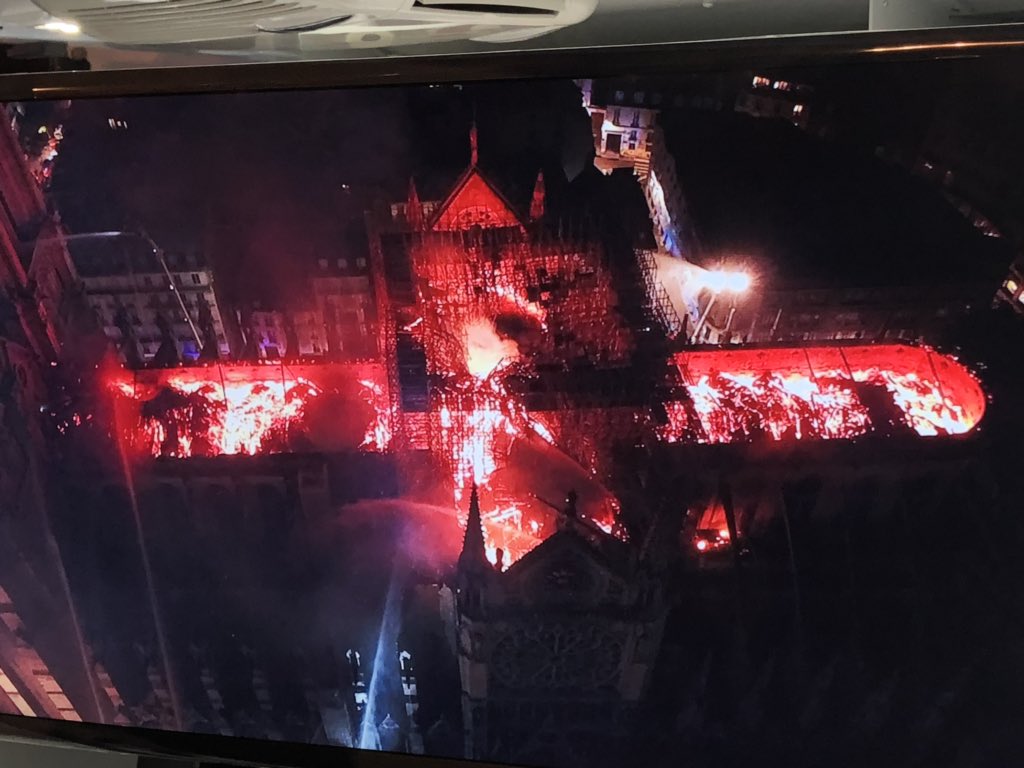

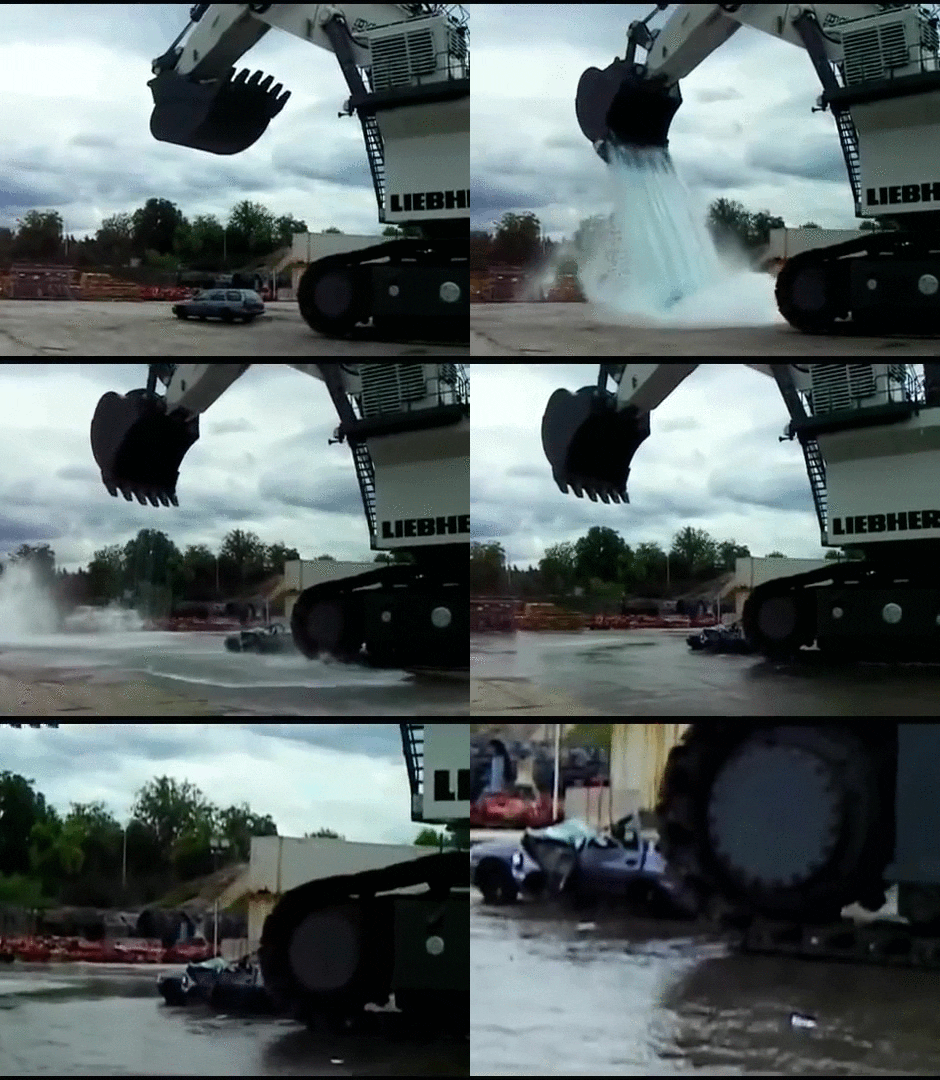


The restoration works that were under place are a result in part of our recommended actions.
The spire was incredible. It was one oak trunk, connected with a "Scarf Joint", or "Jupitre" in French (Bolt-of-lightning joint)
There were the names of the last guys to inspect it in the 1930s, engraved at the top. There was a french ww2 bullet embedded in the spire, presumably shot at a germany sniper who was in the spire...
Everything in the roof was antique wood. Anyone that went into the roof was paranoid of fire.
It's a very, very sad day.
As a celebration, I'm throwing up some photos that we'd never published from our study.
https://imgur.com/gallery/9k9I8Y0