I'm not sure why everyone thinks Obama killed coal. Cratering natural gas prices are what killed coal. So short of artificially raising the price of nat gas, coal is not coming back regardless of who is in charge.
It is a perception issue; apparently coal miners are swayed to believe a people decided to close coal mines.
For some people, it is easier to perceive that a bureaucrat is against your industry, as opposed to find out that the economic value created is exceptionally low.
When a person loses a job, it will be heartbreaking for the person to realise the job performed earlier has low economical value.
Telling someone "We do not need your services anymore" is harder than telling "Well, all those bureaucrats that live elsewhere decided it...".
I do think that economic value of coal is low and it is economically swapped out for other sources.
I think this cause effect is well understood and people who are not impacted can be clinical about it but when your livelihood depends on not understanding something you won't.
What happens to all these people, their families and lives put in disarray. This is what the economic and political system of a society is supposed to address - the well being of all citizens. And we can clearly see this is where globalization and the current economic dispensation falls apart spectacularly.
Wishing it away or washing your hands off is a kind of sociopathy. Are these people to be left alone to form an underbelly of society susceptible to any demagogue willing to exploit their disenchantment for their own ends. This self serving plan of action directly leads to social unrest, breakdown and worse.
This presumes a simplistic model of the market that completely ignores the combination of regulations, tariffs and subsidies.
And, FWIW, Obama did favor natural gas.
Corporate oligarchs have always tried to make the results of their deliberate decisions and the candidates they throw money at sound like the inevitable march of progress. But it isn't. And this election was a repudiation of that.
Wasn't natural gas a byproduct of the shale oil/hydro fracking boom? It seems that perhaps (while oil prices were high) these coal miners should've moved to North Dakota and Texas. Is this not the equivalent of a jQuery developer complaining about lack of jobs when they could maybe learn React or Angular?
> It seems that perhaps (while oil prices were high) these coal miners should've moved to North Dakota and Texas.
Easier said than done when one's entire social structure is rooted in one place, and has been since before one was born.
We forget how lucky we are that we can do our work from anywhere in the world; those of us who've moved around also tend, I think, to forget the real value of staying where one grew up.
What is the value? Whenever I go back home I of course am happy to see old friends and family. But I'm also reminded of all the reasons I'm glad I left, from poorer economic opportunities to poor political decisions manifesting themselves in everyday life.
In the spirit of taking surprising statements at face value, here are some examples.
- Having a kid? Now your whole extended family is available to give you help and advice, to babysit, to be there for you when you need them.
- Need a job? It's a lot easier to find one when you have a personal network in a place already.
- Something terrible happen in your life? You now have a built in set of folks to help you through it.
There's incredible value in having a large local support group. Yes, it's possible to compensate for the lack of it with friends, and those of us who have moved far from home tend to do that, but that's a pretty straightforward second best compared to being with family, people you've grown up with, etc.
Having to move constantly is one of the core grievances people have against modernity and globalism. Some people care about having friends, roots, history, community.
Aren't Americans moving less now-a-days: How to Get Americans Moving Again http://nyti.ms/257a62z? What does having friends and community have with staying put or moving? This sounds cold and calculating, but aren't friends and community fungible? Of course not the individuals themselves, but when we move we find new communities and new friends.
Equating a 45 year old man with minimal education, a mortgage, and generations of family history in an industry with a 20-something software developer with none of those things is... not reasonable.
Oh so after all that time accusing my generation of being lazy and unmotivated, they would rather stay unemployed and vote for a racists than change it. got it.
Just as entropy increases over time, adaptability to change decreases significantly over a person's lifetime. Assuming you are a millennial (based on your claim of your generation being accused), you got an education which prepared you to use technology and learn things on the internet - critical skills for this idea of a "modern employee". Besides, the coal miners in Appalachia aren't exactly known for sitting on their ass.
My father is in the same position as this demographic you mention. Working at large firms, facing regular layoffs due to offshoring and outsourcing, and yet moves around the U.S. when the opportunities are elsewhere. And he has a mortgage, and he's at least 55 years old IIRC.
Right. Because only 20 year old software developers relocate for work.
Anyone is capable of moving. It's hard and it's disruptive but it's possible. And increasingly it's going to be a necessity if you want to have long term prosperity.
It's not like Obama did nothing that effected coal. The industry lost over 83k coal mining jobs during the last 8 years. Hillary lost Pennsylvania, a big coal mining state, by 68,236 votes.
Obama did some things, but the main driver was the market. In politics it makes sense to take credit/blame depending on side. Trump can remove whatever Obama did and the jobs are not coming back for market reasons.
It's the same thing with factory jobs. The US produces more than it ever has (at least the last time I checked), but many of those jobs were automated away.
Same thing for gas. Obama did nothing to lower gas prices. But imagine if for whatever reason (say a hurricane came through and knocked out US refining capacity two months before the election), he would've got the blame for high gas prices. And not just Obama, the same situation kind of happened to Bush when Katrina knocked oil infrastructure offline.
I am of the opinion that the reasons the industry lost jobs, are primarily:
1. Price of natural gas is very competitive.
2. Automation. Mechanisation inside coal mines becomes more effective.
3. As old coal plants are retired, their replacements require exceptionally high capital expenditures. While running an already built coal plant can be feasible, competition for building new plants is not economically competitive.
In the end, it is the free market that took those jobs. In the end, the market always wins.
Doesn't really matter 83k unemployed people aren't going to care about the nuances of which factors contributed how much.
If the industry was already on it's way down the smart thing to do would have been to let it run it course instead of pushing regulations that wouldn't matter any ways and swung the state against you. Similarly if the factors killing coal really are not driven by government regulation than installing a pro-coal guy at the EPA shouldn't have any effect.
Coal was regulated before concerns of climate change became mainstream because it kills people. The pollutants it releases poison people not just in the state where the plant is located, but in neighboring states.
None of the costs of medical treatment or loss of life were borne by the coal industry itself prior to regulation.
um... Pennsylvania hasn't been reliant on coal since the 60's. it's all natural gas now. go visit Pittsburgh and compare it to pictures from the 50's and 60's.
The EPA's Clean Power Plan rule--a major priority of the Obama administration--has the implicit goal of closing hundreds of coal power plants. Although the EPA has not said so out loud, plenty of other people have.
It is currently stayed by court order; a Trump administration could decline to defend it, and thereby permit it to die in court.
Low natural gas prices are in part because the Obama administration has strongly resisted any significant restriction or regulation of fracking. They have resisted it because they want gas prices to fall and displace coal.
When it comes to energy development, it's hard to think separately about technology and policy; they are both factors in every change.
Lower gas prices certainly did not help, but if not for regulations introduced during the Obama administration, many coal plants would still be running. I worked, as an engineer, for a company that made equipment pretty much just for coal fired power plants from 2002-2014. Starting with the ammendments to the Clean Air Act in 2009, then the CSAPR, then MATS, we watched utility after utility make the decision to close plants rather than install the required emissions control equipment. So maybe if natural gas was more expensive they would have chosen to install the equipment, but if not for those regulations they would have just kept running.
> I'm not sure why everyone thinks Obama killed coal. Cratering natural gas prices are what killed coal. So short of artificially raising the price of nat gas, coal is not coming back regardless of who is in charge.
What the Coal industry wants is even more federal handouts. We already give them a ton of money to keep going on the grouds that it's a transition economy and a bridge for the US economy. But the Coal Industry is really damn greedy as a whole.
Even with high profile failures like Solyndra, in general green energy runs at a fraction of the cost. This of course hurts workers, because the labor involved is less well compensated as part of that cost reduction. However, as far as I can tell we're already turning the corner to where (for _generation_, ignoring environmental costs), solar and wind already outperform coal on a cost basis.
People who want to preserve bulk coal generation do so for ideological reasons. From a more "green" perspective, there are more important things we should be doing with our coal and natural gas then burning them to heat water.
Fund the build out of solar production without worrying too much about profits. Not at a loss, just choose to fund factories that will build solar panels as an investment in the future rather than from a portfolio of competitive investments as an attempt to maximize profit.
Please don't kill information simply b/c you disagree with it; otherwise there can no dialogue and ycombinator becomes little more than a billboard for the current dominant political whim.
Is news.ycombinator.com a "real news source"? Should it be renamed to "notnews.ycombinator.com" or such?
Who decides what is and isn't a "real news source"?
Perhaps the judgement:
"breitbart.com is not a real news source."
is an example why so many people were astonished at the election results. After all, if you only talk to people who agree with you then you'll certainly be unaware of those who don't. And when there's a vote, you'll really be surprised!
I've seen this "is not a real news source" on both sides. From the right it's often cast as MSM or liberal media bias.
This attitude is destructive as it's making it so difficult for us to come to any agreement on what we accept as a trustworthy third-party. Where do we start to give people some benefit of the doubt? As it is, even "trust but verify" can appear impossible. I'm not advocating some "can't we all be friends" platitude. As a practical matter, how do we move forward from here?
Edit: minor wording changes to remove generalization and grammar improvement
While we can ask these interesting theoretical questions, we don't want to read all news from all sources. A little of it is real, serious, quality journalism; a bunch is middling; another large bunch is lies and propaganda; another bunch is bad for many other reasons.
There's no way to prove objectively which sources are better but we still have to make judgments. The judgment about Breitbart is not a difficult one.
Slate.com does not describe themselves as a news source, so apparently not. I've certainly never thought of them as informative.
I can't personally comment on Breitbart's content, but apparently a number of their employees quit earlier this year, believing that the site has lost its journalistic integrity since the death of Andrew Breitbart.
Your post got me searching: I found a Washington Post article with a nice analysis and a left-right scale of common news sources. Both slate and breitbart are outliers:
Some of those surprise me. I would have expected to see sources like NYT and NPR as more popular with the right than sources like MSNBC and Huffington Post.
edit: I suppose there might be a selection effect. The large networks are watched by everyone, and the smaller ones are sought out.
I can see you had another larger discussion around this, but I will also add one other thing.
This website has a higher bias towards both people interested in running a business (and the economic climate around it) and interested in disruptive businesses. We see many articles about Tesla, alterantive energy, energy research, and updates to gas and coal based technology.
As such, the article linked really won't fall on receptive ears. We've got a lot of other sources pointing out how very subsidized the coal industry is and we're all well aware that every time an industry risks losing subsidy it immediately performs a football flop to try and stop that, as it's really quite nice to have the taxpayer help bolster your bottom line.
In general, most Americans polled believe that alternative energy is in fact a good thing to pursue and we have evidence of other first world economies making it work and turning a profit while doing so. When we then put slick and popular corporate branding on alternative energy (Tesla's latest offering, but we could name others if you please) then it gets even more popular.
The denial of coal-based power as a harmful and inefficient industrial revolution technology is a minority opinion in the US, but it gets amplified by groups either losing employment or groups hoping to leverage the fact that people are losing employment.
That's why I think you got downvoted. I am ratelimited on this site, so I couldn't spend one of my few daily posts to respond to you yesterday. I apologize for the delay. But very few people here would go, "Oh, I see!" at that article, as it conflicts a lot of other diverse and less partisan sources that pass over this website daily.
The amount of political heat that the Obama administration took for, the amount of effort that they poured into, their new coal regulations makes me skeptical of your claim.
In fairness, quite often we see examples of "political heat" being driven by wilful ignorance and disingenuous outrage. In order to "score points" with the people who are watching them yell at their opponent. A politician might pretend their opponent has a position on something (A) and get very angry about that publicly, while knowing the whole while that actually the truth is (B) or sometimes they might even know that (A) was actually the only viable choice the whole time.
The coal alignment is a bigger deal than climate change. We are SOL on climate change anyway (barring a scientific miracle)--there is no point worrying about whether one administration will or will not engage in token gestures.
But coal is bad. The coal industry costs about half a trillion in externalized damage to health and the environment annually in the US alone: http://m.huffpost.com/us/entry/831755.
I understand that this is wrong, and I know it's part of the messaging campaign of climate change deniers (which doesn't make it wrong, but does raise questions about it). First they said it isn't happening, then it isn't caused by humans, then it costs too much to fix, then there is nothing we can do about it. It's just one fallback position after another.
Climate change is a problem of degree; it's not binary. It can be better or worse, depending on what actions we take. The global temperature can rise 2 deg or 2.5 deg or more or less. The sea levels can rise X feet or X+1 feet or more or less. Droughts and can be more or less long and severe. These are very significant differences.
The government could eliminate poverty if everyone was willing to make significant sacrifices to do so. But it won't happen because the necessary changes would be politically untenable. Climate change is the same. No President is going to make the kind of significant investments necessary to have a meaningful impact on climate change. The Paris Accord is a merely symbolic bit of goal setting. It does not provide an infrastructure for how to achieve the goal, or commit any real resources to doing so.
In terms of national priorities, even among Democrats, climate change takes a back seat to (1) jobs; (2) pensions; (3) education; and (4) healthcare. At the same time, it'll require a bigger change to the economy than any of those things.
I guess we need some research to back up how much it would cost. My understanding is that experts in the field widely believe we can afford to make a significant impact, and that the costs of climate change are far greater than the costs of preventing it.
I think the grandparent's point is that it doesn't matter whether it's technically possible for us to prevent climate change, it's politically impossible even with a Democrat as president. Which I hope is not true, but with Trump in office it seems all the more probable.
There is a big gap between what we can afford and what we are willing to commit. We could probably have a modest impact with a couple of hundred billion a year in investment (equivalent to the home mortgage interest deduction). We could afford it. But I think it's unthinkable we'll get even a few tens of billions a year for climate change. At that point, there are much higher value ways to spend our limited environmental dollars.
But the costs happen at different times. We are already paying some of the cost of climate change, but what we're currently paying is far less than the cost of prevention. It is a short-term vs. long-term problem, and unfortunately short-term thinking is ascendant.
What you are saying is the cost of keeping human life on this planet is too high?
And that even simple steps like not subsidizing coal, when natural gas is cheaper and there for responsible for the decrease in coal mining, it too expensive of a step?
There is no sense in rehashing the same old 'climate change 101' arguments and data here. If you were truly interested in, and knowledgeable on, the subject, you would know exactly what evidence there is and we would be discussing the merits of the evidence. As it is, you cannot be distinguished from the average parrot or troll.
Anyone who does not at least agree that there is evidence that is worrying and worth discussing does not know enough about the subject to be having opinions and posing suggestive questions about it. If you don't at least start with: hey, I understand you are not a total idiot and I understand how it may seem like there is strong anthropogenic climate change going on, but here is why I think that that is not the case, then discussion is pointless.
"For instance, a “runaway greenhouse effect”—analogous to Venus-- appears to have virtually no chance of being induced by anthropogenic activities" (p. 90)
The general scientific consensus is that any localized benefits are far outweighed by global detriments, such as rising sea levels, mass crop failure, animal extinction, etc.
Migration is undesirable because people don't like migration.
Have you been paying attention at all to European or American politics? Even the very small amount of migration being driven by the Syrian civil war has caused massive amounts of discontent and unrest in the richest nations on Earth. Now imagine whole regions full of people wanting to move because rainfall patterns change, or sea level rise displaces them.
Social unrest is the biggest risk that climate change creates. People like things the way they are, and get very upset when they think things are going to change.
> What evidence is there that there can't be more crop production at more northern, theoretically then warmer, altitudes?
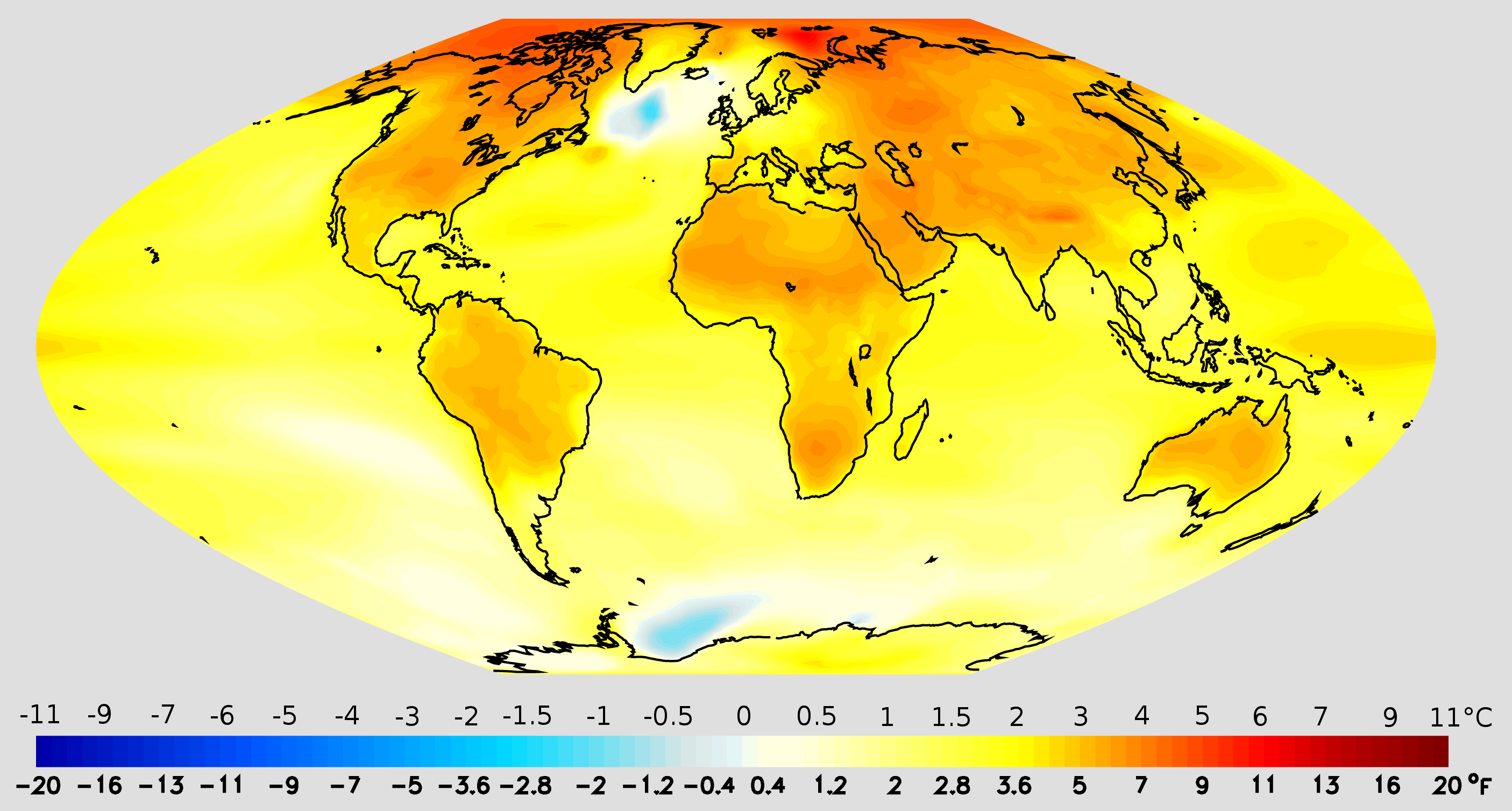
A common misunderstanding of global warming is the belief that all points on Earth will see their temperature rise by the same amount.
The average temperature will rise, but many regions of Earth will actually see their temperature go down. Unfortunately, those regions are already not particularly warm, like Antarctica.
Northern regions of Earth have their temperature heavily tied to the amount of sunlight they receive. While they will indeed get warmer compared to now, they will still be cold, and there is nothing that can be done about the six months of night time. Going to Siberia is not the answer, no matter how much you like Mr Putin.
As for rising sea levels: for obvious reasons, settlements near the sea are common. Rebuilding all those cities will be a tremendous cost. Human migration will also be politically straining, which may cause a part of the US to secede. Immigration tends to irritate people for some reason. A famous US president was recently elected thanks to that resentment.
As for wildlife, rapid changes in temperature are correlated with mass extinction according to the fossil record. In fact, we are already currently undergoing a mass extinction, which is expected to go on: https://en.wikipedia.org/wiki/Holocene_extinction#Global_war....
So wait, let me get this straight. You're asking if any evidence exists refuting your questions, excepting the entirety of the output of the community dedicated to studying the problem?
I am looking for evidence so that humans can draw wise conclusions.
I point out that a group of people who are employed primarily by a single source are going to generate opinions that are favorable to that source.
If they don't, they are handicapping their ability to put food on the table. Work can still be found without catering to the primary source, but it's not as financially beneficial to do so.
Most scientific studies are not funded to give those that paid for it false information to make them feel good. It is to get actual scientific data. You can lie to yourself in a bubble for much cheaper than paying teams of scientists to make up a fake reality for your own ego.
True, but there is a significant risk of false information if the sponsor then can financially gain. For example, if the U.S. government felt that belief in climate change would be economically advantageous, they could pressure local researchers to find in favor of climate change. It seems unlikely that the Chinese government would have a mechanism to issue U.S. grants, however.
This happens all the time in marketing. Although, to be fair, those studies are often preceded by a number of more accurate private studies, and only the publicized one is suspect.
By that logic, consensus should be the only thing you would trust. Paying people for new findings disincentivizes consensus, unless perhaps those people have several avenues to explore and are willing to close off some of the less promising ones - again in favor of consensus being trustworthy.
> Thank you for telling us the consensus of people who literally depend on government grants for their paychecks.
It's a loose, circumstantial, conspiratorial aspersion, which has nothing to do with the facts of climate change. Maybe they could make more by providing credibility to the oil and gas industry.
Again, look up IPCC reports. We're not a forum of climate scientists. I believe gravity also exists; I haven't read the papers myself and don't have time to find them.
If there was any incentive, it would be to deny the problem - after all, discovering global warming leads to the prospect of having to do expensive and unpopular things about it.
If a climatologist "denies" that climate change is a problem, there will be less government spending on researching that problem. Furthermore, he won't get a job from the purse that thinks it's a problem - generating data that shows that it isn't a problem would take away the purse's job too.
You seem to be conflating the benefits of society with the benefits of a living, breathing academic who has kids to feed and bills to pay. There is no conscious "government" - there are only conscious individual actors.
What do you think 'researching that problem' actually involves? Do you think scientists are just paid to sit there and type out bullshit reports?
No, they have to produce real, scientific studies which are peer reviewed by other scientists all over the world. If there's a bullshit study, that's usually quickly discredited and the scientist's reputation damaged. (See: Andrew Wakefield)
You're also living in a delusional world where scientists are not in high demand and can't find a much higher paying job at a private corporation, if they wanted to.
Doing science for a government contract is a step down for most scientists.
These are highly trained, skilled, educated, and intelligent people you're talking about.
While scientists will express their opinions of the data and findings of a study, the scientific method is not an op-ed piece. The great thing about science is that a study comes with a thesis, a description of assumptions, a discussion of the experimental design, data, analysis of data, and a discussion of the conclusions. Other scientists can check the work, both via peer review at the publishing stage, and by judging and reproducing the work after publication. If they believe there's a problem with the experimental design, they can describe the problem. If they believe there's something wrong with the data, or the analysis of the data, they can explain what's wrong. Or run new experiments that demonstrate what's wrong, and publish those studies in turn. This process does create a bias of sorts, but it's the right kind: a bias toward wanting to be shown to be thorough, professional, neutral, and logical in the drawing of conclusions -- and have one's work hold up to attempts at refutation by other scientists, including those with a strong desire to prove the conclusion is wrong.
If a scientist is biased by having an employer with an agenda, and that bias manifests in a study, then that study can be exposed as faulty by other scientists. That's how science works. So unless you believe a global cabal of thousands of scientists and their many different employers are all somehow coordinated in their unwillingness to judge each other's studies as flawed, you must give credence to the overwhelming support among scientists for the idea of anthropogenic climate change.
Likewise, if you believe the multitude of studies is flawed, then go ahead and show how. Pick any couple of dozen and have at it. There are plenty of employers with a strong and admitted bias against global warming (e.g. the oil and gas industry), and they employ scientists. If those scientists produce irrefutable studies disproving anthropogenic climate change, then that would become the accepted science, and those scientists would be viewed as luminaries in the field.
As for the cabal: unfortunately, many believe in exactly that -- including, nominally, President-elect Trump, who has stated climate change is a "hoax". I doubt he believes it's literally a hoax, but I don't doubt he understands that acceptance of the science threatens the bank accounts of those making money from the implicated processes. The same people driving the regulatory capture process, plowing money into congressional elections, etc. The real cabal is the force against the science.
There are so few studies leaning in the other direction that it should be easy to choose an "unfairly" discredited one and expose its field-wide refutations as illogical and biased.
Rapidly shifting environmental conditions usually lead to less, not more, animal diversity, because of invasive species and ecosystem collapse. Greater temperatures are associated with greater biodiversity overall, but this would be of foreign species.
Beneficial effects for humanity? Yes, the rate of change we're heading for is way too high for anything humanity depends on to handle it, including our infrastructure.
> The coal alignment is a bigger deal than climate change. We are SOL on climate change anyway
We're SOL on stopping climate change, but what we're doing now will define how bad it gets, and the later we start the worse it will be and the harder the mitigation, as it has been since the 70s.
It's not a question of "SOL" or "token gestures" it's a question of how fast and how far it will go, and how much time we will have to handle such concerns as mass population displacements.
Not doing anything is a giant middle fingers to those who follow us, or for those of us who won't be dead within a generation (aka pretty much anyone other than the boomers), a middle finger to future us.
> The coal alignment is a bigger deal than climate change. We are SOL on climate change anyway (barring a scientific miracle)--there is no point worrying about whether one administration will or will not engage in token gestures.
I really want to push back on this. This is in fact an anti-climate-change talking point used to say, "Look it just doesn't matter what we do." While it's true that the destabilizations currently taking place are absolutely a part of our lifetime, in the 200 year timeline the scientific consensus is that if we cut our emissions substantially within this century we will in fact avoid locking our descendents into a full climate flip that is NOT avoidable.
We need to play an aggressive game before 2050, and we can save the ice caps. That is not a token gesture. That's the line that we can draw to not destroy every coastal city in the world.
This is absolutely not true. There is a huge difference between a 3 degree world and a 4 degree world. Yes, 2 degrees seems out of reach already, but the Paris agreement is considered a genuine breakthrough amongst many many people who fight for preventing climate change.
It's disingenuous to claim that there are only token gestures. Chinas commitment is real, Europes commitment is real, India is more questionable, but the Obama administrations actions through the EPA were also real.
Trumps win will cost us. It means many many more gigatonnes of CO2 in the air, that means a hotter planet, and that means more dead poor people. To the best of sciences ability to tell, THAT is reality.
I hate to, but I agree with you on all points, including the hopelessness of human nature suddenly pulling a 180 and changing our impact on climate change. The best thing I can offer is that you can't help people who act against their own best interests, and if this election proves anything, it's that compassion and concern is wasted on them.
I believe that it's fear that drove people to Trump. With quotes like "they want to turn off the lights all over the world.” It isn't surprising that many on the right vote against their interests because they fear far worse from the other side.
I'm from KY. According to NPR yesterday, McConnell himself has said that the easing of regulations and executive coal alignment is unlikely to create many coal jobs. Not sure if that was political posturing or not.
The "clean coal" that Trump has pushed for costs way too much money to create, transport, and responsibly store the solid carbon. Coal already has a price advantage when compared to natural gas.
However, I agree with you that the voters in Appalachia generally vote against their own interests. Usually for social reasons.
An absolutely awful cement plant in my town is in the final phase of switching from coal to nat-gas, and it is wonderful. On cold windless days my little town would be covered in a miasma of coal smoke. Regardless of fracking's other issues, it is a massive win against coal.
Are you aware of the implications of being SOL on climate change? A 6 degree rise in temperatures and we probably kill all phytoplanton - the source, along with kelp and algal planton of half our oxygen (ie. we all die).
"And ironically, the voters in Appalachia being courted are bearing the brunt of it"
By "bearing the brunt" you mean "having jobs"? Have you asked them whether they would rather have jobs or not?
Also, they know perfectly well that closing their coal mines doesn't mean that coal doesn't get mined and burned. It just gets mined and burned in other countries where environmental regulations are non-existent.
The simplistic "coal is bad" thesis has a) put a huge number of Americans out of work and b) made the global environment worse.
I am confused by this argument as it seems to be orthogonal to the point the GP was making, namely that coal does have a large impact on the global environment. Stating that China uses a lot of coal isn't exactly helping your case, considering that coal causes more air pollution deaths in China than any other source[1].
China also has huge investments in solar and some of the worst pollution anywhere. They've hit peak coal and are apparently starting in the other direction [1].
According to Wikipedia, eletriciy generation from coal is at 73%. And it is questionable if they are at peak coal. If their electricity generation doubles and they reduce the percentage to 60%, they're going to be burning a lot of coal.
I'm not an expert in this issue or doing any analysis, and neither are you. I shared a link I thought was interesting. I'm sure there is better analysis out there if someone cares to look, but I'm not going to do that right now.
China is indeed 'greening' its economy to move to what it calls a Ecological Civilisation. This is a big development, and it goes lumpy but its government bodies coordination is improving. An example of which is the development of a Green Financial Systems (see this PBoC's link: http://www.pbc.gov.cn/english/130721/3131759/index.html)
How would this have changed if we were mining our own coal? If they're using an amount that far outstrips everyone else combined, the environmental damage would be largely the same with or without US coal.
1) A substantial portion of the Chinese coal is burned to produce steel and other products that are exported to the United States.
2) Burning that coal here (where there are environmental regulations) would produce less damage that burning it in China (where there are effectively none).
I'm not sure why this is confusing.
I'm also not sure why people are modding down factual posts. That type of behavior is exactly what's given you President Trump.
China exports 800 million tons of steel and the US only imports 1.9% of that. Burning coal here will have very little impact on China steel operations.
We don't have to choose. Today's technology means that burning coal is clean. There are carbon dioxide emissions, but in terms of pollutants that make the air dirty, there is very little (carbon dioxide emission have climate impacts, but are not toxic or dirty).
There is NOT actually a clean coal plant that is operational in the US. I would not talk about this as how our coal plants currently operate. Attempts at putting a clean coal plant online have faced complications. Perhaps this why Clean Coal is called a myth?
Maybe it's my white straight male privilege talking, but this scares me 100x more than his racism and sexual predation, and I wish it had gotten more coverage in the debates and election.
If this happens, history will remember Trump as the Neville Chamberlain of the climate catastrophe. He won't just be screwing America's plans, this is one of those areas where "leader of the free world" isnt hyperbole - America's decisions will have massive domino-effects on related economies.
While a lot of people were never able to move beyond Trump as a laughable buffoon and despicable human being, a lot of the harm is going to come from him advancing the mainstream, everyday Republican agenda.
Repealing Obamacare, dismantling the EPA and CFPB, appointing judges to the Federal and Supreme Courts who are friendly to rolling back gay and reproductive rights, privatizing Medicare -- these are all mainstream positions.
While I agree that most of the issues you mentioned are definitely things to be concerned about, would a Supreme Court with Trump nominee's really roll back gay and reproductive rights? Who would have standing to bring a case before the supreme court that could roll back gay rights? Also, the supreme court has been more conservative for a while and nothing has really happened with reproductive rights. I don't see Roe v Wade being overturned anytime in the near future.
The fear stems from the replacement after Scalia -- if Ginsberg is replaced and Kennedy is no longer the median vote, the Court will take a sharp turn on a lot of social issues.
I agree that the Court will take a sharp turn on social issues. The question still that remains will be what cases could be brought before the Court that would actually give them the chance the overturn the previous rulings?
Typically the consequences of a Supreme Court ruling is that lower Courts resolve the cases in the direction of the Supreme Court's ruling and if you are foolish enough to appeal up to the Supreme Court, the Supreme Court simply declines to hear it.
There is nothing preventing the Supreme Court from deciding to hear an appeal (eg, of a Clerk who doesn't want to issue marriage licenses) and then issuing an sweeping decision completely to the opposite of the new status quo.
That is the risk of relying on the Supreme Court to recognize unenumerated rights; the recognition will only last as long as the Court remains favorable to the right.
Its not really privilege, you probably just have no immediate people in your life you care a lot about who are fearing for their freedom in the next four years.
That isn't a negative personality trait either, we cannot as a people expect anyone to have empathy for a group they have no personal ties to, especially in contrast to real threats against themselves.
Both are problems, it is just those who are in danger of suffering from Trump's racism / xenophobia / sexism and their immediate peers see that as the more immediate threat, because he can undo decades of civil rights and equality in the first days of his presidency.
He can set in motion programs to destroy the climate more in the first days of his tenure, but it will take years to suffer the consequences of them, even if they are much more permanent than immediate regressions in liberty. For individuals, permanence does not matter - your time is limited, and everything Trump takes away represents days or years you will never get back of oppression.
>history will remember Trump as the Neville Chamberlain of the climate catastrophe
I'm not sure this is true, but not because the sentiment is wrong: It implies that at some point, climate change will be as universally recognized for its negative effects as Hitler is, and that people will go back to examine how it happened. I don't have a lot of faith in the U.S. to get to either of those points; if I've learned anything from this election, it's that we have an astounding capacity to look at all the facts and just say, "ah, no thanks."
It will take longer, but we'll get there eventually. Imagine 50 years from now the Global South becoming inhospitable and hundreds of millions of refugees fleeing flooding, heat waves, and drought.
They'll look back on us and ask "what did they do when they had the best opportunity to stop this?"
If the US withdraws from the Paris accord, other countries like China will follow, as they will not want to be the ones that try to reduce emissions at the price of being less competitive (in the short run) when one of the largest economies in the world won't do it as well. And if the climate science projections are accurate, we will miss the last window of opportunity to reduce the heating and avoid the whole climate system tipping over. And with the current power that the Republicans have and Trump's attitude towards science it's highly unlikely that someone can stop them from going through with this.
The US is not the only country that matters anymore, I don't think China will pull out no matter what US does, they are smart enough to be making money from building renewable tech for the world and onselling it. It's really in Chinese interest to encourage the shift.
Yeah I think China will see it as an opportunity to show leadership and it will play into their attempt to shift the balance of power away from the USA.
Since that article in July they've cancelled 60 coal plants, including many that had already started construction. The capacity they've cancelled is equal to the total coal capacity of the UK and Spain combined.
They've still got a long way to go, but the signs that they are turning the ship are clear.
China already licensed every nuclear fission tech from Canada, France and Russia and lately the US as well. They have 35 operational reactors and 35 under construction.
> If the US withdraws from the Paris accord, other countries like China will follow, as they will not want to be the ones that try to reduce emissions at the price of being less competitive (in the short run) when one of the largest economies in the world won't do it as well.
I predict the opposite. China knows that climate change is real, and will seek to take a leadership position in fighting it as means of building long-term international prestige.
The U.S. built its reputation today by defending freedom during WWII and then by handing nations back to their citizens after it won.
Fascism, authoritarianism, communism--those were the greatest threats to human society in the 20th century, and the U.S. led the fight that beat them. But the generation who experienced all that personally will soon be dead.
What is the greatest threat to society now? In the long term, it has to be climate change. It's like fuel for every other social unrest you can think of.
50 years from now, international reputation might hinge on who did the most to limit the effects of climate change. If China sticks to it, and the U.S. fails, the U.S. could find itself pretty damn unpopular.
In addition to (eventual) climate change China has been making itself increasingly unlivable due to conventional pollution (in all forms)...but the leadership there has always seen this as a temporary cost that must be borne to catch up with the west.
Internal pressure will already force China to do something sooner rather than later; handling the problem is a good way to consolidate power internally and thus tackled enthusiastically.
Throw in the USA voluntarily ceding its position of world leadership and it's an opportunity to go from barely-tolerated semi-pariah to increasingly-respectable world leader.
In particular expect China to "save" Africa once the worst begins. But, not immediately; groundwork is already being laid, but right now they can afford to be patient.
Republicans and Trump are a red herring. The Paris Accord simply sets a goal. It does not tell how how to get there or commit resources to achieving that goal. Actually keeping climate warming to 2C is going to cost tens of trillions of dollars: https://www.technologyreview.com/s/527196/how-much-will-it-c.... No Democrat in the foreseeable future would have made that investment either. Participating in the Paris treaty is simply an empty feel good gesture.
> very strongly influenced by the “question authority” ethos of 1960s and ’70s counterculture
Sounds like he's really a shining example of those hippie ideals. Strike back at "the man" and his regulations on behalf of those poor oppressed oil, gas and, coal corporations.
Pardon my language here, since I think of hacker news as a place for intelligent and respectful discussion, but, fuck
The way they sell this is by appealing directly to the people losing what amounted to very high paying but relatively unskilled jobs. Coal mining, working on an oil platform, working in a refinery, etc.
That's why people believe this rhetoric even though it seems absurd on its face. They see the faces of people who have lost jobs that is largely obscured from other parts of America because it's of the geographic distribution of signed paychecks to the American middle and lower class.
To defeat that rhetoric over the next 2 years, liberals and socialists need to find a story for how they're going to solve that problem and preserve a livelihood for folks suffering.
And to be honest, that's a wee bit frustrating because as a whole millennials are already tackling these economic challenges without the safety net of a massive lobby, while being told they're lazy and valueless, and often with crippling student debt for a poorly conducted degree. But a vote is a vote, and not every citizen can or will vote against direct self-interest on moral grounds.
Frankly, we had the candidate to address this. Taxpayer-funded education would have allowed these otherwise useless people to gain useful skills.
I fear from now until the world becomes uninhabitable through climate change that these useless people will remain useless and keep voting in fascists and ultranationalists that will quite literally destroy the planet out of spite for the "elite" who were lucky and skilled enough to be useful to society.
Quite frankly, neither party has truly addressed public reeducation in a way that is economically viable for adults losing their jobs. We aren't even providing it to young people who ostensibly need it.
Until we have a way to offer adult education in a way that is financially viable to individuals AND preserves their dignity and aligns with American distaste for pure subsidy, this issue will be nothing but a token talking point for both parties.
This is the stuff we should all be protesting. This is the type of appointment that can be changed in no time if enough people make their thoughts known. Come on all let the powers that be know that you don't like the choice.
Yes, I agree that this type of appointment deserves attention, but Republicans are completely in charge, and Democrats are not know for putting up a fight.
We're really screwed, because this is just the tip of the iceberg.
Imagine what happened during the Bush regime, then scale it up.
If you don't know what happened during that last Republican administration, here's a summary:
1. Statements by govt scientists had to be vetted by political appointees. Expect that to continue, because it's the same anti-science group that surrounds Trump.
2. Corporations were given free rein to do anything. The word regulation was taken out of their vocabulary. Expect more of the same. They're already talking about undoing the Dodd-Frank Act, which was put in place after the 2008 financial crisis.
3. Not a single anti-trust case was brought against any company. And this in an environment where these corporations where going gang-busters. This new gang is going to be even more "business-friendly."
Yes, Republicans are in charge but that does not mean they can't hear us. This "government of the people, by the people, for the people, shall not perish", Abraham Lincoln's Gettysburg address, November 19, 1863.
I'm sure there are plenty of people who voted for Trump for reasons other than this. It might make a difference if somehow they (and others) express this as strongly as possible. As a citizen of the world I'd be more than thankful.
Now a pragmatist's pitch: the US has the potential to lead in the transition away from fossil-based fuels. Look, if the Arab countries are getting involved, that should tell you something. Don't do with energy what Kodak did with the digital age...
This is a presidential appointment and the senate needs to approve it. Let your senator know how you feel about it. Also, let president Elect Trump know about your feelings and he might even back down on the selection. If anything is important this is. What the US does in this area influences what the rest of the world does. Also we, as a nation, are a chief producer of green house gasses.
We are suppose to be the smart ones, the doers, the dreamers. Prove it! DO SOMETHING to change the world.
The head of the EPA is subject to Senate confirmation [1], so you could start with your senators. You could also contribute to organizations likely to lobby on climate change.
I think it's also worth looking at your own personal standing in society. E.g., many business owners are starting to recognize the economic costs of climate change, and they can talk to various business associations. People interested in national security also see climate change as a potential threat (due to disruption of large populations and increased competition for access to resources like water and arable land). I know some veterans have been speaking out on this. Climate change will have very broad effects, so many can speak out about what it means to them.
I am fairly sure we can protest this AND ALSO protest Pence's promises w.r.t., rolling back federal protections for trans people, or Trumps ideological alignment with a militarized police and the danger to people of color that brings, or the now-returned promise to deport people at an unprecedented rate.
If the democrats are guilty of "not listening to the issues" presented by the tea party republicans that won this vote, then collapsing the current protests down into single issues is equally unreceptive. Trump has to be president both for the people who put him in power and the majority that didn't.
This is the real power of POTUS that never gets properly addressed before the votes are cast. I took a moment to read Biden's Wikipedia page back in '08 and was struck how at odds his record was compared to Obama's promises. I still voted for them(the 1st time). Shortly afterward, Obama retained Gates & Geitner for his cabinet...same as it ever was. The Donald will continue to entertain and foment reactions, but biz will go on usual(perhaps worse, we'll see). We never really had much of a choice between the bankers' BFF and the used car salesman, they were selected before they were elected.
This is the kind of stuff that makes some people genuinely concerned and upset about Trump's presidency, leaving alone the ideological divide between the left and the right.
I don't think that climate change is something that you can believe in. You can acknowledge or deny its existence but certainly cannot believe in it.
The problem with the coal and fossil fuels is that we use a technology to produce energy that is literally 400,000 years old. We have the new technology ready (nuclear power) yet we stick to this old, polluting tech. This is insane.
> I don't think that climate change is something that you can believe in. You can acknowledge or deny its existence but certainly cannot believe in it.
Is there something more than semantics here that I'm missing? Not believing in climate change is functionally the same as denying it in this instance, correct?
I usually correct people when they tell me something like "but you believe in X, right?". Maybe it is just semantics, but for me it is significantly different:
- denying it: there is evidence, yet they do not accept it.
- do not believe in it: we cannot prove its existence factually and there are people who still think it exists and some who do not.
- skeptical: there is evidence, but not enough to convince me we should make policy changes such as taxing and regulation; rather we should allow the free market to develop solutions in the form of new technology.
Is this because you believe the free market will follow the most economically efficient path? What if the environmentally friendly options are always more expensive?
Without regulation or tax incentives, it's easy to ignore the externalities in your choices. As an example taken to the extreme: if there was no regulation against dumping your industrial waste in the river, the free market should use that option, as it's cheaper than properly disposing of the waste.
It's a complicated issue, to be sure. Speaking generally, you might be correct, though I think taxes and regulation should be the last resort. For carbon-free energy production, I think there are many free market possibilities on the horizon: safe nuclear fission, nuclear fusion, fuel cells, battery technology, wind power, solar power, or some combination of them.
But all that 'regulation' like carbon taxes do is internalize the cost of fossil fuels and adjust the different costs in the market. The 'free' market is changed like this all over the place - for example via import tariffs that change the market place to favor local production.
Regulation is really the first resort.
The last resort is things like out-right banning the use of fossil fuels or nationalizing the energy industry.
Solar is expanding nicely on its own. Nuclear is expanding, but too slowly. The reason it takes so long to build is because of bureaucratic regulation due to historical opposition.
Now, if we're serious about ending climate change, why not agree to setting a global target temperature?
Yes they are, because throughout most of history, variations were very low, as you can see there, because, you know: It's a graph!
If you notice, the graph is not distorted, it's linear. 1 Celsius degree changes our climate in a mix of predictable and unpredictable ways that you don't want for our planet.
Plus: there's the added problem that the changes can be exponential after a while, melted Ice melts other ice more easily, permafrost defreezing releases methane that is worse than CO2 to the atmosphere, Ice changing color, etc.
There are reactor designs that leave virtually no waste, and can actually consume existing nuclear waste stockpiles. Check out the LFTR [1], for one. Thiel is a big Thorium fan, not sure if he will whisper that in Trump's ear.
No thanks! Once we've stabilised the climate, which is more urgent, then we can deal with (legacy) waste problems. Besides, not an issue with technology under development like thorium and the many fusion projects which I hope we all support.
Turns out that if you pour water into a salt deposit, dissolve the salt and pump out the brine, the terrain above may collapse (salt columns were supporting it). Any remaining brine not pumped to the surface may travel who-knows-where underground to dissolve other salt deposits.
England went through decades of lawsuits and legislation wherein landowners cried for recompense of their collapsed lands from salt producers. The salt producers claimed it wasn't their mining that caused the collapses and the landowners usually lost.
Fast forward to oil/gas fracking in Texas, Oklahoma and other states:
most gas/oil deposits are under salt domes. Fracking injects water (and other chemicals) into the subterranean structures, the salt dissolves and the oil/gas is freed to rise. As in England, the brine that is not removed is free to travel miles underground, removing structure that has lain dormant for eons and collapsing the land above. But fracking also uses chemicals, not merely brine, and so the chance of pollution (esp. of water wells) is increased. The frackers say it does no harm. But funny sounds are coming from below and fracking chemicals are showing up in places (e.g., water wells) where they are not wanted:
Shankar Vedantam when on vacation to Alaska recently and realized how people think about climate change and decided to a podcast about why its hard to make people aware of it. [1]
Basically, its in the future, its complicated, its costly if I recall correctly and our brains will turn off those kinds of things so its a trifecta of the worst characteristics if you want people to pay attention.
IMHO, this theory explains that and many other mysteries of the beliefs of the right wing: A large segment of U.S. society now prioritizes ideology over fact. Climate change is fact, but fails their ideological test. Thus, they reject it.
This is shallow and is part of the reason Trump won.
They prioritize culture, heritage, tradition, community, and stability (economic and social) over academic knowledge, mobility, novelty, etc.
They are not dumb or more dishonest on average than anyone else, and the cognitive biases and blind spots they have are identical to yours. They are 99.99...% genetically identical to you.
What they have is a different goal function.
If you want to solve a monster global problem like climate change, part of it is finding solutions that can be viewed as positive from the perspective of the many operating goal functions in the world. The world is huge so this is hard. One sided answers that try to herd the rest through shame will fail, as they have for the right on other issues like abortion.
People who make money on the status pro control media specifically targeting people to change their opinions. Those opinions include hate for the 'elite', which is code for intellectuals, academics and environmental activists who are exactly the people warning of climate change. This is easier of course because of the social cultural divide between those peoples.
And before you say I'm calling people 'dumb' to be influenced by media that they are consuming; I think people at every level of intelligence are influenced by the media they are consistently consuming. That's why I don't like watching Fox news -- I started realizing that I will subtly adopt their way of thinking, even if I'm consciously critical of everything they're saying.
My comment didn't assert most of the things you attribute to it.
The existence of climate change is not an issue of priorities, but of facts.
> academic knowledge
It's just knowledge about reality; reality doesn't change depending on where the knowledge comes from. Academia happens to have far smarter people and far more resources for examining the world; it's a pretty good resource. Rejecting knowledge because it's from academia is exactly what I described, putting ideology (anti-intellectualism) over fact.
> stability (economic and social)
They voted overwhelmingly for massive change and some made calls for revolution if they don't get it. The policies they favor, including radical changes to government and social programs, would greatly reduce stability.
Because: we understand that there is a relation, but we're having a hard time actually quantifying it (the models predict a wide range of possible future temperatures, and they themselves are super complex and change often so we cannot fully even trust those ranges). Without a solid prediction model, it's very hard to justify financial decisions - let alone global, trillion dollar ones.
Because you want people to pay for something they don't see any benefit for. It's like trying to get a company to invest in better security, except harder because there is little in the way of the climate change equivalent of security breaches.
Defeat ignorance with cleverness. Create a solution that is far superior to what coal and oil have to offer. Make it so affordable that you cut the coal industry off at the knees without relying on politicians to get the job done.
This site is full of very smart people. Get this shit done!
The climate change cheat sheet embedded in that article was rather interesting. In addition to stating what we know, it also suggests some personal actions, actions which have been routinely ignored by the population for many years. A couple of quick examples: reduce flights and reduce eating beef.
Instead of having a paternalistic government claim to solve our problems, we can do so. This election might just be a sufficient catalyst to make things happen.
Also don't forget the power to not purchase from companies based on what they are doing and who they are working with.
It is easy to get outraged and for some it is even easy to take dangerous actions, but to deprive oneself of what we want in the hope that others will do the same, that, that is hard.
Yeah right, like a couple of private citizens not eating beef anymore is going to put a dent in climate change. We need governments to solve this, because they are the only entities big enough to actually affect this sort of large scale problem.
It's not an either/or. Private citizens can also take action. And at least for me personally, relatively small personal actions (like flying less and switching to LED bulbs) make me more supportive of government action precisely because the things I can do directly turn out to be insufficient to the problem.
Government can solve this like it solved abortion rights, gay marriage, education, oppression of people by dictators, slavery, prohibition, illegal drugs, ... Violence, the tool that is the government, cannot change the minds of the people. And for environmental issues, it is very easy to undermine it if many are determined to do so.
All of those government fueled solutions can sometimes make it better for people in the short-term, but they fail to convince in the long run. The South is still pissed off about the civil war 150 years later. If slavery had died off from persuasion instead of at the end of the gun, generations of blacks might have had a better time of it. Post-civil war could have also worked out if the government had not turned its back, but that is exactly the problem. Those who care generally get their way.
That is why one has to convince people of the way and then government can clean up the rest.
Convince 80% then government can handle the other 20%. What does not work is convincing 20% and pretending government can handle the other 80%.
Government has a role, but it truly is the will of the people first. Do your part, spread the word, make it the norm, and then government can handle the outliers.
With illegal drugs, many were against drugs back in the day, but the culture turned. The government reacted with its all-out war on drugs and yet it continues to fail while doing massive damage.
If hypothetically half of the US stopped eating beef today, that would make a huge positive impact on the US climate footprint. It wouldn't matter if the change were instigated by the government or by the people.
Exactly. The whole point of many government actions is to induce millions of private citizens to change their behavior. Continuing to contribute to carbon emissions by flying commercial or building energy-sucking data centers while claiming that it's a pending disaster is hypocrisy.
The big energy companies love this because it deflects attention away from them.
I stopped flying, sold my car, cut down on meat consumption and generally try and live a low impact life, all it's done is lower my standard of living compared to my friends and neighbours. I don't regret it but you soon realise asking individuals to change their behaviour isn't going to get you anywhere.
The only real solution I can see is to shift taxes to carbon as it comes out of the ground then let the market find alternatives.
A single individual will not and if you broadcast that your life is less good because of it, then you are actively working against your goal.
Instead, you should revel in a better life, such as having more energy from a fresher diet and more exercise, if that is true. If it is not true, then you have to do the harder (probably impossible) job of convincing them that they are dooming their descendants.
Sometimes, just being an example, one that is transparent enough to make it look doable, might make it possible.
Weirdly, even the big gas and oil companies are at the stage when they're calling for a carbon tax. They put out a joint statement over a year ago. It's just US coal that's holding back the consensus.
Man I hope so. ~30% of Indians are without power[1], and I hear they have a lot of coal naturally, so if they're not careful they could be a large growing source of problems in the future as they grid up. It's good to hear that both India and China seem to be taking climate change seriously.
What can citizens do about this? Trump hates women, so I'll donate to PP. Trump hates minorities, so I'll donate to the ACLU. Trump hates the actual physical earth - so what do I do about that?
Call your senator and tell them not to confirm but to fight against the nomination. Donate to NGOs supporting climate efforts. Tell your friends to do the same.
My energy utility allows me some choice in the generation source. You may have the option of voting with your dollar. You'll likely have a much larger impact if you convince your employer to switch to greener sources of energy.
The thing that puzzles me about this argument is any planet we find is likely to have a worse atmosphere than even a polluted Earth. If we're able to terraform Mars or whatever then we can likely also reverse the effects of global warming on Earth.
> At the rate we're messing up this planet, we'll need to find another planet real fast - relatively speaking, off course.
We can't even handle the planet we're already on, how in hell do you think we can terraform an entire separate planet? We're still only scratching the surface of understanding ecosystems today, the big thing these days is starting to try and understand how our internal microbiomes affect us personally, we're nowhere near understanding microbiotic effects on ecosystems at large. And all CES attempts so far have been abject failures.
It's worth pointing out that coal is not coming back. Far too much of industry has moved on and converted to natural gas based supply. Not to mention the costs of starting up coal mines and processing again. In the current energy market, it's rather unfathomable.
Is there a difference in being the leader of an agency and leading the transition at an agency? Because the latter is what he is labeled as which makes it seems like it's a fairly temporary role.
This reminds me of James G. Watt- Regan's secretary of interior. He believed it was pointless to worry about the environment since the Lord's second coming was nigh.
Trump is a businessman by training. Business pivots a lot. He will probably try different things and pivot as needed in his administration. I'm sure nothing is cast in stone. With enough opposition, he will change his appointment.
He fired his campaign manager for poor result in the primary and brought on a new one who brought success to his campaign. I'm sure he will fire a number of people in the coming days.
He also assaulted a female journalist (from Brietbart ironically) and then the Trump campaign flatly denied it ever happened despite it happening to one reporter right in front of another. Luckily for them it was also caught on camera or they'd have to live with being smeared as liars by the next President of the USA:
Corey is much more effective as a campaign manager than a token guy in CNN. He got fired because of the loss of Colorado delegates without voting in the primary. Conway proved to be a better campaign manager anyway, leading to a successful presidential bid.
The point is Trump fires people for poor performance, and he is not afraid to pivot.
I'm sure he does believe in it - as I'm sure many who are "climate deniers" in positions of power do, but the profit motive to get others to not believe in it is simply too strong for a man of wretched morals.
I mean, one can make the rational (with a rather callous set of precepts) argument that if it happens after you're dead it doesn't matter - I had this argument made to me by a hedge fund owner/manager last year who I queried over his heavy investment in fossils - he is essentially looking to make a fortune and isn't concerned about the "far future".
Where things will get interesting is when these figures realise that it isn't far future, it's going to impact their quality of life - but by then it'll likely be too late.
I'm not sure any amount of wealth will be enough, ultimately. You can't eat gold, and if we end up with mass displacement of people, we either go totalitarian or anarchy as the ship sinks.
Trump won't listen to traditional environmental groups. I think what is needed is for a right-wing organization to offer a conservative non-denier as an alternative, and mount a large public campaign to pressure Trump to change course.
Perhaps the scariest part of Trump is that he is such an unknown blank slate, but that also offers an opportunity if we recognize it.
I'm contacting my Republican Senator and making an, admittedly, futile attempt to appeal to his reason. Please consider doing the same: http://www.senate.gov/senators/contact/
This kind of thing is what scares me most about a trump presidency (that and wondering what kind of over the top candidates are going to appear in three years to try and imitate his success) but I'm trying really hard to be positive and see a way out for the climate, and I only see two options
1. Green energy becomes so much more competitive than fossil that trump and his cronies have to do a 180
2. Millions more people worldwide are inspired to go green and start generating their own green power, through wind and solar technology like musks roof tiles.
Preferably both, otherwise it's goodbye civilisation in the next 50-100 years.
#2 isn't going to happen anytime soon. Governments worldwide are cutting funding and subsidies for micro generation, and even though it could lead to a small profit over time, nobody wants to pay say $20k upfront[0] to have a solar system fitted.
Its kind of funny, because if we paid more in the short term we could do a lot to limit climate change, and even reduce energy costs in the future - but everyone just wants everything as cheap as possible now.
[0] Although I have seen companies offering to install panels on your property, which they own, then they pay you a % of the profits from energy generated.
The thing is, for certain aspects of the story #1 is absolutely there already and other countries recongize this. Alternative generation brings new challenges (and less well subsidized jobs), but other countries are not collapsing their economy as they convert.
> “I really think that people should be suspicious of authority,” he told an interviewer last year. “The more you’re told that you have to believe something, the more you should question it.”
This amounts to a sort of intellectual homeopathy when it comes to dismissing the scientific consensus on an issue without commensurate evidence.
Back in the cold war days it was something of a banal truism that only an objective, external threat--e.g. alien invaders--could ever get us squabbling apes to set our differences aside and work together towards some common goal.
It is very likely that within a decade the effects of climate change will go from "scientists arguing" to "transparent to everyone".
Although this will not exactly be "alien invaders"--"real life godzilla" seems closer to the mark--civilization as we know it will be faced with an external threat that cares not for what we think--indeed, that cannot be bargained with--but only for how we act (and indeed, if we act).
If nothing else that thought experiment will become a real experiment soon; I hope we make it through.
One thing to consider is how much uglier our national discourse will likely become. For example, the narrative around our recent election seems to be settling around a rejection of urban and coastal elites and experts: middle america is tired of being ignored, insulted, condescended-to, looked down upon as ignorant yokels, and so on and so forth..."show us and our opinions some respect", they say, electing the man who's now appointing the man who's going to (literally) slam the pedal to the metal while (figuratively) rolling coal all the way.
I wonder how these people will wind up being thought-of once climate change goes from deniable--as it is now, at least domestically--to undeniable (as it certainly will, and likely soon).
I mean, seriously: if for forty years you've been warned by experts that continuing to do X will eventually lead to Y, you continue to do X, and it eventually leads to Y...how can you reasonably expect anyone to respect you? To consider your opinions worth the time and energy even to listen to, let alone take into consideration? Why should you not expect to be seen as anything other than an idiot in the classical sense ("incapable of useful reasoning; danger to self and others")?
I do not expect this to end well--culturally and socially--and expect it will play out far uglier than the dust bowl...
I also think readers on this site vastly underestimate how radically the world will shift once change becomes undeniable; the default assumption seems to be that things will generally continue as they always have right up until it gets so bad it's game over for everyone.
In reality, as soon as it climate change begins having undeniable impacts expect a radical changes in financial behavior...which will likely have direct, pervasive impact upon daily life well in advance of the direct impacts of climate change proper.
Will the 30-year mortgage remain typical for home purchases? Will 5-year commercial leases remain typical? Will it remain possible to price weather derivatives accurately enough to be viable? Will SV angels continue hobby-investing in high-risk, high-reward gambles, or turn their attention to second homes in northern latitudes?
I can only see a move to shorter time horizons and more risk aversion from the private sector.
I looked at jrcii's account and see what you describe: jrcii was feeling his oats after the elections and took a Trumpic victory lap by posting a pretty snarky comment on YC. In that comment jrcii disses:
climate warning, "Silicon Valley people, LA people, NYC people, city people, liv[ing] in a bubble formed by the urban politics around you and reinforced by liberal college professors, the liberal students they create, and the liberal mass media. This is simply not reality for vast swaths of the country."
OK, so he does this once, just once. There's no pattern of misbehavior. He didn't threaten anyone (no "Second Amendment People" comin'!). For all we know he's the last conservative in SF and needs to blow off steam.
YC is a great forum. I think it harsh for a techie to be banned for a single scattergun comment especially after a heated election. I would think a caution would be better at this juncture, or even some ribbing: "OK, we hear you celebrating! Your guy won this time. But soon we'll find out whether he can ride the horse!" or such.
I'm not sure why you think that account was banned for a single comment. When we ban accounts we almost always do so after repeated warnings, and then we post about why we've done it: https://news.ycombinator.com/item?id=12703655.
My bad and I apologize for the oversight. When I reviewed jrcii's comments I failed to notice the "More" link at bottom of the first page and there is indeed a bit "More" to read!8-O
I appreciate your thoroughness.
jrcii is indeed a bit sensitive. From the nature of his last post, I suspect he regrets being banned from YC, where he was active for almost two years. Too bad.
As for several repeat violations mentioned in the thread, you can find several other comments in jrcii's history that have been marked as [flagged][dead].
Actually, it sounds like he might be moving towards a situation where "we" burn a lot more coal, do a lot more fracking and, do a lot more of the things that generally release carbon into the atmosphere.
That actually is a very bad thing.
Potentially increasing emissions during a time when not cutting them deep enough represents a catostrophic risk, is a really bad thing.
Emission cuts and support for renewable energy stimulate technology that will make your economy stronger. You cannot build this kind of technology and infrastructure overnight.
EU and China make strong push towards clean energy in few years they will have cheap, clean energy.
How is nuclear power not a "unilateral emissions cut"? If we start using more expensive nuclear power, then that will 'hurt' our economy (because we could have more nominal money if we bought the cheapest power).
I think nuclear power would be great for the climate and we should pursue it, but it would be great in exactly the same way as any other unilateral emissions cut would be great (eg. tax incentives for electric cars, or a carbon tax, or replacing coal plants with wind farms).



http://reason.com/blog/2016/10/11/natural-gas-ambush-killed-...
http://oilprice.com/Energy/Energy-General/Cheap-Natural-Gas-...