If you are interested in Concorde, this thread (which starts a little slowly) eventually ropes in some of the plane's original designers, pilots, and even a flight attendant. They talk about every aspect of the plane in the best aviation thread I've ever found online. It's amazing reading.
There are lots of strange abbreviations - BUT - Caution very much needed. Only a few pages in, but how extremely fascinating and interesting! Thanks a lot!
No there are many good hours of reading for sure. This made me laugh:
Ancient tale.
There's this SR-71 Blackbird stooging around Cuba on a top-secret mission, at FL500+ and Mach 2+.... when they get a call requesting them to change heading "because of traffic at your altitude".
Traffic at THEIR altitude ??
Anyway, they comply, and shortly, yes, there's an Air France Concorde out of Caracas (Air France flew there in the early days) slowly sailing across their flight path.
Just imagine... two guys in bonedomes and full pressure suits, in a cramped cockpit, watching something like a hundred people in shirt sleeves or summer dresses, sipping their champagne and maybe just starting on their smoked salmon hors d'oeuvres, flying at their altitude and nearly their speed....
Something was quite wrong with their navigation if they where around Cuba between Caracas and Paris! ;-)
Not even flying to New York would take you over Cuba.
Flew it once myself, must have 1986 or 1987. Some of the same memories:
- Not just tiny, but claustrophobic: seemed like it had about 30 or 35 rows, so if you were in the back it was like looking down a long too-narrow tunnel.
- The force, and the speed, of takeoff and landing. Ridiculously fast compared to today.
Plus:
- The view out of the too-small window: it was late morning, but the sky was a dark blue and you could see a couple stars. Also, I thought I could see a slight curve of the earth. As close to space as I'll ever come, I suppose!
- Steve Martin and at least four other people I vaguely recognized were on my flight.
- They offered (I think for free) transfers to LaGuardia or the World Trade Center by helicopter. I really regret not doing that!
- And I remember being underwhelmed by the "Mach 2" speed: other than the flight being only a little over three hours, it didn't "feel" fast in the air at all.
I forget how it much cost, but I remember using frequent flier miles to upgrade to Concorde from a paid first class ticket.
The Museum of Flight in Seattle has a Concorde you can walk through. I'm a big guy and I had to walk sideways down the aisle and stuck in my gut. I was shocked at how tight it was inside.
Ha believe it or not yeah; it wasnt the relatively inexpensive black roe you find in grocery stores, but proper sturgeon caviar. My grandfather loved it and always used to share some with me when I'd visit. He especially liked malossal(?) Beluga. I don't think you can even get that anymore.
When USA and Soviet Union were building more impressive fighters and bombers to threaten each other, Britain and France collaborated on a craft that in some ways was so much better than anything else, and it was for peaceful purposes.
I think the most fascinating part was making it really operational and reliable. That's a very hard problem. AFAIK it has more supersonic time collected than all the other aircraft combined. And if you look at military jets, they have a mind boggling amount of maintenance hours for every flight hour.
I have no idea what ratio is a good ratio and what's a terrible ratio so I googled it and the first link said the Boeing C-17 globe master iii specs say
only 20 aircraft maintenance man-hours per flying hour
I don't know anything about flying but I assume there's a limit to amount of the parallelization you can do? Can twenty technicians finish the maintenance in an hour? More importantly, how long can you put off this maintenance? Do I have to spend this before each flight or can I delay this as a batch process later in the week?
For commercial aircraft, this article would suggest massively less wall clock hours in maintenance than in flight, about a ratio of one to ten (assuming 12 flight hours per day and 16 hour days in maintenance).
Maintenance man-hours would be about three per flight hour. So comparable to the cockpit crew.
"With upgrades to keep the B-1 viable, the air force may keep it in service until approximately 2038.[133] Despite upgrades, the B-1 has repair and cost issues; every flight hour needs 48.4 hours of repair. The fuel, repairs and other needs for a 12-hour mission costs $720,000 as of 2010.[134] The $63,000 cost per flight hour is, however, less than the $72,000 for the B-52 and the $135,000 of the B-2.[135] "
For me, the sad part of the story of Concorde is that Boeing has failed to build a supersonic plane and as a revenge has lobbied to prohibit the Concorde flying over the USA. This protectionism and the petrol crisis have caused its commercial failure.
Supersonic flights over land is actually a fairly difficult problem to solve, as the noise levels are very high. This is a major reason behind why the Concorde only flew across the ocean.
Nonetheless I did not know Boeing was lobbying against it - that kind of protectionism does indeed hinder innovation.
When I was 13, we had a math class that was scheduled at the same time the Concorde flew over the school, 35 km away from the Roissy airport. The teacher had to stop talking for 10 seconds and wait for it to fly away. This thing was loud.
Concorde did actually fly over land - Braniff Airways operated it between Washington DC and Dallas Fort Worth under a short-lived, strange 'tag flight' arrangement (where the aircraft would continue on from Washington to London / Paris under BA / AF crews).
And for each US domestic rotation each individual aircraft was reregistered onto the US N-register, and then back onto the UK or French register for the Atlantic crossing.
At that time only N-reg aircraft were pemitted to operate internal commercial US flights.
To simplify the process the BA Concordes were allocated unique-for-the-UK alpha-numeric registrations which could have their 'G-' prefix hidden by speed-tape:
Apparently (can't find the article I read on it) the noise would be much less of a problem today.
The magnitude of the sonic boom is relative to mass, and modern planes are being built lighter and lighter (to save on fuel). Something like a 50-seat mostly-carbon-fiber super sonic aircraft at 50,000 ft might well be perfectly fine to fly over land at Mach 2. The smaller size might also help with the problem of empty seats. As well, ideas like wings that change shape/angle for different portions of the flight could also help.
Someone just needs to put down the R&D money and take the risk to build such a plane.
That doesn't sound reasonable. The sonic boom is caused by (I had thought) air being compressed at the front of the plane. That would mean the loudness is determined by speed and shape of the plane.
The only way mass would have an effect is if the exhaust (which heavier planes presumably generate more of) contributed to the sonic boom, which doesn't sound right.
I'll believe that modern planes might generate smaller sonic booms, being more efficient sounds like it's related to how you displace the air, which sounds very related to the size of the boom, but I don't believe you that mass is related.
Not necessarily. The amount of air displaced is related to the mass of the aircraft. A heavier plane displaces more air, leading to a more energetic boom.
Are you suggesting that if we have two planes of the same size and shape, the heavier one displaces more air?
I can understand that objects floating on water follow that principle but that's because they are floating. Once fully suspended in water, I think the amount of water they displace is just their volume. Shouldn't it be likewise for aircrafts in the atmosphere?
To maintain level flight, a plane has to generate lift equal to its weight. It generates lift by forcing a mass of air down. More mass means more air disturbed.
When people explain flight through Bournoulli or whatever, they tend to forget Newton's basic laws, which really are the simplest way to understand flight. It won't make you an aerospace engineer, though.
Not quite. Outside of ground effect, a downward force is applied to the air mass around the aircraft, resulting in lift on the aircraft. IIUC, this results in compressed, high pressure air below the plane and low pressure air above it. The result of that is a pair of vortices roughly centered on the plane's wingtips. These vortices themselves are Somehow Important to the whole thing. Anyway, you can see the deal when a plane flies close to a cloud top.[1]
In ground effect (i.e. the aircraft is flying within roughly one wingspan of the ground), the proximity of the ground blocks the formation of the wingtip vortices (?) and greatly enhances the efficiency of lift production (by some form of magic, AFAIK).
You need to sum craft weight and lift when applying Newton's laws in figuring downward pressure, more lift -> less ground pressure across all craft weight.
The magnitude of the sonic boom is not relative to mass. It is relative to the altitude and to the speed of the aircraft, and the duration and maximum amplitude of the shock wave are dependent on the shape of the aircraft.
You may have misread an article describing pounds-per-square-foot as a measure of sonic boom intensity. This measurement is not about the mass or density of the aircraft relative to its area, this is the change in air pressure at the ground caused by the sound wave.
Actually being able to use simulations to a much larger extent than was possible back when Concorde was being developed must play a role in lowering the costs of building a new supersonic aircraft. I believe this is what Boom is trying to do! Let's hope they can spur more investments into this field - it would be very cool if we got to see supersonic travel again :)
This again! US warplanes are also prohibited from supersonic flight over the US (with the possible exception of extremely sparsely populated parts of the western US).
Source: I'm 56 years old, have lived in 6 US states (including Nevada) and have never heard a sonic boom in the US. I know what they sound like because I visited Germany in 1970 where sonic booms from US warplanes were common.
Is a vengeful corporation or protectionism responsible for that prohibition, too, in your opinion?
I don't know where you were but my experience is different. I grew up in Southern California equidistant from LA and Edwards AFB. In the 60's and 70's I definitely heard sonic booms. No one was taking off near us so they weren't damaging to property or people, as people expected the SST might be.
The area is now called Santa Clarita, California. The area was then a clump of bedroom communities that may have totaled about 50 thousand people. Some farmland was still cultivated then (the aroma of the onion harvest is a childhood memory), sheep were even grazed. But there were tracts of houses and the tracts were already closely spaced enough to support three significant high schools. Even from a jet you should have known you were flying over a populated area by looking out the window.
My personal recollection is, there were two or more a year. There may have been less in the seventies. In any case more frequent than the minor earthquakes one endures everywhere in California. I was there from age 3 to age 18.
Back in the 1960s, the USAF did practice runs around some US cities, including Cleveland. One night there was quite a sonic boom, which I remember chiefly because my grandmother nearly jumped out of her chair. I think that we may have heard others in those days too. I believe that was a B-58 that produced the sound I remember.
So, is there a replacement coming for the Concorde?
Here's a related obligatory Elon Musk quote from his talk at the 67th International Astronautical Congress in Guadalajara, Mexico last month:
"Actually, I was sort of thinking, like, maybe there is some sort of market for really fast transport of stuff around the world, provided we can land somewhere where noise is not a super-big deal — rockets are very noisy — but we could transport cargo to anywhere on earth in 45 minutes, at the longest. So most places on Earth would be maybe 20, 25 minutes. So maybe if we had a floating platform out off the coast of the USA, off the coast of New York, say 20 or 30 miles out, you could go from, you know, from New York to Tokyo in — I don't know — 25 minutes. Cross the Atlantic in 10 minutes. Really, most of your time would be getting to the ship. And then it'd be real quick after that.
So there's some intriguing possibilities there, although we're not counting on that."
> So, is there a replacement coming for the Concorde?
Unlikely. Flying supersonic is expensive, and the larger the jet the more expensive it is.
The market for people willing to pay significantly more for a somewhat shorter flight is way too small, people much prefer cheaper flights (hence the success of Ryanair and similar) and those who would/could be willing to pay for it will use private or shared charter jets instead.
Note that even the POTUS doesn't care, Air Force One is a militarised 747-200.
I believe Airbus is partnering with a startup that is working on a supersonic biz-jet called the Aerion. This probably makes more commercial sense than a large transport - people already willing to spend USD 100 million on a jet will spend USD 120 million to fly faster and quicker.
> Note that even the POTUS doesn't care, Air Force One is a militarised 747-200.
No president has really had a chance to choose super sonic vs subsonic. There's never really been a plane big enough to support the whole retinue and support apparatus that POTUS travels with that's capable of super sonic flight.
The FA says that the perception that the Concorde was expensive was incorrect and that the airlines raised it's tickets costs to match that incorrect perception.
No, it says customers thought the Concorde more expensive than it actually was, that's a very different statement. That people thought Concorde tickets more expensive than they were doesn't mean they were cheap by any stretch of imagination.
Interesting - is an airplane something that can be reasonably done by a startup? My perception was always that it takes the major manufacturers decades to get a new model out into production, and that changes and improvements are very incremental from existing models. Building a new passenger airplane from scratch in startup dimensions looks like an impossible challenge at first glance.
I think Boom are helped by computer aided design being good these days and plan to fly a 1/3 scale prototype powered by an existing jet engine in late 2017. The I guess they'd have to raise major money to go full scale. http://www.popularmechanics.com/flight/a23382/race-build-sup...
Hm. I suspect that the 20/80 rule applies there and "here's our shiny new aircraft design, have fun testing and debugging it for the next 15 years" isn't a viable strategy there. There are often those "vision designs" of wonderful new planes that are developed internally by the major companies, but then never realized. I bet they can easily produce the 20% part themselves in much less time. But maybe it's an illusion and they are really ripe for disruption.
True - but I guess an airplane that flies 100 passengers every day will have much more complexity and safety regulations than a (so far) unmanned rocket.
That's great, but didn't Concorde show that there's really not that big a market for shaving a few hours off an intercontinental flight? Wouldn't it be more future proof to invest in "fast enough" ultra low fuel, low cost intercontinental means of transport, that's still viable after peak oil?
Pretty much. Airliners have actually gotten slower since the 1960s because it saves a nontrivial amount of fuel.
That said, there probably is a market for supersonic commercial aircraft. The problem is it's not large enough to develop the hardware. When Boeing or Airbus comes out with a new subsonic mid-sized widebody they're expecting to sell thousands to the commercial market, plus an air freight version, plus tanker variants for military use.
When I was a boy, I had a book. It featured the Transrapid (look it up!), the Shuttle, the Concorde ... as heralds of the future.
The 2000s, when all of these things slowly were phased out, were a hard time, making me feel old for the first time. Sure, we got the Internet, we got vertically-landing rocket boosters, we got huge improvements in medical procedures ... but they all look so ... non-futuristic.
There are few things more futuristic than the vertically-landing rocket boosters.
But futurism has itself taken a massive knock. The 80s was the era of popular realization of the downsides of technology (Chernobyl, Bhopal, phaseout of CFC and tetraethyl lead, global warming, environmental issues generally) and the 2000s the era of realizing that progress is not a ratchet and the simplistic view of bombing countries into democracy wasn't going to work.
You can't present people with an unalloyed utopia and expect them to believe in it. People will ask the same questions of technology as were asked of Concorde - cost and safety - but be far less impressed with the raw concept of highspeed travel.
None of the problems with Chernobyl, Bhopal, phaseout of CFC and tetraethyl lead had anything to do with technology. In each case the problems were understood and technical solutions were available and had been for many years. The problems were social, political, financial, and had a lot to do with vested interests being much more powerful than those who wanted change and safety.
That is, people have realised that you can't treat "technology" as some kind of standalone magic that would, of itself, deliver a better society. People themselves will not be remade in technology's image.
Not that I'm consciously aware of, but I may have subconsciously lifted it from somewhere. "Made man in My image" is of course from Genesis.
The idea of technology making or remaking man rather than the other way round is definitely part of Futurism, Modernism and to some extent Bolshevism. I'd suggest reading Bruno Latour on the subject, especially "Aramis, or the Love of Technology".
A Falcon 9 returning from past the Karman line at near hypersonic speed, flipping around, balancing itself like a pencil on a fingertip, and landing back at the launch pad isn't futuristic?
We are living in a second golden age of aerospace innovation.
Fun fact: the Falcon 9 cannot throttle its engines low enough to hover. That means it lands at >1g, cutting thrust the moment it touches the pad to avoid taking off again.
There's a real transrapid up for auction right today, one of the original test trains. so if you have a little spare cash in your pocket you could get your childhoods herald of the future delivered right to your front door. You'll have to be quick though: https://www.vebeg.de/web/de/verkauf/suchen.htm?SHOW_AUS=1643...
There's a long-distance maglev train line under construction in Japan from Tokyo to Osaka, scheduled to be partially complete (Tokyo-Nagoya) in 2027 and fully complete in 2045 (if you're lucky and win the chance to buy a ticket, you can ride the bit of track that is complete already):
https://en.wikipedia.org/wiki/Ch%C5%AB%C5%8D_Shinkansen
Actually, I am toying with the idea to fly to Shanghai (instead of Hong Kong) once in my life just to be able to take the Transrapid... Can you tell me when those high-speed time slots happen?
The Shanghai airport transrapid is surprisingly loud and rumbly, kind of like a roller coaster with its rubber wheels. Or like the Montreal Metro.
(in Montreal they also believe that heir trains are super smooth and quiet because of the rubber wheels, compared to steel train. I can not explain this belief.)
The German Wikipedia says that there are two 45 minute slots a day, but not when exactly. Maybe their web site tells it? I could find the information after a cursory look.
When I was 13, in 1996, I used to dream that everything was possible. I dreamt of a personal drone that would look at the streets from above (unthinkable at the time, energy-wise), and a mini-computer in my hands to drive it, so I would find my way in a new city, find out where my friends were, send them little objects, do awesome stuff on the little computer, never be idle while waiting for someone and never miss them just because you were waiting for each other on the wrong side of the building.
I often wonder what kids can dream of, today, given all of this happened. The only parts of my dreams which haven't yield are AI and infinite energy.
I'm pretty satisfied with the future we live in. But the global warming is coming too fast.
> Looking things up from different sources quickly while talking at the dinner table
we all get what you mean, it's great and whatnot, but this specific case you describe are new-age idiots - constantly checking cell phones, while sitting with each other, just because there is 'something important'... no, there isn't
Video chats are common, but actual eye contact is currently impossible: you either look at the other person's eyes, and thus you appear to be looking off, or you look at the camera, and then they see you looking at them but you aren't actually looking at them in the eye.
There's currently research going on to find out if there is any way to make eye contact possible, but I don't know of any proposed way so far.
I would think the only practical approach would be to precisely position multiple webcams around the perimeter of the screen, and then use software to merge and manipulate the video streams in real time to simulate eye contact.
Fair enough. My main point was that being able to look at a person while talking to them, even slightly off due to the constraint you mention, makes a big difference and is already a huge step in the "future".
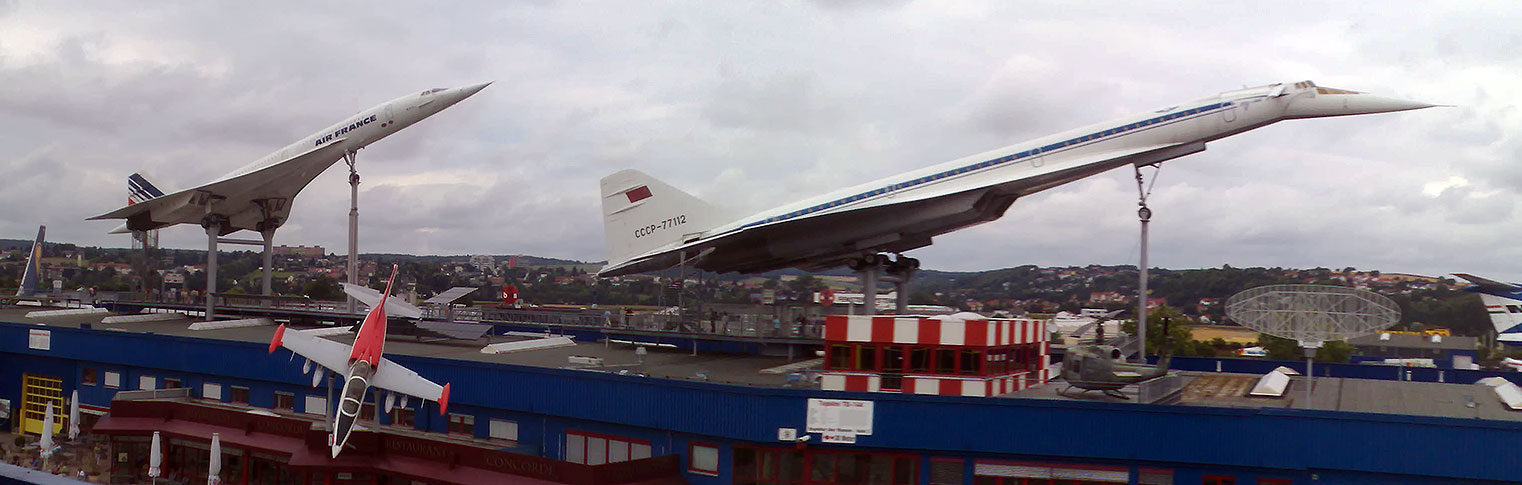
At the technics museum in Sinsheim (Germany) there are a Tupolew Tu-144 and a Concorde on exhibit. Raised steeply into the sky, and you can walk through the aisle up to the cockpit!
Another little-known fact: prior to 2000, the three organizations in the world racking up the highest number of supersonic flight hours each year were, in descending order:
1) British Airways
2) Air France
3) The United States Air Force
Military jets don't go supersonic very often or for very l0ng, and virtually never cruise at Mach 2+. (The striking exception being the SR-71, which -- like Concorde -- is now retired.)
An iconic aircraft. I was lucky enough to see one come into our local airport once, flanked by RAAF Mirage III fighters to mark the rare occasion. Apparently it was on a private charter by a group of extremely wealthy high rollers who were flying around the world visiting various casinos. I cannot imagine a life like that!
They didn't have an APU (weight), so towing to runway would need an external spin up too. It would probably have no air or hydraulics until it got there.
Engines and intakes were designed to be supersonic efficient, which meant they were horribly inefficient at subsonic and taxi speeds. SR71, XB70 and similar big supersonics of that generation had similar, but worse, issues. Being military it didn't matter - they used to just in-air refuel the SR71 right after takeoff!
The SR-71 also had the problem that its fuel tanks wouldn't seal when the plane was cold, since naturally the whole thing was designed for sustained cruises with skin temperatures of hundreds of degrees. As a result, it leaked fuel like crazy before takeoff.
There is https://en.wikipedia.org/wiki/TaxiBot. In 2011 Lufthansa also did some tests with an electric taxi system in the main gear of an A320 but I couldn't find anything more recent on that.
More vehicles on the runway equals more chances for FOD on the runway - which ironically caused the Air France accident and loss of one Concorde and all hands on board.
Interestingly, the opening paragraph of the wikipedia article contradicts this:
> The TaxiBot eliminates the use of airplane engines during taxi-in and until immediately prior to take-off during taxi-out, significantly reducing aircraft fuel usage and the risk of foreign object damage.[1]
This "Taxibot" seems to be designed mostly on the tarmac where engines are idling to keep the APU happy and reach operational temperature, a place where FOD is often caused by humans, not machines - it's not meant for operations to the runway, where engines usually are at full capacity and humans are absent.
Most likely, in this different scenario, there actually is a FOD Advantage.
It needed to be refueled right after takeoff, before it had gone high altitude. In part because it never took off with a full fuel load (to limit strain on the machine and risks in case of takeoff flameout), in part because the fuel lines were literally leaky on the ground (to allow for thermal expansion, and because the fuel was used as coolant and fuel lines ran throughout the machine) and in part because the J58 had been designed specifically for high-speed high-altitude operation, they got more efficient with both speed an altitude as they switched from turbojet to ramjet regime. Sub-sonic SR-71 burned fuel like nobody's business to say nothing of takeoff itself.
> So basically the travellers would cause more pollution in the 10 minutes of taxiing than in maybe 10 hours of driving a car...
That's an exaggeration. 100 passengers, so 20kg/passenger, i.e. about 20l, which is less than 200km worth of fuel. Maybe 2 hours' worth.
And a car has pretty bad fuel consumption going in and out of the driveway too. You want to compare the fuel consumption for the flight as a whole really, since the alternative is presumably driving a transatlantic-equivalent distance.
I'm lucky enough to have flown on the Rocket once. A fun added benefit is that in any typical company I will still (after 13 years) retain the bragging rights for highest altitude (55500 feet / 17 km) and speed (Mach 2 at 1330 mph / 2140 km/h).
Don't forget that Richard Branson offered to keep Concorde flying under the Virgin colors, but this was too much for BA to stomach.
Didn't Sukhoi have a project for a supersonic business jet?
Concorde flew briefly into Miami as well. I don't know how long it took them, but LHR-MIA is something like 10 hours subsonic. They also flew to someplace in the Caribbean regularly.
Used to fly to Barbados from Heathrow, which is why I had my honeymoon there. When we booked it's retirement hadn't been announced if I wasn't already travelling by Concorde I would done the LHR-JFK Concorde with QEII back round trip.
I think flight time was around 4 hours, looking at the other folks arriving in reception hours after us all looking shattered after a 9ish hour flight was a great experience.
Would do it again tomorrow if I could worth every penny.
I lived and worked within ten miles of London Heathrow airport when Concorde was flying; not under the flight path but off to the side. Every time Concorde took off you had to cease conversation until it passed; it was that loud.
I lived under the flight path during my 2nd year engineering exams. I thought about building some noise cancelling headphones but I couldn't work out how to stop my whole skeleton from vibrating.
I subsequently worked with a Concorde when I worked at the Science Museum in London and I must say I fell a bit in love with it. It had a wonderful mix of glamour and geek that completely struck a chord.
I lived for a while right at the end of the Terminal Four runway at Heathrow. You could fairly reach up and touch the departing planes, and obviously cups and cutlery would rattle on the table as they passed overhead.
However, Concorde really wasn't the worst offender. The 747s delivered a noticeably deeper and more earthshaking thunder.
I am aware this is completely anecdotal, and that once supersonic, the Concorde would drown out anything Boeing.
Lived for a few months within yards of the approach for Pease AFB, New Hampshire... KC-130Qs and F-111s. (Yep, that long ago.) The F-111s were cool sounding, almost a metallic screech of those long thin supersonic engines.
The KCs used water-augmentation (I think) on takeoff with a full fuselage of fuel, and honestly sounded like the sky was made of 100 layers of cotton and someone was tearing them apart with their hands. 2 solid minutes of "hey, they're ripping the sky again" and the water would run out and they'd sound like a normal heavily loaded Boeing chassis again.
Likewise. I used to live in Reading, west of Heathrow, and twice a day they'd be this crackling roar and the windows would rattle, unlike anything else that flew; and you'd look up, and there would be that glorious arrowhead silhouette, sliding through the sky.
I don't care if Concorde was uneconomic. Some things you should do just because they're beautiful.
Saw a Vulcan doing aerobatics fairly low over the wee Scottish village where I grew up probably late 70s - an absolutely unforgettable sight and the NOISE - like a thousand tormented demons howling at once.
Not sure if the Vulcan was supposed to deter the Soviets with its nukes or simply scare them to death.
Edit: The Vulcan wasn't just loud in the "strategic bomber" sense of loud - it also sometimes generated a completely unearthly howl that it is famous for. Combine the engine noise and the howl and it really was quite a monster.
I think awareness of the Vulcan's purpose coupled with that howling was the big thing for me when I saw it fly after they restored one. What an incredible machine.
Just a shame it was originally built to kill millions of Russians. I know military investment produces all kinds of awesome technology, but... we could be better than that. And that's something Concorde felt like it represented.
> BA's service had a greater number of passengers who booked a flight and then failed to appear than any other aircraft in their fleet.
All Concorde tickets were first class; first class tickets on flag carriers are fully exchangable without rebooking fees, and the carriers will honour each others tickets -- if you have a first-class ticket on Air France and the flight's cancelled they'll ensure that some other (any other) airline with a free first class seat will carry you instead.
So first-class tickets are popular with people who really need flexibility, and if you were flying JFK-LHR you might as well book a Concorde seat because if you missed the speedbird you could just waltz aboard the next departing 747.
US internal first class is not the same as full-fat intercontinental first class on a flag carrier. (It's barely up to regular business class.)
I do know a guy who was booked JFK-LHR in business class in the 90s and whose flight was overbooked; BA offered free first class upgrades to anyone who was willing to travel on the next departing flight with seats so he volunteered, and was most surprised to get home two hours early!
> It has been suggested that Concorde was not withdrawn for the reasons usually given but that it became apparent during the grounding of Concorde that the airlines could make more profit carrying first class passengers subsonically.
It was withdrawn because USA had no such to this plane and they were pissed, so FAA forbid concorde to fly over their country, and always made clear they would revoke the tolerance for landing near the transatlantic anytime soon.
USA is okay for being the first, but not the other country. They look like France (and UK) of the colonial times.
So fun that a nation became what they fought against.
The Concorde was forbidden to fly overland in the USA because the sonic boom is horrible for the people underneath it. And it's even horribly loud flying subsonic.
We won't get supersonic commercial flight again without going suborbital (which seems likely to happen at some point, just land SpaceShipTwo somewhere else... like Australia), or someone figuring out how to design an airframe which dissipates the boom before it hits the ground.
Oh, and the mirage and rafale find inhabited places everyday to make their sonic bangs, so I am sure it can be done in the USA too and that their military planes are doing so too.
world is constantly changing, it's just us with our super-limited lifespans that see (and want to see) some things as static, stable and given.
empires rise and fall, look where greek, roman or ottoman empire where and where the countries are now. same will happen to US, it lost many ideals of it's founding fathers and losing more every day. I wouldn't stress too much about it, it's natural. all old must die so new, maybe even better can be born
If that was true, they would probably have been grounded far earlier. The aircraft were certainly approaching the end of their design life when service ended, some being almost 30 years old.
Grounding them was also a very good thing from an environmental perspective!
The theory here is that if the airlines hadn't been forced to ground Concorde for a year following the 2000 crash, they never would have realized they could be bilking more money out of people by providing an inferior (conventional) air travel service.
I'm sure the airlines were well aware that conventional first-class tickets were more profitable. Both British Airways and Air France made plenty of money selling those at the time, and they still do.
But Concorde was a differentiated product that other airlines couldn't compete with. Despite it's high operating costs, it was profitable (at least for BA) and it also acted as a "halo" product that boosted to the image/prestige of the entire airline.
In the case of BA, they were also given the aircraft (and spare parts) by the government at far below market value. There may have been some kind of unwritten agreement that they would keep operating them for as long as reasonably possible, basically as a matter of national pride.
Dad got to fly it once. He had tickets on another Air France flight but because of a strike (it is France) it was cancelled. A German coworker started yelling at the ticket agent, who after a few minutes of this abuse, shrugged and upgraded dad, then walked off.
One of the regular charters in the 1970s / 80s was by the Royal Air Force, hiring Concorde to perform supersonic runs off the east coast of Britain for radar calibration and interception trials.
My uncle was involved from the radar side and recounts how amusing it was to watch the Lightning fighters try to scramble to perform a mock interception; they could peak at Mach > 2.2 but that wasn't anywhere near sufficient. They could only manage it if held airborne with a tanker ahead of the flight path and given lots of warning.
Later the Lightnings were 'replaced' by the Tornado F3, which was so anemic in performance that they didn't even try for a firing solution. They used to have to engage partial reheat to keep-up with the turboprop Soviet 'Bears'!
They ran them from Bournemouth Airport where I live, and they were always popular. I went down to watch it take off once, and the noise and jet blast was incredible - MUCH more than any other plane I've seen take off from there, like being blown by a hairdryer all over.
My most lasting memory of it, though was the pollution - the air was brown behind it when it initially thrusted up, and the smell was really intense. A great machine, but not a friend of the environment, sadly!
They struggled to get them in and out of regional airports.
Can't remember runway minima etc, but I remember watching one leave Leeds-Bradford that also ran some charters near end of life.
Right to the end of the runway, then full short takeoff tactics. Spin up engines and fire reheat on the brakes, then release. Noise and smoke as you'd expect - engines were in the power and on reheat before it even moves. One thing afterburners can never be is environmental.
Still managed to look like it used most of the runway before unsticking!
Bournemouth has a long runway, legacy of its WWII roots. It was chartered for £60,000 for some 20-minute subsonic flights. There were also some day trips to Cairo from Bournemouth.
The noise on takeoff was insane. In another aircraft on the taxiway (sadly the closest I every got) at Heathrow you could barely hear your own engines, or even those of nearby 747s taking off, but when Concorde fired up the reheat and went down the runway, you knew all about it! Lovely to watch, and hear. I also regret not getting a flight on it, the cheapest ex-Paris tickets were actually closer to business class prices than first, so it wasn't as expensive people believe at all.
> The fastest transatlantic airliner flight was from New York JFK to London Heathrow on 7 February 1996 by British Airways' G-BOAD in 2 hours, 52 minutes, 59 seconds from takeoff to touchdown. It was aided by a 175 mph tailwind.
0_O - I think they invented the first commercial, non-viable time-travel.
> To prevent excessive exposure, the flight deck comprised of a radiometer; if the radiation level became too high, pilots would descend below 45,000 feet.
I don't think that's the proper wording; I'm pretty sure there were other things on the flight deck besides a radiometer.
2 tons of fuel cost around $2000 (obviously this would vary, but that's the sense of it), a single seat on the Concorde cost $6000+ one-way towards the end of its service. Apparently the economics of a) retrofitting an auxiliary power unit to the Concorde so that it could be towed with engines off and b) adding personnel to the ground crew for towing the airplane did not make sense. And even if the airline cared greatly about the environmental impact, 2 tons for a few Concorde flights is a tiny fraction of even a single airline's fuel usage.
The concord didn't have an auxiliary power unit to provide energy with the engine off. So it needs to rely on energy from the gate or a special external unit. This unit was also necessary to provide the energy to start the engine.
Obviously, it could start the engine but don't use them for taxiing, except that the 4 engines were so powerful that at idle produced enough thrust to move the plane (and they were burning a lot of gas). So better to taxi on it's on power than been towed.
P.s: the 2 tons figure was the higher estimation, not the regular consumption...
Nowadays we're on the edge to re-using rocket launcher and still not rethinking about how this Concorde could be improved and re-made viable... Too bad...
If you go look on your nearest bay of pirates you can find a 3 hour video covering an entire flight of Concorde from the cockpit. Details preflight, taxi takeoff, fuel management, flight stages and everything.
Sadly not. 8 hours going west, 6 hours going east. An ideal flight is about 12 hours, giving uninterrupted 8 hours of sleep as well as time for a movie, dinner and breakfast. Even better if there's no jetlag. London to Joburg for example.
> An ideal flight is about 12 hours, giving uninterrupted 8 hours of sleep as well as time for a movie, dinner and breakfast. Even better if there's no jetlag.
Well... after having done Paris/Réunion a couple of times, a 12-hour flight with little jetlag, I must say this was a pretty terrible experience. The problem with sleeping for me isn't the length of the flight, it's the general noisy environment and uncomfortable seats with little room for legs (even if I'm not that tall), the upright posture, etc. Also, you don't get time for a movie but for three or four of them.
I've always liked the Paris/Montreal flights much better simply because they're short enough that you don't get bored as much.
Couldn't agree more to the "uncomfortable seats with little room for legs" part. I always envy people who aren't as tall as me and seem to be able to actually get some sleep in.
That said, after having done Europe<->Australia and North America<->Australia a couple of times, the prospect of a 12 hour flight doesn't really sound that bad any more ("Only 12 hours? Sweet!").
I've come to realize that to cope best with a long flight like that, you have to be well rested and have had enough food and so on. You tolerate stress much better if you are well prepared.
Joburg-New York, on the other hand is a real killer at 16+ hours with a stop for crew change in the Canaries. I've been on that flight several times when they run out of drinking water, toilets overflow,... it's horrible. Once flew it with a colleague who was a cigarette smoker - he suffered terribly!


CAUTION: huge timesink hazard.
http://www.pprune.org/tech-log/423988-concorde-question.html